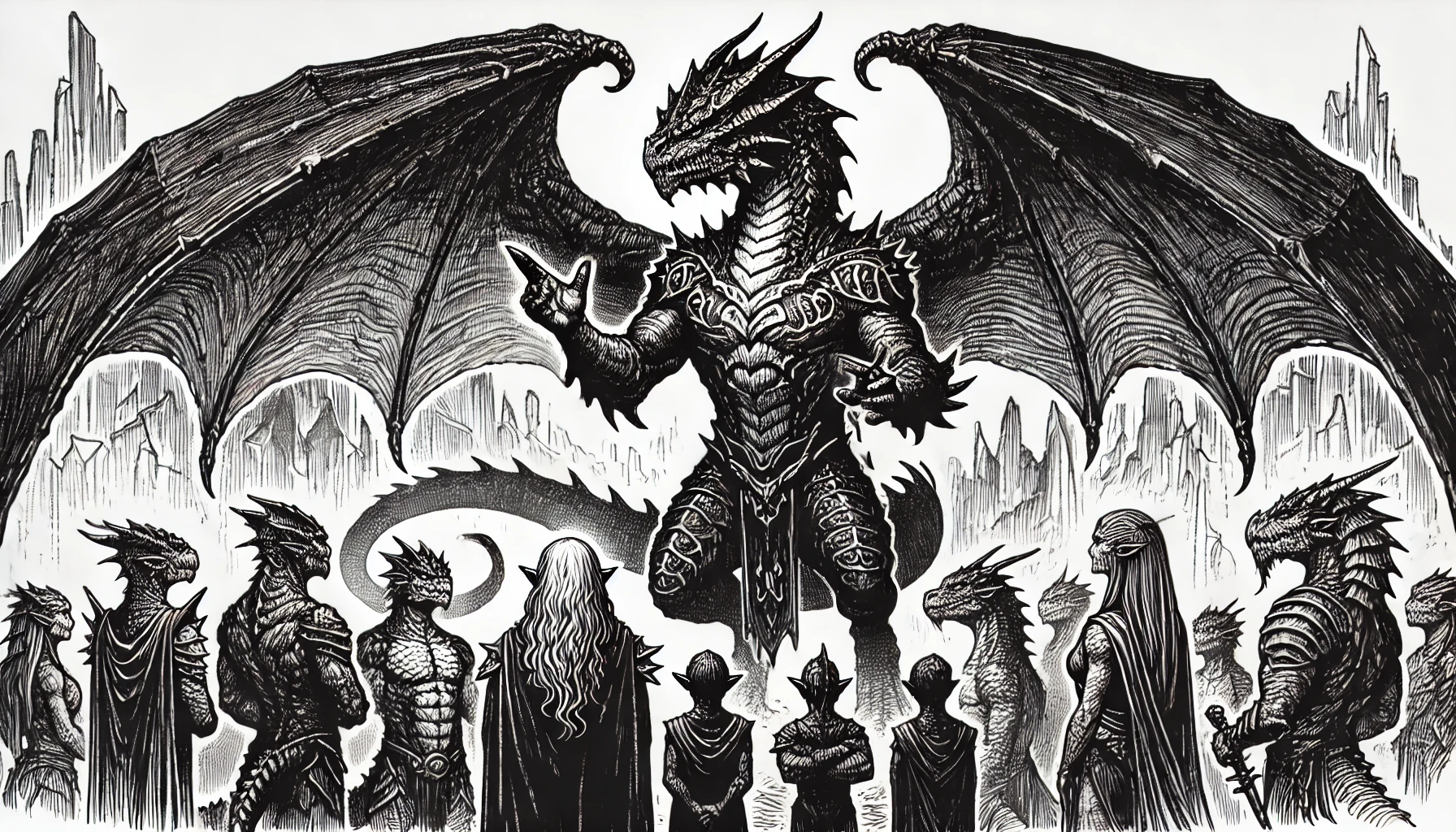
 A dragon addressing its dragonblooded kin.
Dragons
Overview
Throughout recorded history, dragons have occupied a singular position among the great powers of the cosmos. Chroniclers, arcanists, and theologians alike have struggled to categorize them, for they are neither wholly divine nor merely mortal. Wherever dragons are found, they are accompanied by traces of earlier ages—ruined citadels, warped landscapes, and traditions that predate the peoples who now dwell among them.
It is the prevailing view among modern scholars that dragons did not originate upon any single world. Rather, they are believed to have emerged from a distant and as-yet unidentified crystal sphere, crossing the Phlogiston during a formative epoch when the boundaries between spheres were less rigid. This migration marks the first recorded expansion of dragonkind into the Known Spheres and serves as the foundation for nearly all subsequent draconic history.
Many preserved accounts attribute this vast movement to the influence of a powerful draconic pantheon, whose actions appear to have drawn great numbers of dragons outward from their place of origin during the First Era. Following this exodus, dragons dispersed across multiple worlds, establishing realms that at times encompassed entire continents or planets. These early draconic dominions functioned as centers of magical development, accumulated knowledge, and immense material wealth. Though their structures have largely fallen to ruin, their influence endures in lingering enchantments, altered ecosystems, and the mythic record of younger civilizations.
With the passing of ages and the transition into the Second Era, the supremacy of dragons gradually waned. This decline was not the result of extinction or sudden catastrophe, but of shifting cosmic and political realities. As younger races expanded and new powers emerged, dragonkind adapted to a diminished, though still formidable, role. Dragons remained active participants in the affairs of the spheres, serving as territorial powers, custodians of ancient sites, and living repositories of lore otherwise lost to time.
In the present age, dragons are no longer recorded as uncontested sovereigns of the Known Spheres. Surviving accounts instead describe them as enduring but situational powers, their influence varying greatly by region, flight, and circumstance. Draconic activity continues to be documented in matters of territorial control, ancient sites, arcane phenomena, and long-standing rivalries, suggesting that while their role has changed, dragons remain an active and consequential presence within the broader cosmic order.
The Progenitors
Within each recorded flight, sources consistently describe a single dragon occupying a position of primacy. This individual, commonly referred to as the progenitor, is identified as the eldest surviving member of the flight and is generally regarded as its most powerful exemplar. Other dragons of the same flight are understood to descend from this figure through direct or extended lineage, and they typically acknowledge the progenitor as the central authority of their kind.
Sustained veneration of these progenitors over long periods has led to their recognition as divine patrons within draconic tradition. This elevation is not attributed to a singular transformative event, but rather to the gradual accumulation of worship, ritual observance, and symbolic authority. Progenitors are therefore understood to hold religious significance alongside their ancestral and political roles, with each aspect contributing to their continued prominence within their flights.
Progenitor dragons are collectively identified as the Divine Flight, a draconic pantheon whose internal distinctions are commonly interpreted through comparison with non-draconic divine hierarchies. Progenitors of the Greater Flights are frequently described in terms equivalent to Greater Deities, reflecting the breadth of their worship, the scale of their influence, and the stability of their cults. Progenitors of the Gem Flights are more often likened to Intermediate Deities, possessing well-defined but narrower spheres of reverence and authority. Those associated with the Ferrous Flights are typically compared to Lesser Deities, with influence that is localized, situational, or closely bound to specific traditions or regions.
Accounts further note the absence of progenitors once associated with the Lesser Flights. Surviving records describe a prolonged and destructive conflict confined to those lineages, resulting in the loss of their progenitors and the subsequent fragmentation or dissolution of their flights. While the details of this period remain incomplete and often contradictory, its outcome is consistently cited as a factor shaping the present composition and balance of the Divine Flight.
True Dragons
Among those who study dragonkind, the term true dragon is used to describe dragons that display the full and undiminished nature of their kind. In most treatises, they serve as the standard by which all other draconic beings are measured.
What most clearly distinguishes a true dragon is the way its power deepens with age. This growth is not limited to size or physical strength, but extends to magical ability, endurance, and awareness. Accounts repeatedly note that an elder dragon is not merely a larger version of its younger self, but a fundamentally more dangerous and capable being. For this reason, age is commonly treated as the clearest indicator of a true dragon’s standing among its kind.
True dragons are commonly described as an immortal race, a characterization that arises from their extraordinary longevity rather than any belief that they cannot be slain. Records describe dragons whose lives span eras, with age marking continued growth rather than decline. Despite this, numerous historical accounts attest to the deaths of true dragons through warfare, rivalry, or exceptional circumstance, making clear that their so-called immortality reflects endurance, not immunity.
The Dragonblooded
The term Dragonblooded refers to peoples and creatures believed to descend, in whole or in part, from true dragons. These lineages exhibit varying degrees of draconic traits, expressed through physical features, cultural practices, or innate magic. Though they do not share the longevity or age-driven growth of true dragons, they are widely recognized as retaining a meaningful connection to draconic heritage.
Dragonblooded societies place strong emphasis on lineage and flight affiliation, with identity commonly tied to a progenitor dragon regarded as both ancestral source and guiding authority. Social structure is typically maintained through elders, councils, or hereditary leaders who claim continuity with established bloodlines. Religious practice centers on veneration of the progenitor through rites, offerings, and communal observance, reinforcing cohesion and shared identity.
Dragonborn occupy a distinct position within this broader category. Rather than arising solely through inheritance, they are understood to result from formal pacts with powerful dragons, enacted through the Rite of Rebirth. Despite this direct bond, dragonborn do not hold positions of governance among dragonblooded societies and are instead regarded as champions, agents, or independent warriors. As a result, they are more often encountered as solitary figures or itinerant adventurers than as members of settled leadership.
A Note On Dragonblooded Creatures:
Due to the nature of the setting, any creature that is draconic in origin (or is related to dragons in any way), and does not have the Dragon type gains the Dragonblood subtype. The list of races this applies to will increase over time, but for now treat all races that follow the aformentioned rule as included. The list of some examples are as follows:
- Kobold
- Spellscale
- Draconic Template
Chromatic Dragon Flights
Chromatic dragons are among the oldest known powers in existence, their origins predating mortal history and most recorded cosmologies. Draconic scholars broadly agree that the progenitors of both the chromatic and metallic flights did not originate within the Known Spheres. Instead, they arrived from distant and uncharted crystal spheres following a prolonged and devastating war between the two factions. The precise location where the chromatic progenitors first settled after this conflict is unknown; no surviving accounts identify a singular point of arrival. What is documented is that, during the First Era, these progenitors spread across multiple Known Spheres, establishing territories aligned with their elemental nature and inherent temperament.
From this expansion emerged the Greater Chromatic Dragon Flights, each aligned with one of the five principal chromatic lineages: Black, Blue, Green, Red, and White. These flights functioned as extensive networks of power, each led by a single Greater Chromatic Dragon who ruled as both sovereign and divine patron. Through lineage and sustained worship, these progenitors attained godhood within the Divine Flight, becoming central figures in the spiritual, cultural, and political identity of their followers. The influence of the greater flights extended across vast regions, shaping early history through conquest, manipulation, intimidation, and long-term dominion. Their rule left lasting marks on political structures, ecological balances, and the development of early mortal civilizations.
The Greater Chromatic Flights were not unified among themselves. Rivalries over territory, resources, and influence frequently escalated into wars between flights, resulting in the devastation or destabilization of entire regions. Though their methods varied—from overt military domination to subtle indirect control—all chromatic flights demonstrated a consistent emphasis on the accumulation of power, wealth, and authority as measures of supremacy.
Alongside the greater flights arose several Lesser Chromatic Dragon Flights, including the Brown, Deep (Purple), Fang (Gray), Yellow, and Orange dragons. Smaller in number and narrower in reach, these flights established themselves in environments poorly suited to large-scale draconic empires, such as deep deserts, subterranean expanses, mineral wastelands, and other hostile or unstable regions. Within their territories, however, lesser chromatic flights exercised authority with an intensity comparable to their greater counterparts, enforcing dominance through survival pressure, environmental control, and localized terror.
During the Second Era, the progenitors of the Lesser Chromatic Flights were destroyed in a conflict with the progenitors of the Lesser Metallic Dragons, permanently severing both the lesser chromatic and lesser metallic flights from their original divine patrons. In retaliation, the Greater Chromatic progenitors annihilated the progenitors of the Lesser Metallic Flights. Though both the lesser chromatic and lesser metallic flights persist into the present age, they now exist without divine rulers. Deprived of centralized authority, these flights have become fragmented across the Known Spheres, maintaining continuity only at the brood level, with no enduring hierarchy beyond individual lineage and inherited tradition.
Greater Flights
Black Dragons (Skull Dragons)
Black dragons are the most cruel-tempered of the chromatic flights, infamous for their malice, patience, and territorial aggression. They are slender and wiry compared to other chromatics, distinguished by forward-curving horns, a prominent neck frill, and glossy black scales that provide effective camouflage in swamp and jungle environments. Their presence is often marked by the stench of stagnant water and decay. Black dragons are solitary by nature and rarely form lasting alliances, preferring to rule through fear and isolation. They favor ambush over direct confrontation, striking from water, darkness, or dense foliage, and wield a stream of corrosive acid as their breath weapon. Their lairs are typically submerged or partially flooded caverns hidden within marshlands, often with multiple concealed entrances. Hoards are accumulated both for wealth and as a display to attract mates, and reproduction is competitive, with females selecting partners based on hoard size. Black dragons rely on concealment rather than protection to safeguard their eggs and will always prioritize their own survival, though they are relentless in vengeance if wronged.
Blue Dragons (Storm Dragons)
Blue dragons are orderly and calculating chromatic dragons, noted for their structured hierarchies and disciplined territorial control. They are physically distinguished by a single massive horn projecting from the forehead, large frilled ears, a short, broad neck, and a thick, flattened tail. Their presence is often accompanied by the scent of dry sand or crackling electricity. Blue dragons inhabit deserts and arid wastelands, where they construct extensive underground lairs accessible through burrowing. Adept diggers, they frequently lie buried just beneath the sand, ambushing prey with sudden bursts of lightning that erupt from the ground. Their breath manifests as a focused line of lightning or a powerful electrical discharge. Unlike most chromatic dragons, blue dragons are attentive and protective parents, rarely leaving their eggs unattended. Their societies emphasize rank, loyalty, and long-term planning, and blue dragons regularly patrol their territories from the air, using the open landscape to detect intrusions far in advance.
Green Dragons (Forest Dragons)
Green dragons are manipulative, secretive, and highly intelligent chromatic dragons that dominate forests, jungles, and wooded borderlands. They are immediately recognizable by the long crest that runs from the nose along the length of the body, flexible scales that grant exceptional mobility, and long forked tongues. Their bodies are compact, with elongated necks and tails suited for navigating dense vegetation, and their scales provide natural camouflage amid foliage. Green dragons delight in intrigue, espionage, and corruption, preferring to rule indirectly through manipulation, enslavement, and psychological domination. They stalk prey and rivals for extended periods, gathering information before striking, and often leave survivors to spread fear and rumor. Their breath is a cone of poisonous gas, which can be expelled even underwater, and their lairs are complex underground warrens hidden behind waterfalls, cliffs, or magically cultivated thickets. Green dragons prize hoards of art, carved wood, rare plants, and gems, but value sentient servants above all else. Unusual among chromatics, they form strong parental bonds and are known to fiercely defend their brood, even at the cost of their own lives.
Red Dragons (Fire Dragons)
Red dragons are the largest and most feared of the chromatic flights, defined by arrogance, appetite, and a relentless drive to possess. Their hides range from glossy scarlet in youth to deep crimson in age, with darker, scorched-looking membranes and frills; ancient reds may have eyes that seem like molten embers. Their wings are immense—built for dominance rather than subtlety—and their very presence carries the stink of smoke, sulfur, and hot stone. Red dragons lair in warm mountains, high peaks, badlands, and volcanoes, preferring deep caverns near geothermal heat and a high perch from which they can survey what they consider “their” world. Their breath is a devastating cone of fire, and they are at their most comfortable amid heat, ash, and open flame. Solitary and intensely territorial, red dragons treat other beings as resources—food, tools, or tribute—and their moods can shift into explosive rage at the smallest insult or theft. Their hoards are vast and obsessively cataloged, favoring durable wealth that survives heat: coin, metalwork, stone treasures, and fiery-hued gems, with trophies taken from rivals displayed as proof of superiority. Reds often use minions and fear to keep their lairs maintained and their tributes flowing, and they have a habit of letting survivors escape simply to spread the story of their power.
White Dragons (Ice Dragons)
White dragons are the smallest and most feral of the greater chromatics—less clever than their kin, but still deadly, relentless, and hard to dislodge once settled. Their hides range from white to gray and ice-blue, blending seamlessly into snowfields and glaciers. They have short necks, streamlined heads with high cranial crests, and a spined dewlap beneath the chin; their scent is crisp and chemical, like winter air and frost. Built for the arctic, whites have widely spaced toes with barbed claws for gripping ice and thin eyelids that guard against snowblind glare. They prefer simple, direct violence—strike first, kill, then eat—and their strongest memory is reserved for grudges. A white dragon will pursue a perceived offense for years with single-minded vengeance, often without considering consequences. Their breath is a cone of killing cold, and they are immune to it from birth; many also command winds and freezing fogs that turn the terrain treacherous. White dragons lair in ice caves and frozen mountains, sometimes carving their own dens by freezing packed snow into solid ice. They are capable swimmers and enthusiastic hunters of cold-water prey, even great aquatic beasts, and they often cache kills by burying them in snow or ice to “keep” for later. Their hoards favor glittering things that resemble ice—diamonds, pale gems, polished silver or reflective treasures—and they are more scavengers and collectors than schemers. Whites are not social; mating is brief, and the young are typically left to survive with little guidance. Their territories are harsh, their habits blunt, and their patience long—especially when revenge is involved.
Lesser Flights
Brown Dragons (Desert Dragons)
Brown dragons are wingless chromatic dragons of deep deserts and arid badlands, defined by leathery sand-colored scales, massive jaws, and unmatched burrowing ability that allows them to move beneath dunes with lethal speed. Ferocious yet intelligent, they view most creatures as prey and favor ambush, erupting from the sand to unleash a line of corrosive acid while relying on vibration-sense and darkvision to prevent escape. Immune to acid, desert heat, and even airless conditions, they lair in vast chambers far below the surface and subsist on meat and minerals alike. Older browns command wind and sand to raise localized storms or conceal themselves, and the eldest wield powers capable of disintegrating matter. With their progenitor gone, the Brown Flight survives as a loose lineage of solitary rulers, each dragon claiming and defending its own territory through hard-earned knowledge of the desert and its dangers.
Purple Dragons (Energy Dragons)
Purple dragons are large, lean chromatic dragons of plains, prairies, and low scrublands, marked by deep violet scales that darken toward black with age, pale horns, and serrated claws and teeth. Arrogant, calculating, and overtly cruel, they delight in fear and devastation and actively seek out powerful foes—dragon and mortal alike—to demonstrate their superiority. Primarily nocturnal hunters, they strike from the night sky or amid storms, wielding a breath of volatile magical force that can erupt as searing energy, blinding flashes, or focused blades used in close combat. They lair in deep caverns beneath open terrain, favoring darkness where their blinding attacks are most effective, and will burn or carve through stone when natural passages fail them. With no progenitor to bind them, purple dragons act as self-made warlords, carving petty realms, breaking rivals, and imposing rule through conquest, intimidation, and calculated displays of overwhelming force.
Yellow Dragons (Salt Dragons)
Yellow dragons are solitary, secretive chromatic dragons of hot deserts, salt flats, and saline marshlands, marked by dusty yellow-gray scales that never reflect light and remain small even as the dragon grows to immense size. Cruel, selfish, and orderly, they rule through deprivation rather than overt domination, shaping their territories to deny water, shelter, and relief. Their breath weapon is a cone of razor-sharp sodium chloride crystals that scour flesh, choke lungs, and blind victims, with repeated exposure capable of causing lasting blindness; underwater, it manifests as a dense cloud of super-saline water with similar effects. Fresh water can wash the salt away, but most magic cannot. Immune to heat, fire, and poison, yellow dragons favor traps, ambush, and magic tied to silence, wind, and water control, often collapsing sand pits or isolating prey before closing in. They lair alone in scorching wastes, hunt anything from herd animals to isolated settlements, and preserve excess kills through salting. With no progenitor to impose unity, the Yellow Flight is defined by isolation and habit, each dragon maintaining control by turning its environment into a slow, grinding weapon against all who trespass.
Orange Dragons (Sodium Dragons)
Orange dragons are rare chromatic dragons most often found in tropical swamps, rivers, and lakes, their brilliant orange scales sometimes mottled with red or yellow as they age. Highly intelligent and violently impulsive, they are equally dangerous on land and in water, favoring humid environments where the devastation they cause is easier to contain. Their breath weapon is a stream of liquid sodium mixed with oily saliva that ignites explosively on contact with air and detonates violently if doused with water, allowing them to annihilate prey, camps, or vessels in a single strike. Resistant to magical fire and poisons and immune to natural flame, orange dragons rely on ambush but are just as likely to attack boldly, often igniting waterways beside their targets. They lair near rivers and swamps, hunt fish, rainforest beasts, and intelligent prey alike, and sometimes tolerate subordinate servants in exchange for loyalty and information. With no progenitor to anchor their flight, orange dragons remain rare, volatile powers—feared less for dominion than for the sudden, catastrophic destruction they bring to any territory they choose to haunt.
Gray Dragons (Fang Dragons)
Fang dragons are brutal, hunt-driven chromatic dragons of mountains, badlands, and open barrens, their mottled gray-brown scales studded with bony plates, spurs, and detachable spikes that turn their bodies into weapons. Poor flyers but lethal in close combat, they favor aerial pursuit followed by savage physical attacks, using claws, tails, wings, and an oversized, fang-filled maw to overwhelm prey; their bite is especially feared for its life-draining effect. Cruel, volatile, and easily provoked, fang dragons delight in stalking intelligent prey and often turn negotiations into deadly games of pursuit, valuing the hunt more than the kill itself. Their breath weapon—an adhesive, caustic acid granted through later divine alteration—ensnares and slowly dissolves victims, reinforcing their preference for prolonged, terror-filled engagements. Fang dragons lair in rocky highlands and seal their dens when ranging far afield, returning only to feast or deposit trophies taken from past hunts. With their progenitor gone, the Gray Flight is shaped by instinct rather than structure, its dragons roaming widely as apex predators, bound less by lineage than by a shared obsession with the chase.
Metallic Dragon Flights
Metallic dragons are counted among the oldest enduring powers of draconic history, their emergence closely intertwined with that of the chromatic flights. Draconic scholars broadly agree that neither faction originated within the Known Spheres. Instead, the progenitors of both metallic and chromatic dragons arrived from distant and uncharted crystal spheres in the aftermath of a prolonged inter-sphere war. The location of the metallic progenitors’ first settlement following this conflict is unrecorded, and no surviving tradition preserves a singular point of arrival. During the First Era, however, these progenitors dispersed widely, establishing domains shaped by their elemental affinities, philosophical outlooks, and long-term designs.
From this dispersal arose the Greater Metallic Dragon Flights, each aligned with one of the five principal metallic lineages: Brass, Bronze, Copper, Gold, and Silver. Each flight formed a durable network centered upon a single progenitor who ruled as both sovereign and divine exemplar. Through continuity of bloodline, codified ritual practice, and sustained devotion, these progenitors ascended within the Divine Flight, shaping the moral frameworks, cultural norms, and behavioral traditions of their descendants.
Unlike the chromatic flights, metallic dragons rarely pursued dominance through conquest alone. Their influence instead manifested through stewardship, arbitration, selective intervention, and long-term guidance. By shaping alliances, opposing threats judged existential in scale, and preserving knowledge deemed essential to continuity, the metallic flights exerted a subtle but profound influence on political development, cultural stability, and inter-spherical balance across multiple eras.
Historical records also attest to the existence of several Lesser Metallic Dragon Flights during the early Second Era. These flights were fewer in number and narrower in scope, often bound to specialized environments or tightly defined philosophies. Their progenitors were destroyed during the Second Era conflicts with the Lesser Chromatic Flights, and in the reprisals that followed, the Greater Chromatic progenitors annihilated the remaining lesser metallic patrons. As a result, no unified lesser metallic flights persist into the present age; those lineages that survive do so without divine rulers, existing as isolated broods or solitary actors shaped by inherited temperament rather than hierarchy.
Greater Flights
Brass Dragons
Brass dragons settled primarily in arid and semi-arid regions across the Known Spheres, favoring deserts, badlands, and sun-scorched plateaus where travel routes naturally converge. Lean of build and long-limbed, with polished brass scales that reflect heat and glare, they are built for endurance rather than brute force. Among the metallic flights, brass dragons are the most openly social, driven by curiosity, discourse, and the exchange of stories and knowledge. They favor prolonged engagement over swift judgment and seek nonlethal resolution whenever possible, though they are capable defenders of their domains. Their lairs are often expansive cavern networks near oases or trade paths, designed as places of gathering rather than fortification. Brass hoards emphasize records, maps, stories, and relics tied to notable events, alongside conventional wealth. Dragonblooded of the Brass Flight commonly serve as intermediaries, historians, diplomats, and lorekeepers.
Bronze Dragons
Bronze dragons established territories along coastlines, archipelagos, and major waterways where trade, exploration, and conflict intersect. Powerfully built and heavily scaled, with crested heads and hides that darken toward greened bronze with age, they are the most overtly martial of the metallic flights. Bronze dragons place great emphasis on justice, vigilance, and preparedness, and they are more willing than other metallics to intervene directly in warfare. Their lairs are typically sea cliffs, fortified coastal caverns, or submerged chambers that allow rapid response by land, sea, or air. Bronze hoards favor weapons, banners, naval relics, and trophies taken from defeated threats, valued as records of service rather than conquest. Dragonblooded of this flight often take roles as soldiers, commanders, wardens, or guardians.
Copper Dragons
Copper dragons typically claimed rugged hills, rocky uplands, and broken mountain terrain where agility and clever terrain use offer advantage over raw power. Smaller and more agile than many metallics, they are marked by expressive features and polished copper scales that dull and verdigris with age. Copper dragons value adaptability, humor, and intellect, preferring indirect solutions such as misdirection, riddles, and negotiated challenges. Even conflict is often treated as a test of wit rather than strength. Their lairs are complex tunnel systems filled with false paths, traps, and vantage points rather than heavy fortifications. Copper hoards emphasize clever craftsmanship, mechanisms, and curiosities with layered histories. Dragonblooded of the Copper Flight tend to prize ingenuity, independence, and personal freedom.
Gold Dragons
Gold dragons established wide-ranging territories rather than tightly bounded domains, acting as long-term overseers instead of regional rulers. Physically imposing and unmistakably regal, with radiant gold scales and immense wings, they embody authority tempered by restraint. The Gold Flight emphasizes balance, judgment, and careful intervention, viewing history as a continuum measured in centuries rather than moments. Gold dragons act rarely but decisively, and their interventions often reshape events across generations. Their lairs are ancient and enduring sites—mountain sanctuaries, hidden plateaus, or sanctified ruins—chosen for permanence over visibility. Gold hoards favor artifacts of lasting significance: ancient magic, compacts, relics of fallen empires, and preserved records. Dragonblooded tied to this flight commonly serve as arbiters, spiritual leaders, judges, and custodians of tradition.
Silver Dragons
Silver dragons settled near emerging mortal populations, often in mountainous regions overlooking developing settlements and trade routes. Graceful and sleek, with bright silver scales and expressive bearing, they are among the most openly benevolent of the metallic flights. Silver dragons prioritize protection, coexistence, and moral guidance, frequently living among other species—sometimes for decades—in altered form. Their lairs are discreet and defensible, positioned close enough to allow swift intervention while remaining hidden from casual discovery. Silver hoards emphasize gifts, symbols of alliance, and treasures tied to shared history rather than raw wealth. Dragonblooded of the Silver Flight often take roles as diplomats, advisors, protectors, and mediators within non-draconic societies.
Lesser Flights
Mercury Dragons
Mercury dragons are slender and serpentine, with sleek bodies, whip-like tails, and smooth silver-white scales that grow increasingly reflective with age. Agile and fast in flight, they favor speed and maneuverability over brute strength. Their personalities are highly changeable, driven by curiosity and a constant need for new experiences. Mercury dragons frequently shapechange into humanoid forms to explore unfamiliar lives, though their behavior is often eccentric. They avoid routine, even in diet, becoming lethargic when deprived of variety. Their hoards are scattered assortments of coins, jewelry, and curiosities from many lands and eras, valued more for novelty than cohesion. In combat, they are unpredictable, relying on hit-and-run tactics, blinding lines of burning, poisonous light, and superior mobility rather than sustained confrontation. Without a progenitor, mercury dragons exist as independent broods across the spheres, sharing temperament but lacking a unified doctrine.
Electrum Dragons
Electrum dragons are rare metallic dragons with refined features and distinctive deep green eyes. They favor remote, elevated regions far from civilization, often lairing on high mountaintops where they can observe the world for long periods in solitude. Calm and philosophically inclined, electrum dragons enjoy debate, negotiation, and the exchange of ideas, and they are generally welcoming to visitors who approach peacefully. Their hoards reflect an appreciation for beauty rather than wealth, consisting primarily of finely crafted objects—statues, tapestries, musical instruments, gems, and jewelry—while coinage is usually sparse. Though non-aggressive by nature, electrum dragons are capable combatants when threatened, relying on composed awareness and a breath of weakening, disorienting gas to undermine opponents. Skilled spellcasters from birth, they devote much of their time to magical study and experimentation. With the loss of their progenitor, electrum dragons persist as isolated broods or solitary individuals, united by temperament rather than hierarchy.
Steel Dragons (Grayhawk Dragons)
Steel dragons are rarely encountered in their true form, preferring to live disguised among humanoid societies, particularly in large cities. In dragon form, they are feline and graceful, with burnished steel scales, silk-like wing membranes, shield-patterned chest scales, and expressive faces framed by hair-like spines. In humanoid guise, they conceal their nature carefully, though a subtle steel-gray trait—hair, eyes, or markings—always remains. Steel dragons are curious, witty, and sociable, drawn to art, culture, history, and politics. Neutral in outlook, they seek to experience the breadth of mortal existence and often alternate between lives as heroes, patrons, or quiet manipulators. They oppose rigid authority and tend to undermine tyranny from within established systems. Their hoards favor property, businesses, works of art, books, antiquities, magical writings, and trusted associates rather than coin alone. As omnivores requiring a dragon’s appetite, they periodically vanish to hunt wild game. Steel dragons are solitary by nature, though cordial with others of their kind, and maintain long chains of assumed identities over their lifetimes, preserving past experiences through ritualized memory vaulting. Without a progenitor, steel dragons exist as independent observers and participants in mortal history, each following their own long, carefully curated path. The only known dragon species that has admitted to its origins, having originally come from a distant crystal sphere known as Grayspace on a planet named Oerth.
Orium Dragons (Orichalcum Dragons)
Orium dragons are lithe yet powerful dragons with feline features, long prehensile tails, and crimson-red metallic scales that they keep meticulously groomed, sometimes inlaid with jade designs. They favor jungles, river deltas, and sheltered valleys rich in ancient ruins, which they regard as their most prized possessions. An orium dragon’s lair is not merely a dwelling but a restored monument to a long-dead civilization, rebuilt to evoke past grandeur rather than historical accuracy. Taciturn and deliberate, orium dragons initially question intruders to determine whether they are thieves, future servants, or food. They value ancient knowledge above all else, seeing the restoration and study of ruins as homage to ancestral dragons who once served or ruled empires. Their hoards consist primarily of antiquities—old coins, archaic jewelry, relics, and ancient magic—supplemented by writings and reconstructed architecture. Orium dragons rely on coerced or loyal servants to provide food and labor, offering protection in return. Since the loss of their progenitor, orium dragons persist as isolated rulers of their own ruins, bound by inherited reverence for the past rather than any shared hierarchy.
Gemstone Dragon Flights
Of all known lineages of true dragons, the gem dragons are the least understood—not because they lack power, but because they keep themselves apart from the wider world. They are plainly draconic in form, with wings, claws, and strength to rival any of their kind, though they are often smaller and slower than chromatic or metallic dragons. This has led more than one reckless observer to underestimate them. Such errors are rarely survived, for gem dragons possess keen minds, deep magical talent, and a natural command of psionics unmatched among dragonkind. Most scholars agree that they share the same ancient origin as other true dragons, having crossed into the Known Spheres from a distant crystal sphere in the earliest ages. Unlike other flights, however, they never founded empires or lasting realms. Where they passed, they left no cities—only scattered lairs, strange crystal formations, and lingering impressions upon the land and mind alike.
Gem dragons are sometimes mistaken at a distance for dragons of similar color, but the illusion quickly fails up close. In clear light, their faceted scales glitter and refract in ways no other dragon’s hide can manage. Their lairs are most often found at Manifest Zones tied to the Inner Planes, places where planar influence seeps steadily into the world. These locations are chosen with care, each suited to the nature of the flight that dwells there, and over time the surrounding land bends subtly to that influence. Gem dragons are broadly neutral in outlook and strongly solitary by habit, especially as they age. When more than one is encountered together, it is usually a mated pair with their young; cooperation beyond this is rare and undertaken only when circumstances leave little choice.
In manner and conduct, gem dragons prefer subtlety over command. They are fond of riddles, careful speech, and persuasion, and they rely on psionics as readily as tooth or claw. This same restraint governs how they treat their domains, for a gem dragon’s lair is the Manifest Zone itself, not a structure raised upon it. Likewise, their hoards are not stockpiles of coin or relics, but the planar crystals that grow within the zone. These crystals are gathered, arranged, and guarded as both treasure and responsibility. Scholars remain uncertain why gem dragons maintain these zones, but numerous accounts describe them intervening when a Manifest Zone grows unstable, carefully removing excess crystals or otherwise restoring balance to prevent a catastrophic rupture.
Within the Divine Flight, gem dragons hold an intermediate place. Their progenitors remain present yet removed, guiding through example and long memory rather than open rule. As a result, gem dragon flights are not strict hierarchies, but loose lineages bound by shared nature, planar affinity, and discipline of mind. This distance from rigid authority has allowed them to endure while other flights rose and fell. In the present age, gem dragons persist as rare, watchful beings—keepers of Manifest Zones and their growing crystals—whose influence is quiet, deliberate, and deeply rooted in the unseen workings of the planes.
Ferrous Dragon Flights