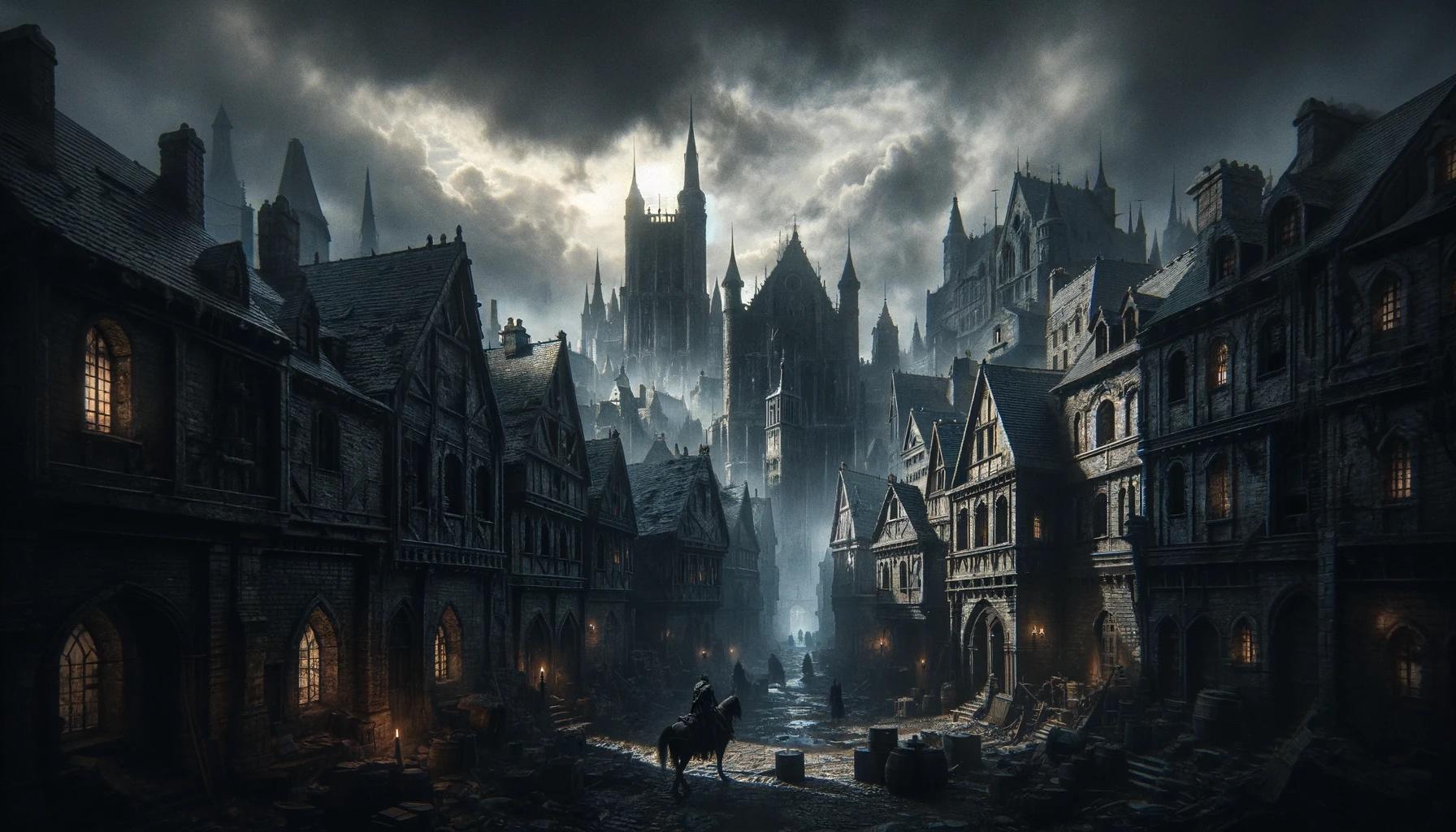
 Representation of the type of architecture found in the city and its surroundings, not an actual representation of the city itself.
Hnaleah
Overview
The Holy City of Hnaleah stands as a bastion of devout belief and unyielding theocratic rule. Governed by an Imperial Theocracy, this city is a stronghold of faith, dedicated to the deities Lux Dawnbringer, Thrain Stoneheart, and Leonus Ironmane. This devotion is not a matter of personal choice but a mandated aspect of life in the city, deeply ingrained in its cultural and social fabric. Its society is shaped by the fervent adherence to these divine figures and the teachings they represent. It stands as a symbol of unwavering faith and rigid theocracy. It is a city where devotion to its deities permeates every aspect of life, from governance to warfare. Despite its prosperity and power, Hnaleah's uncompromising stance on religious purity and its crusade against perceived evil cast a shadow over its holy aspirations. The city's rulers are not mere political figures but spiritual leaders, each wielding authority derived from their devotion to the divine. The city's fervent adherence to its theocratic principles fosters an environment of intolerance and rigidity, often leading to repercussions both within and beyond its walls. Despite the stringent theocracy that governs its society, Hnaleah has flourished, becoming a beacon of both spiritual and material wealth. Governed by a stern and protective regime, the city's theocratic leadership exerts a pervasive influence over the lives of its citizens, often at the cost of personal liberty and privacy.
Political and Military Structure
The power structure of Hnaleah is deeply intertwined with its religious convictions. The city is led by a council of high priests and clerics, revered figures who serve as both spiritual guides and governing authorities. Each member of the council is a dedicated follower of one of the city's three patron deities: Lux Dawnbringer, Thrain Stoneheart, or Leonus Ironmane. Their governance is based on the interpretation and enforcement of religious edicts and doctrines, which form the foundation of Hnaleah's laws and societal norms. Decision-making within the council is guided by a combination of divine inspiration and rigorous theological study. The council members are seen as the mouthpieces of their deities, their decrees believed to be direct manifestations of divine will.
The city's military, known as the Legion of Righteousness, is a force steeped in religious fervor and discipline. The Legionnaires are more than warriors; they are devout acolytes, trained in both martial and spiritual disciplines. Each soldier in the Legion of Righteousness takes an oath to uphold the city's religious doctrines and to defend Hnaleah against all forms of evil and heresy. Their commitment is not only to their city but to the divine mission it embodies. The Legion is well-equipped and highly trained, their tactics and strategies often infused with religious symbolism and zeal. They are known for their unwavering resolve and their willingness to engage in holy wars, crusading against those deemed unholy or in opposition to the city's religious ideals.
Hnaleah's theocratic rule and its Legion of Righteousness represent the embodiment of a society where faith and governance are indistinguishable. The city's leaders wield their religious authority with a sense of divine purpose, while the Legionnaires march not only as soldiers but as crusaders of their faith. Together, they uphold the sanctity of Hnaleah, a city where devotion to the deities is paramount and where the line between the temporal and the spiritual is seamlessly blurred.
Societal Flaws and Zealotry
Hnaleah's unwavering commitment to its religious tenets breeds a culture of intolerance towards beliefs and practices deemed "unholy" or contrary to its doctrines. This intolerance extends to arcane magic users, who are viewed with suspicion and hostility, and to adherents of religions other than those of Lux Dawnbringer, Thrain Stoneheart, and Leonus Ironmane. The city's authorities actively suppress any form of religious or magical expression that deviates from the sanctioned norms. This suppression often takes the form of persecution, with individuals or groups practicing forbidden arts or beliefs facing harsh penalties, ranging from imprisonment to banishment or even execution. Hnaleah's zealous opposition to the undead and other manifestations of evil is more than a doctrinal stance; it is a call to arms. The city has embarked on a perpetual crusade to root out and destroy these threats, a mission they believe is sanctified by their deities. This crusade often leads to military conflicts with neighboring regions, particularly Ingbrook and its allies, who may harbor individuals or practices that Hnaleah deems heretical or malevolent. These conflicts strain diplomatic relations and have the potential to escalate into larger-scale wars.
The city's rigid theocracy and its crusading zeal have significant implications for its society. While the majority of Hnaleah's citizens are devout followers of the state religion, the minority who do not share these beliefs live in a state of fear and concealment, wary of drawing the ire of the authorities. Externally, Hnaleah's aggressive stance against what it perceives as evil has isolated it diplomatically from many neighboring regions. Its crusades and intolerance have sown distrust and animosity, casting a shadow over its reputation as a holy city. Its crusade against perceived evil and its strict enforcement of religious conformity paint a picture of a society where righteousness is pursued with a fervor that often crosses into zealotry, impacting both its citizens and its relations with the world beyond its sacred walls.
Dominant Religions and Cultural Uniformity
In Hnaleah, the worship of Lux Dawnbringer, Thrain Stoneheart, and Leonus Ironmane is an obligatory practice, a decree enforced by the city's theocratic government. The teachings and tenets of these deities permeate every aspect of public and private life, shaping the city's laws, traditions, and moral codes. The mandate against the practice of other religions creates a homogenous religious landscape in Hnaleah. Alternative beliefs and practices are not just discouraged but actively suppressed, reinforcing the city's singular devotion to its trio of deities. The vast majority of Hnaleah's citizens are devout followers of Lux Dawnbringer, Thrain Stoneheart, and Leonus Ironmane. Their faith is a source of identity and community, with religious festivals, rituals, and observances playing a central role in the city's social life. For the minority who do not align with the city's mandated religious practices, life in Hnaleah is a careful balancing act. They conceal their true beliefs, practicing in secret or not at all, to avoid the harsh consequences of defiance. The fear of retribution, ostracization, or worse hangs over these individuals, compelling them to a life of silent dissent.
The enforced worship of the city's chosen deities creates an atmosphere of conformity and unquestioning obedience. While it fosters a strong sense of unity among the faithful, it also stifles religious freedom and diversity. The city's cultural events, art, literature, and public discourse are all colored by the religious doctrines of Lux Dawnbringer, Thrain Stoneheart, and Leonus Ironmane. This singular focus on a specific set of beliefs shapes the city's identity but also limits the richness that comes from a multiplicity of spiritual perspectives. The city's unwavering commitment to the worship of Lux Dawnbringer, Thrain Stoneheart, and Leonus Ironmane creates a society marked by religious fervor and unity, but also by an undercurrent of tension and suppression, as the voices of the few who dare to believe differently are silenced by the overwhelming chorus of the faithful.
Economic Prosperity and External Relations
Hnaleah's prosperity is in part due to its robust trade relations, particularly with Shegrove and other neighboring regions. The city's strategic location and stable governance have made it an attractive trading partner, fostering a vibrant economy. The city is renowned for its production of divine magical items. Artisans and clerics of Hnaleah, blessed by the favor of Lux Dawnbringer, Thrain Stoneheart, and Leonus Ironmane, craft items imbued with potent healing properties and protective enchantments. These items, including healing potions, scrolls, and other artifacts, are highly coveted for their quality and efficacy. The crafting of divine magical items in Hnaleah is not merely a commercial endeavor but a sacred art. The city's craftsmen and enchanters view their work as an extension of their devotion, infusing each item with not only arcane power but also religious significance. The demand for Hnaleah's divine magical items extends far beyond its borders, attracting buyers and pilgrims from across the region. The city's reputation as a center of holy craftsmanship contributes significantly to its economic standing and cultural prestige.
The government of Hnaleah, driven by its religious convictions, actively offers its services to other regions to aid in the eradication of what it perceives as evil. This mission is seen as a divine mandate, a way to extend the influence and righteousness of their deities beyond the city's walls. These services often involve dispatching members of the Legion of Righteousness or clerical envoys to assist in purging undead, demonic incursions, or other malign presences. Hnaleah views these interventions as both a religious duty and a means of asserting its theocratic ideals on a broader stage. Hnaleah is a city where the zeal of faith intertwines with the pragmatism of trade. Its prosperity is a reflection of its ability to harness its religious fervor into the creation of sought-after divine artifacts, even as it seeks to expand its theocratic influence beyond its borders. The city's role as a hub of holy craftsmanship and a crusader against perceived evil defines its unique position in the region.
Governmental Oversight and Worldview
The government of Hnaleah, viewing its rule as a manifestation of divine will, takes a deeply paternalistic approach to governance. This stance extends beyond public affairs and into the private lives of its citizens, where surveillance and oversight are commonplace. The city's authorities, in their pursuit of holiness and order, monitor the populace for signs of heresy, dissent, or practices deemed contrary to the state religion. This vigilance often leads to a significant intrusion into personal freedoms, with citizens' actions, associations, and even beliefs subject to scrutiny. Hnaleah's leaders govern with a conviction that their authority is divinely ordained. This belief imbues them with a sense of infallibility and justifies their far-reaching control over the city's affairs and its people. The rulers of Hnaleah view the world through a lens of divine providence, believing that their deities have preordained the spread of their faith across the globe. They see themselves as agents of this divine mission, tasked with guiding the world under the auspices of Lux Dawnbringer, Thrain Stoneheart, and Leonus Ironmane.
Hnaleah's government holds the belief that it is their sacred duty to liberate the world from those they deem heathens or non-believers. This conviction drives much of their foreign policy and their interactions with neighboring regions and states. The city's crusade to convert and guide is not limited to military conquests but also extends to diplomatic and cultural efforts. The government seeks to spread its religious doctrines through various means, viewing each conversion as a step towards fulfilling their perceived divine destiny. The government's protective yet intrusive nature, coupled with its vision of global religious dominion, paints a picture of a city at once resolute in its convictions and unyielding in its control. The citizens of Hnaleah, living under the watchful gaze of their rulers, navigate a society where devotion is both a way of life and a mandate from above, shaping their existence within the hallowed yet confining walls of the Holy City.
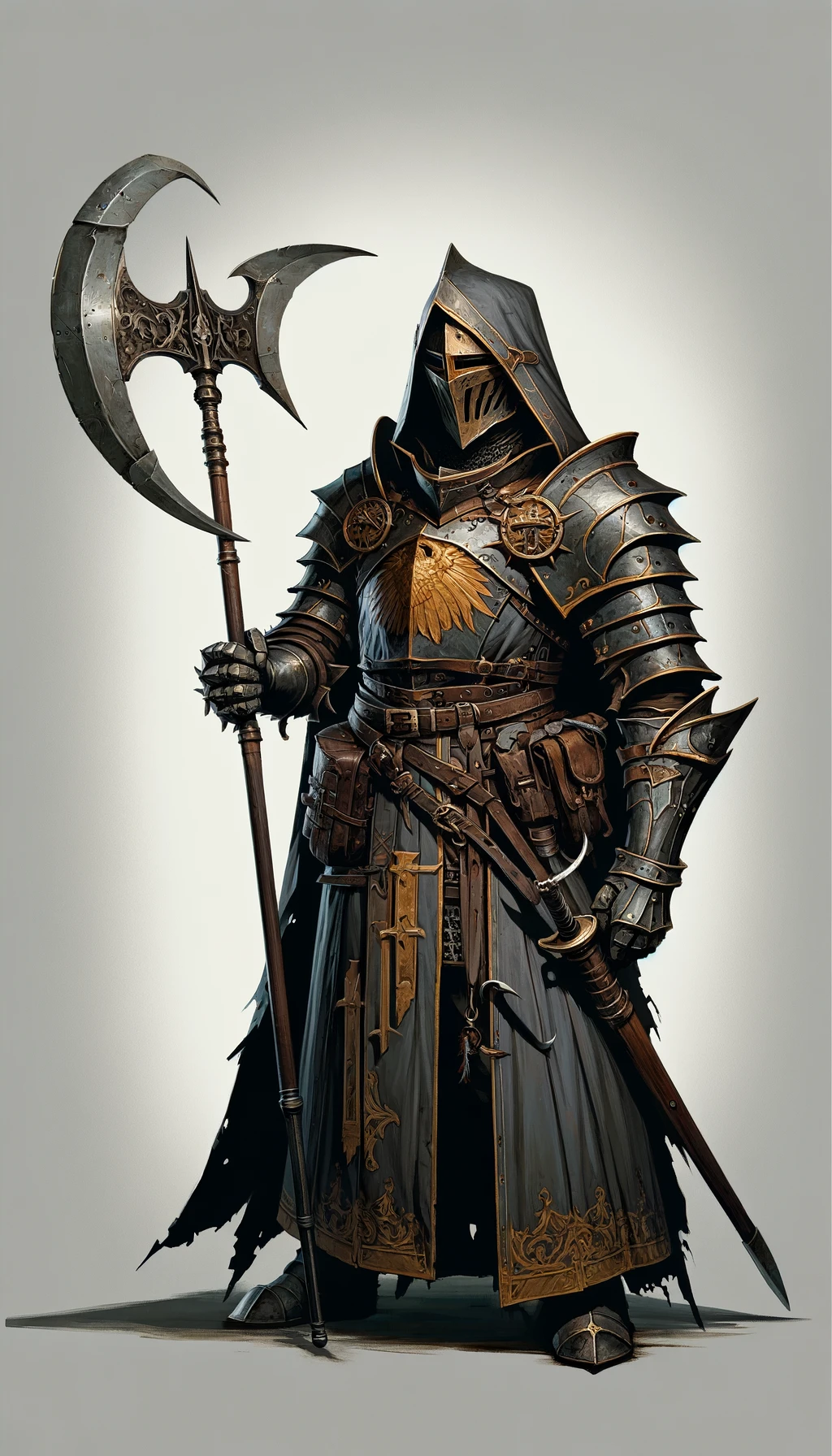 Standard Righteous Legionairy foot soldier
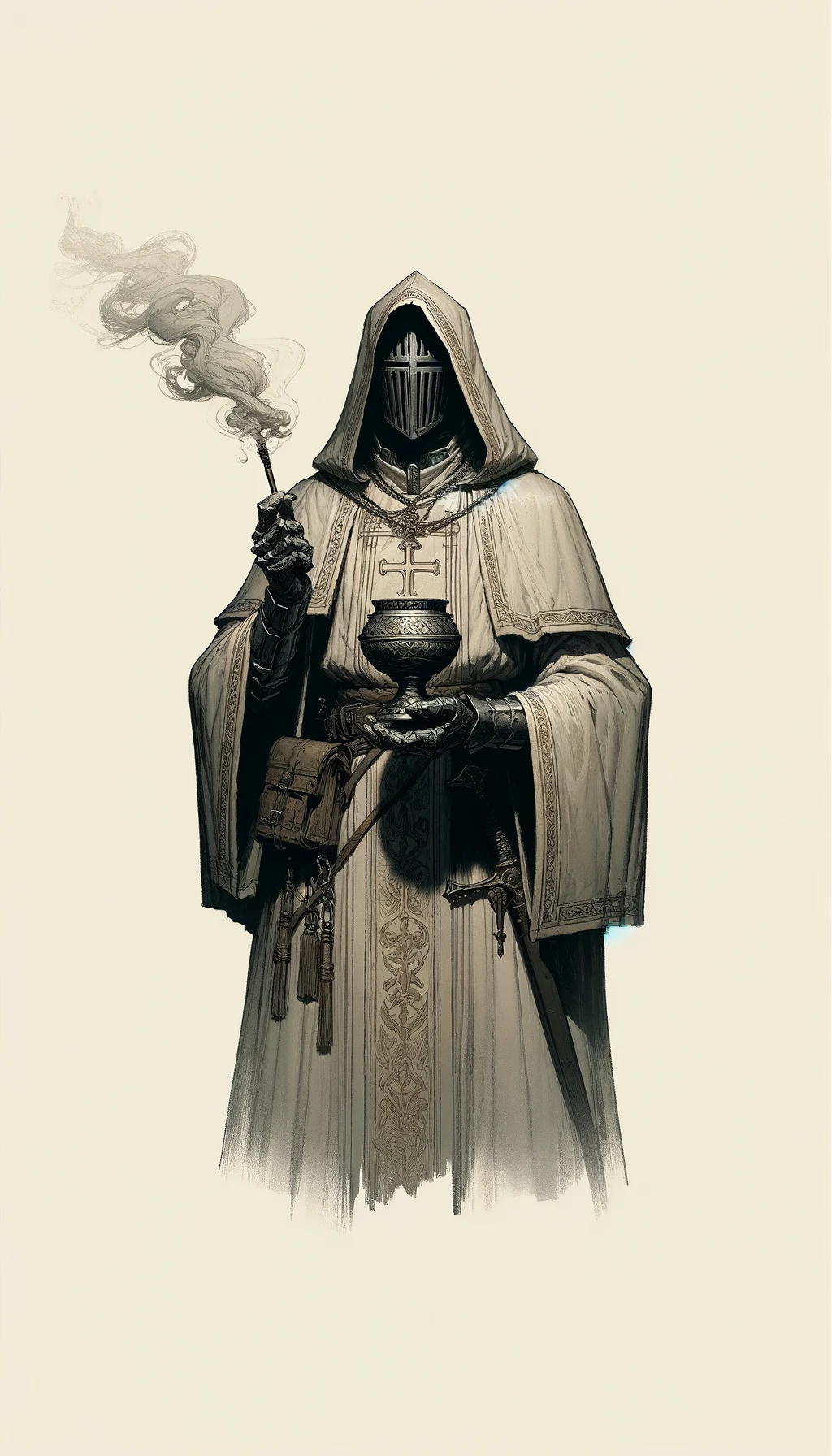 Standard Righteous Legionairy cleric
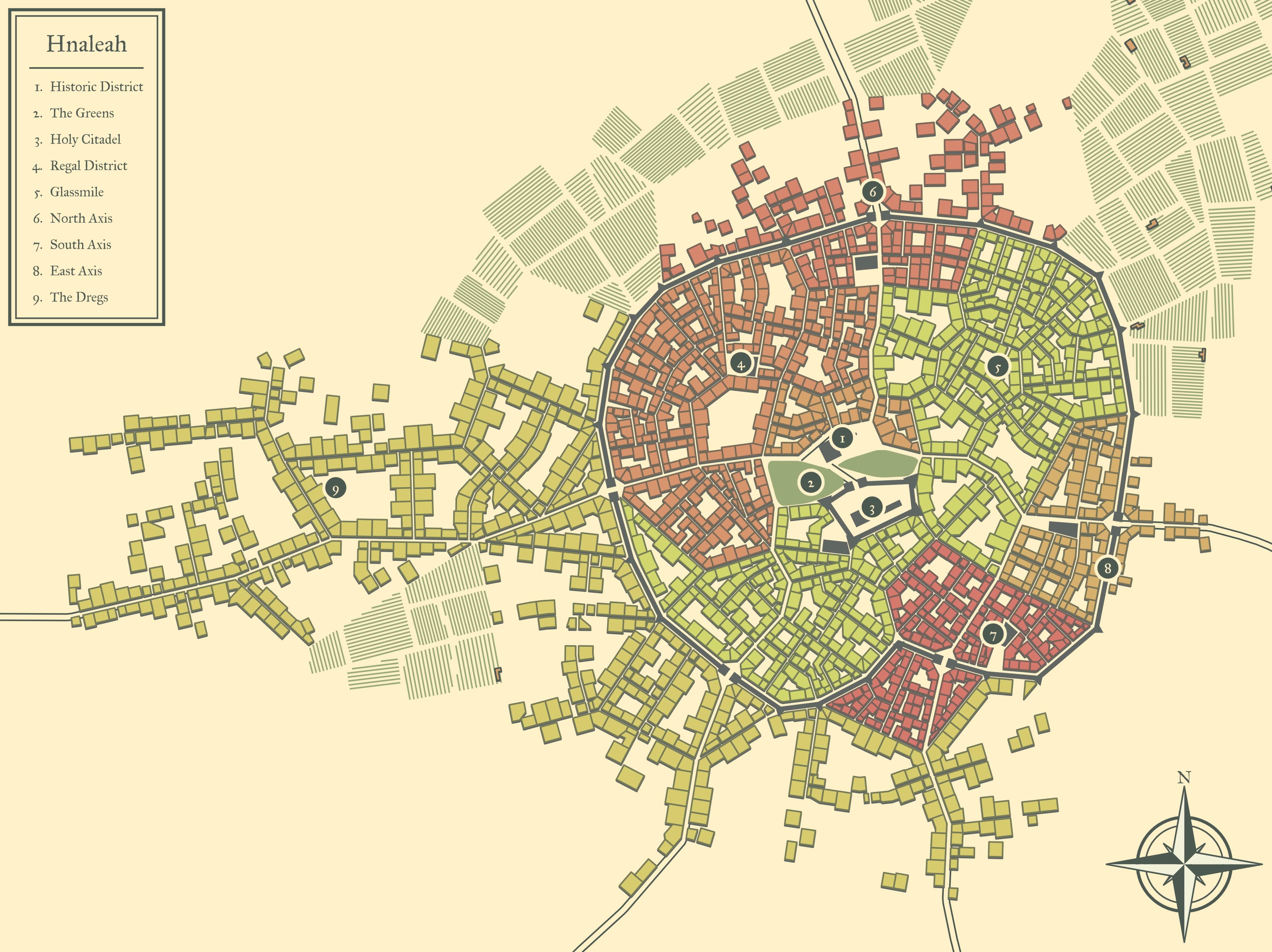 Map of the city.
Districts
Historic District
This section of the city was where the original inhabitants of the city first settled. It is comprised of government buildings and old shops. The buildings here are some of the first ones built in the city and have been preserved due to their historic significance.
- Social Class: Upper
- Population ~525
- Subdivisions
- Civic
- Fine Shops
- Parks
Regal District
The Regal District is where the nobility and high priesthood live and spend most of their day. It contains shops that sell the finest of wares and the forefront of fashion of Hnaleah. Many people envy those who live here, so it is usually hidden that one lives here and disguises are used when entering and exiting this district. It also contains the remnants of the old Lord's Keep, which has been preserved due to its historical relevance. It now serves as governmental offices and for its dungeon.
- Social Class: upper
- Population ~1,750
- Subdivisions
- Lord's Keep, vacant
- Finance District
- Fine Shops
- Noble Estates
- Wealthy Residential
Glassmile
Glassmile is the reason that this city has retained its ties to the rest of the Sewich Union, as this is the city's "adventurer district." While most of the city has kept to its religious extremism and continues to try and dominate this district of the city in the same manner, Hnaleah's government has failed to do so, citing its profitability for the city as the sole reason they do not invasively encroach on the district. Though that is not to say that they operate under different laws, they are just enforced significantly less here. The main attractions for this region are the vortexes to the Halls of Valor located here. Rumors tell that these vortexes are artificial, while others hold that they are divinely gifted to the city and its residents by Leonus himself. In either case, the gladiatorial games held here are renowned throughout the Sewich Union and draw in many adventurers participating. These events are scryed on by special devices attuned to the outer plane, showcasing the games for onlookers to watch. While it is outlawed in the rest of the city, betting on the matches has been restricted to inside this special district of the city and is overseen and managed by the government.
- Social Class: Middle
- Population ~5,520
- Subdivisions
- Embassy
- Inn District
- Immigrant Enclave
- Adventurer's Quarter
- Coliseum
- Guildhall District
- Marketplace
- Red Light District
- Tavern District
- Undercity
- Warehouse District
- Theatre District
North Axis
One of the few truly residential districts of the city, the North Axis is home to several apartments that residents live in. It is mostly self-contained with its own shops and garrison, and contains much the same sights one would expect of a residential district of a city such as Hnaleah. The South Axis and East Axis districts are the same in this regard, with not much distinguishing them from each other, other than their relative positions to each other.
- Social Class: Middle
- Population ~1,900
- Subdivisions
- Apartment Homes
- Garrison
- Shops
- Professionals
South Axis
One of the few truly residential districts of the city, the South Axis has no real difference from the North and East Axis districts.
- Social Class: Middle
- Population ~1,900
- Subdivisions
- Apartment Homes
- Garrison
- Shops
- Professionals
East Axis
One of the few truly residential districts of the city, the South Axis has no real difference from the North and East Axis districts.
- Social Class: Middle
- Population ~1,900
- Subdivisions
- Apartment Homes
- Garrison
- Shops
- Professionals
The Dregs
The Dregs is a massive slum, located outside the walls of the city and filled to the brim with the "dregs" of society. What defines a dreg is relatively subjective to who is asked, but the common answer is usually equated to "dissenter" or "apostate". Generally, when one is discovered to have broken from the main religion of the city, or from one of the many other tolerated religions, they eventually find themselves here. It is the home of the down and out, the nuisances, and the undesirables. Many have found themselves here for one reason or another, whether it was because they openly worshipped a deity that was not approved by the state, or simply because a priest took offense to their appearance and deemed them"unholy" and cast out of the city.
- Social Class: Lower
- Population ~3,850
- Subdivisions
- Goblinoid Ghetto
- Red Light District
- Shantytown
- Slum
- Tenement District
- Undercity
- Warehouse District
As a note from the author, the setting is currently under revision to accommodate the inclusion of the Spelljammer setting.
Antæra is unofficial Fan Content permitted under the Fan Content Policy. Not approved/endorsed by Wizards. Portions of the materials used are property of Wizards of the Coast. ©Wizards of the Coast LLC. For more information on the Fan Content Policy, visit the link here.