Arcane Space
Everything You Know About Space Is Wrong
Infinite space, stars as flaming spheres of super-heated plasma, movement through space as a balance of scientific forces, thrust providing acceleration and maneuverability, scientific fact backing up natural phenomena, and life on other planets built along blocks of carbon or silicon elements—forget all that. It's wrong. You can get out of the atmosphere on the back of a roc, fly between the planets through a breathable ocean of air, sail between the crystal spheres that surround the inhabited worlds on a river of magical energy, and encounter roving mind flayers and beholders. The stars are living things in some areas, great bowls of fire in others, and pinpoints of light painted inside a sphere in yet others.
Space can be divided into two types: wildspace and the phlogiston. Wildspace is what comes to mind when we talk of "space." It is the vast emptiness that lies between the planets and the stars. All space inside a crystal shell is wildspace. It is mostly vacuum (more correctly, most regions of wildspace are vacuum, but the cosmos is a big place, and there are exceptions to almost every rule, as shall be shown later). Wildspace is not truly a void, however, even though it is often referred to that way. The simple fact that there is "space" rules out its being a true void.
The phlogiston is a turbulent, unstable, multicolored, fluorescent gas (or gaslike medium) that fills the regions between the crystal spheres. Very little is known for certain about the phlogiston or this region. Every planetary system known is encased within a crystal sphere. Essentially, the crystal sphere keeps the wildspace in and the phlogiston out (this, of course, is a tremendous simplification, but it is easy to grasp). Like the phlogiston, crystal spheres are a great mystery; their origins and substance are unknown.
Within wildspace are the celestial bodies: planets, suns, moons, asteroids, and a host of other items collectively lumped together under the heading "planetoids." Most celestial bodies have an atmosphere of some sort, although it is dangerous to assume that this is an inviolable rule.
Celestial Bodies
The celestial body that is most familiar to typical player characters is their home planet, be it Krynn, Oerth, Toril, or any one of hundreds of others that populate the universe. Celestial bodies extend upward in size to that of the sun and downward to the size of asteroids and planetoids. The tremendous variety that is possible (and proven) in celestial bodies mandates that the only accurate definition for the term is any significantly large conglomeration of matter that is wheeling about in wildspace. In general, however, a celestial body is a planetary mass. Most have a regenerating atmosphere.
Celestial bodies can have any shape, though the most common is spherical. Still, there are flat worlds, elliptical worlds, cubic worlds, amorphous worlds, ring-shaped worlds, and hollow worlds. Astronomers from Calimshan have even theorized the existence of a Möbius world. Celestial bodies usually, but not always, have an atmosphere that is usually, but not always, breathable. The depth, or thickness, of the atmosphere is directly related to the size of the body. The larger the body, the deeper the atmosphere. Again, these are general rules, and exceptions abound. Voyagers may encounter large worlds without atmospheres, small worlds with thick atmospheres, and otherwise habitable worlds with poisonous atmospheres.
Some celestial bodies are aflame, fueled either by internal reactions or by significant access to the elemental plane of fire. Such bodies are called suns and provide most of the heat and warmth for the celestial bodies within any particular crystal shell.
Wildspace
All the celestial bodies within a crystal shell float in an airless void called wildspace. Conventional (meaning "those that take place on the prime material plane") interplanetary journeys around a solar system take place within wildspace. It is the first obstacle that must be conquered by would-be space travelers.
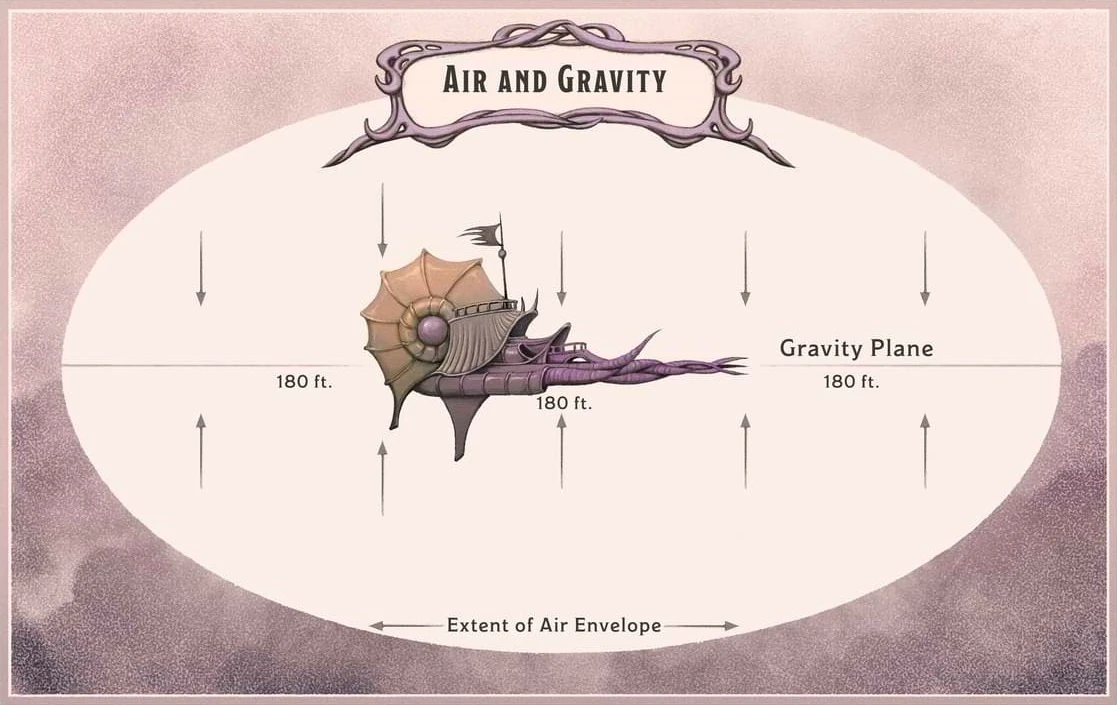
As an adventurer moves higher (whether climbing a mountain or on the back of a roc), the atmosphere becomes thinner and thinner until at last it becomes vacuum. The climber can still breathe, however, because as he moves upward, an envelope of air clings to him. When he reaches the point where the planet's air is no longer breathable, he is breathing his own air, held near him by his body's own gravity. This air envelope attaches to everything that passes through the atmosphere and allows normal survival in wildspace, at least for a short time.
The disadvantage to such an envelope is its small size. The envelope of breathable air that attaches to any body has an all-around depth equal to the cross-sectional diameter of that body.
Example: A spherical beholder 5 ft across has an air envelope 15 ft in diameter. Similarly, a block of wood which is 1 ft by 2 ft by 3 ft is surrounded by a more-or-less rectangular envelope of air which is 3 ft by 6 ft by 9 ft.
A creature will exhaust the air in its personal envelope in 2d10 turns. Since this is barely enough time to get anywhere, most crossing of wildspace is done with larger vessels that have correspondingly larger atmospheres. The amount of air which a vessel can bring along limits the minimum size of most space-going ships to no less than 100 ft in length (this measurement is called the keel). The cost of moving this amount of mass limits the upper size of the ship.
Gravity
The reason everything drags its own atmosphere around through space is gravity. This is also the reason why people can stand on a space-sailing ship without falling off its deck and can stand on a spherical planet without falling off the bottom side. Every body in space has its own gravity. Gravity is an accommodating force in that its direction seems to be "that which is most convenient." In an object the size of a planet, gravity is directed toward a point at the center of the planet so that people can stand anywhere on the surface and dropped objects fall perpendicular to the surface. In smaller objects, like spacecraft, gravity is not a central point but rather a plane that cuts horizontally through the object.
Significantly, this gravity plane is two-directional; it attracts from both the top and bottom. A sailor can actually stand on the bottom of the ship's hull and move around as easily as if he were walking on deck. In this case, "down" is actually "up," back toward the plane of gravity that cuts through the ship. One of the stranger side effects of all this is that an object falling off the side of a spelljammer can oscillate back and forth across the plane of gravity, falling first in one direction until it crosses the plane, then reversing direction and falling back across the plane again, and so on until something causes it to stop. To a person standing on the deck, the object appears to fall down, then up, then down, then up. This trick is commonly used to amuse passengers new to space travel. More than one groundling has gotten in trouble for standing at the ship's rail and tossing an endless stream of apples overboard just to watch them bob.
Example: A Viking longboat cruising through the fjords is suddenly thrown from its home into wildspace. Its crew can still stand normally on its deck. Down for them is toward the bottom of the boat. Similarly, an individual could stand on the bottom of the longship and find that "down" for him was back toward the top of the boat. Someone who jumps off the deck of the boat would fall downward and pass through the boat's plane of gravity, whereupon the direction of gravity would reverse for him and pull him back toward the underside of the hull.
A carefully thrown object can actually go into orbit around the ship. Such orbits do not last long; the object quickly collides with the ship's rigging or oars, or slows down in the air envelope and crashes into the ship. One of the favorite pranks of experienced spellsailors is to toss an apple or similar light object off one side of a ship in such a way that it curves around and strikes someone standing at the other rail.
Ships and Gravity Planes
Since the gravity plane of a ship runs through its two horizontal axes, it is possible to stand on the "bottom" of the boat, facing the opposite direction of the rest of the ship. In fact, it is feasible to build a ship with two decks, one topside and the other on the bottom.
The fact that this is not done reflects both human (and other sentient) nature and common sense in space. The human nature part is the tendency to want all things "right-side up" when working with them, and while space-born races deny any such similarity with the groundlings, they are as much creatures of habit as their ancestors were. The more practical reason is what happens when two large bodies meet in space. The larger gravity plane takes over the smaller gravity plane, and its direction of "up" becomes the other's as well. A ship that has a standard "up" direction can more easily adjust to this new situation, while one with multiple "ups," such as our double-decker, will be caught in a situation where one side will go spilling off the deck toward the newly established gravity plane.
This situation results in most ships having a definite "up." Whether they can land on a planet or asteroid or not, they will eventually find themselves in the gravity plane of a larger ship and thus build accordingly. The huge neogi deathspiders felt they could escape this until they ran into a dwarven citadel ship that caused their umber hulks to go splattering against an overhead dome that suddenly became underfoot. The older dwarven citadel ships, now abandoned, show a multidirectional nature, but encounters with still larger craft (such as the Spelljammer) have caused them to reintroduce standard facing.
Matters of Gravity
In space, whether in the flow or in wildspace, gravity performs the same way. A plane of gravity runs through the long axis of any large body. Any structure or creature with an axis at least 25 ft long has a plane of gravity sufficient to attract other objects. A person could walk on the back of a 25-foot-tall giant floating in space as if the giant were a planet.
Every body with a plane of gravity (including asteroids, most standard ships, and some huge or larger monsters) exerts a pull identical to that on a standard planet ("Earth-normal" gravity). A body without a plane of gravity still maintains an envelope of air but exerts no pull on other solid objects.
Gravity is an all-or-nothing proposition. Either it is there at full strength, or it is not there at all. Gravity always exerts the same force, whether the body creating it is the size of a whale, the planet Toril, or a massive gas giant planet. The gravity of a body extends to the same distance as the air envelope—that is, to the edge of the object's atmosphere. Within those bounds, gravity functions normally toward the gravity plane; outside that limit, gravity is not present in any degree. A body in that region is weightless.
Since gravity is represented by a plane running through the long axis, any large body has a "top" and "bottom." It is possible to walk along the bottom of a ship, as gravity is still pulling the character down toward that long axis. Technically, a ship could be built with two decks, both parallel to the gravity plane. In practice, this is almost never done because such a ship cannot land. Some deep space craft and asteroid bases have equal housing on the top and bottom.
The plane of gravity runs out beyond the edges of the body to the fringe of the air envelope. Therefore, a character stepping off the deck of a ship falls toward that plane. He passes through the plane, at which point the direction of gravity reverses, and then he falls in the opposite direction. There is no damage from falling off a ship in this fashion.
Drifting
There is a problem for unrestrained objects resting on the plane of gravity of another large object, however. Along the plane, an object is weightless, but it is pushed slowly out toward the edge of the gravity field. Therefore, a man overboard would eventually come to rest at the ship's plane of gravity, then begin drifting away from the ship along that plane toward the edge of the air envelope. On reaching the end of the gravity plane, he is pushed outside the air envelope and then left behind as the ship moves away.
Because objects at the level of the gravity plane itself are weightless and undergoing a small but definite push toward the edges, this center plane is often used to launch heavy missiles or prepare boarders to attack other ships. Aside from this slight push, there is no relative motion of a ship within its air envelope, aside from turning. A ship's air envelope does not turn with the ship when it turns, but objects in the ship's air envelope do not drift toward the rear of the ship simply because the ship is moving forward.
Overlapping Gravity
When gravity planes intersect (such as when two ships pass each other at close range and different angles), the gravities of both ships remain in effect, regardless of size, up to the point where they physically intersect. An object is under the influence of whichever gravity plane it is closest to. A character could leap between two passing ships, altering his down direction as he crosses the midpoint between the two.
When two ships come into direct contact (one rams the other or lands on the other), the gravity of the ship with the higher tonnage is dominant and becomes the gravity for both ships. For example, an elvish light scout has its own gravity until it lands on its parent ship, at which point it adopts the down direction of its parent. Or, as another example, a large mind flayer vessel could ram a smaller ship from directly above and spin the smaller ship's gravity plane by 90 degrees, causing everything on the rammed ship to tumble toward the larger ship's plane of gravity, probably with disastrous results.
Falling
A weightless character who enters the air envelope of a larger body is immediately affected by the pull of gravity of that body. He will, in effect, fall the distance from where he entered to the surface of the body, or to the plane of gravity, whichever is nearer. Normal falling damage applies if the character hits something solid at the end of the fall.
In cases where the drop is more than one mile, there is also danger of the subject heating up and igniting from friction with the air (becoming a shooting star). This happens after one mile of uncontrolled descent. The falling object catches fire and takes normal damage from fire for the remainder of the plunge. Flight, levitation, or any sort of control over speed and descent can negate this effect.
Characters who are weightless can move under the familiar laws of physics. Any force has an opposite force. A drifting fighter can move (slowly) by throwing equipment in the opposite direction. Maximum movement in this fashion is 3 ft per round.
Combat
Combat in weightless conditions is considered a foreign combat environment for those who are not accustomed to the situation. Nonnatives of space have a -4 penalty on their initiative rolls and a -2 penalty on all attack rolls. Nonnatives are those characters and creatures who do not possess the Spacefarer feat or are unfamiliar with weightless conditions and fighting in three dimensions. Characters who are native to space can fight without these negative modifiers.
Missile fire functions normally within gravity fields. Once outside those fields, however, there is nothing to slow down the objects once fired. For this reason, missiles will continue to travel forever, with no limit, until they encounter something. All missile weapons in space have an extreme range that extends from the limit of long range to the limit of the character's vision. There is a -10 modifier to hit at extreme range. A missile travels the equivalent of twice its long range each round.
For example, imagine a character firing a longbow at a target that is 2,000 yards away. The longbow's long range is 210 yards. After being fired, the arrow will travel 420 yards per round. It will reach its target five rounds after firing.
This applies to normal hand-held weapons only. Siege machinery, catapults, and ballistas mounted on ships suffer no such limitation, as they are designed with such long distances in mind.
Weightless conditions apply to both wildspace and the phlogiston with no differences. Despite their size, crystal spheres have no gravity, inside or out.
Crystal Shells
All wildspace is bounded by crystal shells or crystal spheres. Inside the crystal sphere is the vacuum of wildspace, the planets, and stars. Outside the crystal sphere is the rainbow ocean of phlogiston and more crystal spheres. The size of a crystal sphere is determined by the size of the planetary system inside. Usually, a sphere has a radius at least twice as big as the orbital radius of the outermost celestial body in the system (i.e., the distance from the shell to the outermost body of the system is the same as the distance from that outermost body to the center point of the system).
Because of their great size, the outside of a crystal sphere appears perfectly flat. The curvature is so gradual that it is completely undetectable to anyone who is close enough to see the crystal sphere through the obscuring phlogiston. The spheres consist of an unbreakable, dark, ceramic material of unknown origin. Some legends state (and various theologians agree) that the smooth-surfaced shells were created and positioned by the deities themselves to protect their worlds from the ravages of the phlogiston, which is held to be the prime matter of the universe. Less charitable philosophers maintain that such shells were placed by an even higher authority to keep deities and men in and confine their activities.
Whatever their origin, the crystal shells are uniform throughout space. All appear as great, dark, featureless spheres of unidentifiable matter. The crystal spheres are definitely solid. They have no gravity along either their interior or exterior sides (an exception to the rule that all large objects have gravity). No magic has been found that can damage or alter the surface of a shell, except for those spells that cause portals to open. Even this, however, is believed to be nothing more than an artificial triggering of a natural phenomenon since portals also occur naturally and seemingly at random. They are apparently immune to the effects of wishes and even the wills of the outer planar powers (though this does not rule out the possibility that the outer planar powers created them—perhaps they were wise enough to prevent even their own tampering).
The crystal shell is an impassable barrier to space voyagers unless they are properly prepared or very fortunate. Five methods are known for getting from one side of a crystal sphere to another:
- It can be bypassed entirely with a teleport or dimension door spell. The traveler blinks from one side of the shell to the other without physically crossing the shell. Only a magical item or magical spell can effect such a transfer.
- A phase door spell or magical device that duplicates that spell allows a ship or a portion of the shell to become immaterial so the ship can pass through.
- Naturally occurring portals pierce the shell in various locations at random and unpredictable intervals. Looking for such a portal can be a time-consuming task.
- In some systems, stars are located around the fringes. Occasionally, such stars are themselves portals to other locations which can be accessed by diving into the heart of the star. Such portals are very rare; voyagers definitely should check local listings before incinerating themselves in an unknown situation.
- The legendary Spelljammer and creatures such as space dragons seem to have an innate ability to open portals to the phlogiston. These portals close slowly over a long period, so other ships can sometimes pass through them. From outside a sphere, these portals are easily visible.
Note that portals, as discussed here, are merely simple doors allowing passage from one side of a crystal shell to the other. They are not gates and do not allow transit between dimensions. Magic that relies on other planes or other dimensions is notoriously unreliable when cast in close proximity to a crystal shell.
The crystal sphere itself represents the outer limit of the influence of deities and other-dimensional creatures. Magic that summons or draws power from such beings or creatures does not function outside these bounds.
Those fantasy systems with stars in the night sky often have these stars mounted along the inside of the crystal sphere. The nature of stars varies from sphere to sphere; within some spheres, the stars are small portholes looking out on the phlogiston, in some they are painted lights along the interior, in some they are great cities inhabited by alien creatures, and in others they are great bowls of fire held aloft by huge statues of forgotten deities.
Why are Crystal Shells Round?
The systems of the SPELLJAMMER universe are all held in bubbles which drift in a rainbow ocean called the phlogiston. Whatever the shape of the system within—whether a collection of clusters, or a single flat plane, or a chaotic bundling of planets—the sphere that it all fits into is round.
Why?
No one knows, but there are several theories by way of explanation:
"The sphere is the most natural shape for such things, much like bubbles in amber or champagne.
The sphere is the easiest shape for the deities (or whomever built these things) to construct.
The sphere is a perfect shape; the shape that shrinks its plane of gravity to a single point at its heart, attaining a perfect balance.
The simple fact is that no one knows, save perhaps the deities, and if they know, they aren’t telling. There may be system shells out there that are cubical, or ellipsoidal, or even irregularly torus-shaped. We just haven’t reached them yet.
And when we do, we’ll probably start the sages arguing all over again."
—From Elminster’s Musings on Empty Space, a scroll from Elminster of Shadowdale to Lord Khelben of Waterdeep.
The Phlogiston
Outside and between the crystal spheres is a turbulent, rainbow ocean of flammable ether called the phlogiston. The phlogiston is a multicolored sea upon which float the various systems within their crystal shells. The term phlogiston is applied equally to both the multicolored medium and to the entire region surrounding the crystal spheres.
Phlogiston has varying thicknesses in space and forms dense rivers between planet-sized objects (such as the spheres themselves). Voyagers moving along these paths of concentrated phlogiston discover that the greater the density of the flow, the faster a ship can move. A ship can speed up and slow down by penetrating deeper into or raising itself out of these phlogiston rivers. Stellar distances can be covered quickly in such areas. Further, the speed of the ship is at least partially dependent on the surface area it presents to the flow, so many ships carry sails to increase their speed in the interstellar ocean.
Gravity works in phlogiston the same way it does in wildspace. Down is directed toward the major axis of the ship. Phlogiston is none of the recognized four elemental matters. It is neither air nor earth, fire nor water. It cannot be reproduced or brought inside the bounds of a crystal sphere. If an attempt is made, whether by physical or magical containment, the phlogiston inexplicably dissipates, leaving no trace. Phlogiston simply cannot exist within wildspace or on the surface of a planet.
Finally, phlogiston is dangerously flammable, much like oil-soaked cotton, which poses its own problems. Any flame exposed to phlogiston causes the surrounding area (including the phlogiston-laden air envelope of the ship) to burst into flame. This flame expands immediately to three times its normal diameter and inflicts three times its normal damage. For this reason, fireballs, bombards, arquebuses, and any other weapons that rely on a spark or flame are not used in the phlogiston.
These effects occur immediately. For example, lighting a flask of oil to use as an incendiary weapon will cause it to explode immediately. (Actually, a character would have to be extremely tricky and careful even to get that far. The phlogiston would ignite as soon as a flame was created with which to ignite the oil.) The fire resulting from a fireball or other fire-related spell is centered on the caster of the spell.
Because of the nature of phlogiston, all flaming light sources are extinguished by the crew before entering the flow. Phlogiston is radiant, so no other lights are needed on the exposed decks. Below decks, or in rare (and haunted) Dark Regions of space, cold natural lights (moths or fireflies, fluorescent moss) or magical lights are used for illumination. Structures built by creatures with darkvision do not have running lights, as their darkvision allows them to see.
Voyagers can move along the rivers of phlogiston at random or according to a planned course. Many of these rivers flow in both directions between two crystal shells. In some cases, a river flows in one direction only, forcing the voyager to follow a different course when returning home.
The crystal spheres bob in the phlogiston like corks in an ocean (mind-boggling, enormous corks, but they do bob). As a result, over time, the spheres actually shift their positions relative to each other. This almost never changes the courses of the rivers, however, so navigation is possible. Just because a ship passed certain landmarks on its way from A to B does not mean the ship will pass those same landmarks on its way back to A from B. Fortunately, when crystal shells drift too close, the phlogiston between them thickens to the point where the two massive spheres are moved apart, preventing a collision.
| Type of Flame | Damage | Range (radius) |
|---|---|---|
| Candle (lit) | 1d6 fire | 4 in |
| Lantern (lit) | 3d6 fire | 1 ft |
| Oil Flask (lit) | 3d6 fire | 3 ft |
| Cooking Fire | 4d6 fire | 10 ft |
| Fireball | ×3 | ×3 |
| Match (fuse)* | 1d4–2 (min 1) | Self |
* Immediately causes an arquebus to misfire. | ||
Castaways in the Flow
When dealing in terms of space, there is always the chance that an individual or ship will find itself adrift without a way back to civilized space. In wildspace, an individual is likely up the creek without sufficient atmosphere. Roll for normal encounters until the air runs out. Items such as a beacon will affect how much and what type of attention is drawn.
In the phlogiston, the preserving nature of the flow means that an individual lost in space may return—weeks, months, and/or years down the road. Roll 1d10; that is the number of standard weeks that will elapse before someone discovers the preserved character. On a 10, roll another 1d10 and add that. If that roll is a 10, add it to the total and continue until a final sum total is reached. A character can literally be "on ice" for years or decades, given a nasty situation and bad luck, but most will float back into circulation after a few standard months.
The nature of the rescue is up to the DM, but for those looking for a quick response, use the following table. The DM may modify the table or create his own as he sees fit for his section of space.
Most of the ships of space follow a "Code of the Deep," where lost bodies are recovered and returned to life unless obviously hostile to the individuals involved. The neogi will definitely bind the character and sell him or her into slavery at the next stop, as will 50% of the mind flayer ships involved.
Merchants and pirates will offer the lost individual passage in exchange for work, with the pirates tossing those unwilling to serve back into the deep. The elves and dwarves will rescue humans but keep them under watch until landfall is made. Scavengers will loot whatever is available on the body and toss it back into the flow, where it will float for another random number of weeks, determined by the "1d10+" process described earlier.
| D10 | Rescuers |
|---|---|
| 1 | Neogi-Slaver |
| 2 | Mind Flayer Trader |
| 3–4 | Normal Merchant |
| 5–6 | Pirate Ship |
| 7–8 | Elvish Military Ship |
| 9 | Dwarvish Ship |
| 10 | Scavengers |
Breathing in Space
As a character ascends a mountain, the air becomes thinner and thinner until finally, it becomes the unbreathable vacuum of wildspace. Fortunately, all bodies take an envelope of air with them, providing some breathable atmosphere. Unfortunately, this envelope is rarely large enough to support life for very long.
A single, human-sized body drags along with it enough air to last 2–20 turns. If that human-sized body is standing on a rock 100 cubic yards in size (roughly 40 ft in diameter), it may have enough air to survive for several months. Larger-than-man-size creatures (ogres and giants, for example) drag along enough air to last twice as long (4–40 turns).
Larger objects, such as ships, are rated for their tonnage. Each ton represents 100 cubic yards of space, which brings along enough air to support one human-sized crew member for four to eight months. A 30-ton frigate, therefore, could support 30 crew members for four to eight months under normal circumstances and double that under reduced circumstances. This is explained fully in the chapter on Ship Design. The minimum size for a usable ship in space is 1 ton (100 cubic yards). The limitations on moving a ship through space determine the upper limit of ship size.
Air Quality
The air envelope around a body or ship can be one of three classes or qualities: fresh, fouled, or deadly. Air can change from one quality to another over time.
- Fresh air is completely breathable. The air around an individual body remains fresh for 2–20 (2d10) turns. Air around a larger body (one ton or more) remains fresh for four months if the vessel carries a normal crew.
- Fouled air is stale and partially depleted. It is humid and smells bad. Air becomes fouled after the first 2–20 turns around a single body and remains fouled until the 30th turn. For example, if the air was fresh for 12 turns, it would be fouled for 18 turns, for a total of 30 turns. The air around a ship is fouled from the beginning of the fifth month until the end of the eighth month. All attack rolls and ability checks made by characters or creatures that must breathe air have a -2 penalty if the air is fouled.
- Deadly air is completely depleted and filled with carbon dioxide. It cannot support life. The air around an individual becomes deadly at the beginning of the 31st turn; that around a ship becomes deadly at the beginning of the ninth month in space. Anyone trapped inside a deadly atmosphere must make a saving throw versus poison each turn. Failure means the character passes out. A second failure brings death. Only fresh (or fouled) air can revive the character after he passes out.
Most trips aboard a ship take less than four months to complete, or at least present the opportunity to replenish and refresh the air supply within four months. Air usually is not a problem except in extreme cases and emergencies.
Changes aboard the ship can affect how long the remaining air will last. There are two ways for the DM to handle this: a fast method that involves some necessary simplifications and an accurate method that involves considerably more math.
Method 1: A ship's air is fresh for four months. This is altered only if the number of crew aboard is at least 25% high or low. For each 25% over the standard crew, the air supply is reduced by one month. For each 25% under the standard crew, the air supply is extended by one month. These adjustments are made at the beginning of the trip. From that point on, the air supply cannot be extended by losing crew members, but it can be shortened by adding crew members. The crew must be increased by at least 25% of its standard limit to reduce the air supply by one month. For example, a 30-ton frigate sets sail with 30 characters aboard, the standard limit. It has air sufficient for four months. After six weeks, 10 characters are lost in a battle. Even though this represents more than 25% of the crew, it has no effect on the air supply because the air supply cannot be extended. Three weeks later (nine weeks total, or 2.25 months), 20 characters are rescued from a drifting hulk. This raises the current crew to 40, which is at least 25% greater than the standard limit of 30, but not 50% greater. The air supply is reduced by one month, so it will now be fouled at the end of three months.
Method 2: This method is entirely mathematical. The DM redetermines the ship's air supply every time the number of characters aboard changes. The air supply can increase or decrease. To determine the ship's new air supply when it changes, multiply the current air supply by the number of people that air was for, and then divide that product by the new number of crew. Round fractions down. For example, a 30-ton frigate sets sail with 23 characters aboard. It carries enough air to remain fresh for four months (16 weeks) if breathed by 30 people. With 23 crew, the air will last (30 x 16 / 23 =) 20 weeks. Seven weeks into the trip, five crew are lost fighting a monster. The remaining air will now last (23 crew x 13 weeks / 16 remaining crew =) 18 more weeks before becoming fouled.
When two bodies meet in space, their atmosphere is exchanged. The class of the air in the smaller body becomes that of the larger body. If the smaller body is at least two-thirds the size of the larger, both get one-half as much air as the larger had remaining. If the smaller is less than two-thirds the size of the larger, both get the larger's full supply of air, minus one week. For example, if a 30-ton frigate with fouled air encounters a 60-ton man-o-war with 12 weeks of fresh air, the frigate gets 11 weeks of fresh air and the man-o-war loses one week. If the frigate had been 40 tons or more, both ships would have gotten six weeks of fresh air.
The same thing applies to two individuals exchanging atmosphere. An individual has no effect on a ship's atmosphere, however, unless the individual is at least huge.
A number of creatures can survive in space without air (undead or magical creatures such as golems, for example). They are unaffected by the status of the air envelopes around them. Certain spells and magical items provide additional protection to the star traveler who may find himself in deep space without a ship.
Classes of atmosphere operate in the same manner in the phlogiston as they do in wildspace. However, when the atmosphere goes deadly, a special property of the phlogiston takes over. Instead of dying, the individual lapses into suspended animation until the atmosphere around him is recharged. Living flesh turns gray and stonelike and remains that way until the individual is rescued. By following along the flow, a ship or individual will eventually drift near a sphere, where recovery is at least possible. Note that rescue is not necessarily by someone with good intentions. The neogi and mind flayers do excellent business in robbing and enslaving the unfortunate individuals they find adrift in the phlogiston.
Crystal shells usually have no atmosphere of their own, either inside or outside. There are many asteroids and planets that lack atmosphere as well, in contradiction to normal physical laws.
Temperature
Due to the activity of the planets, the spheres, and various gates to the plane of elemental fire, temperature in wildspace is generally not a problem for adventurers. The ambient temperature in most space is about the same as a moderate summer day in the temperate regions of most worlds. Some crystal shells, however, have surprisingly higher or lower temperatures, and those should be noted on any star chart worth reading. A shell that is little more than an opening into the plane of elemental fire will have a higher temperature than one without any such openings. For instance, Krynn space has a very low natural temperature (about 16 degrees Fahrenheit) and is plagued by small, lethal clouds of ice particles.
The phlogiston maintains a similarly comfortable temperature, but with the added danger of explosive fire, as described above. There are no seasons in the phlogiston or wildspace. Of course, as a ship approaches a star, the temperature increases. Landing on a body of fire creates problems similar to entering the elemental plane of fire. A water body could conceivably be cold enough to be nothing but a ball of ice.
Time
Local time often varies from planet to planet and sphere to sphere, depending on rotational periods, customs, and a host of other factors. Spelljammers often rely on what is considered the standard day for timekeeping aboard ship.
A standard day is 24 hours and is broken into three watches of eight hours each: first watch, second watch, and night watch (also called graveyard watch). A standard week is seven standard days, and a standard month is four standard weeks (28 days).
There is no standard time period beyond the month. The typical method of determining the length of a year—the time that passes during a complete cycle of the seasons—has no meaning for a group that spends most of its time in space. Anything from 10 to 15 months can be considered a year, depending on the people who are keeping track of it.