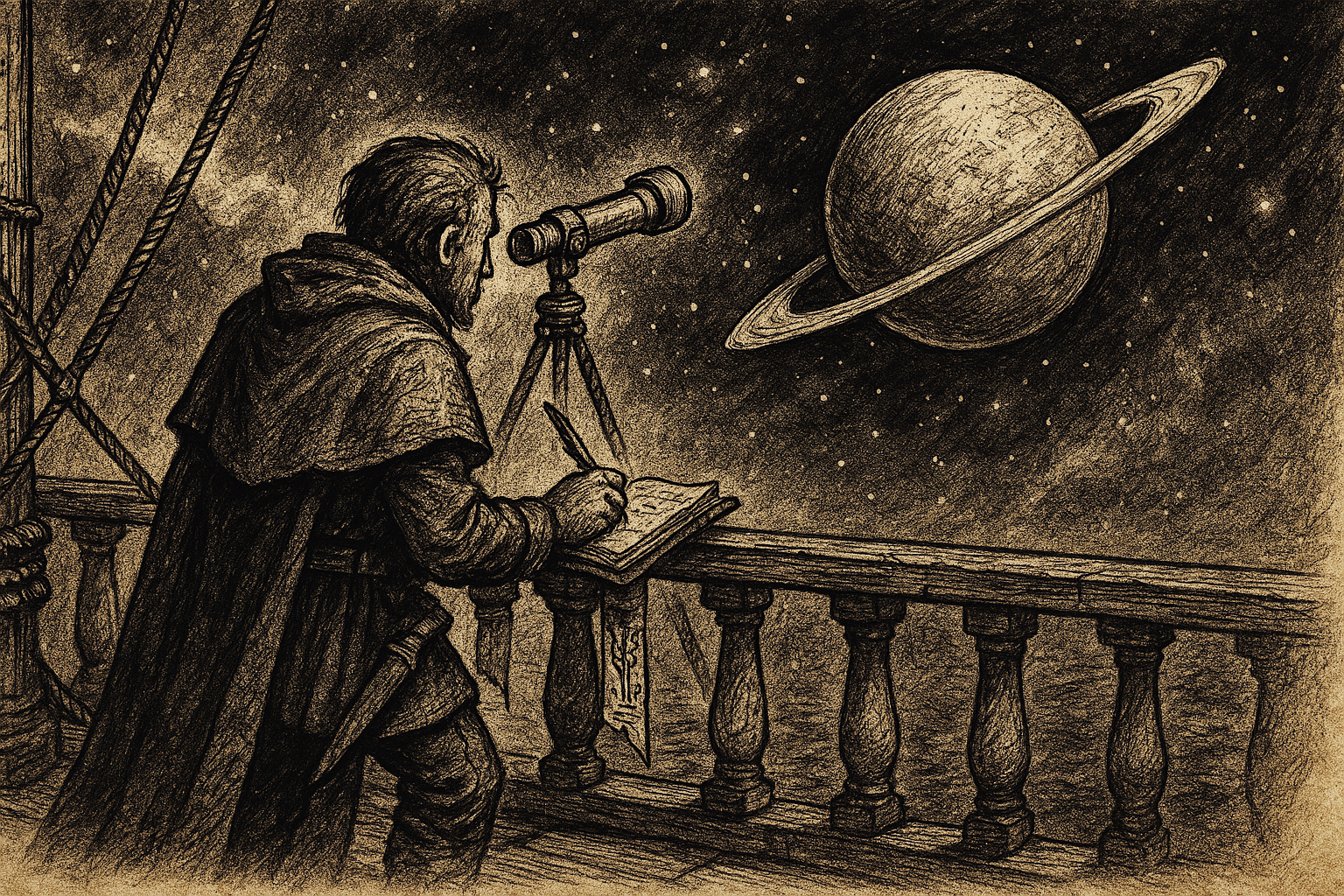
 Planetologist taking notes about a newly discovered planet.
Astrology Planetology
Traveling in Wildspace
Traveling in a straight line, spelljamming ships can attain high velocity relatively quickly, spanning the great emptiness between the planets in a short time. The operative phrase, however, is "straight line." Upon making a turn or coming into the gravity field of another large body, the spelljammer helm automatically decelerates to a more manageable speed described under Combat. This is a function of all spelljamming, regardless of the type of helm or owning race of the ship.
A "large body" is any body of 10 tons or greater space displacement (300 ft^3, or a cube slightly less than 7 ft on a side), which includes most spelljamming ships, planets, stars, and other worthwhile celestial bodies. Small items such as boats and elvish flitters, which rate under 10 tons, do not have this effect.
A ship can travel 100 million miles per day regardless of its SR rating. This is the speed of all spelljamming ships over long distances, regardless of the size of the ship or the level of the helmsman manning the helm. As long as a ship has a functioning spelljamming device of any type and an individual who can use it, a ship can move 100 million miles in a single standard day (about four million miles per hour).
Four million mph sounds like a lot and in "real terms" means that a ship with SR 1 can travel from Earth to the Sun in a single day. However, space is incredibly large, and that same ship would take 36 days to reach Pluto. Given that the crystal shell is as far from the orbit of the furthest planet as is the primary star, a trip from the Sun to the crystal shell girding Earth's system would take 72 days.
Therefore, movement between the planets is time-consuming when dealing with the outer bodies and relatively rapid among the inner spheres. Again, using the Earth/Sol system as an example, a ship from Earth with a spelljamming device could reach as far as the orbit of Saturn in a single week. (Of course, the planet may not cooperate by being there, but that is another matter. See Celestial Mechanics for information on planetary placement.)
What slows movement among the more crowded inner planets is the presence of multiple, occasionally overlapping, gravity wells. Once a ship moves within the gravity well of a large body (10 tons or greater), it immediately drops to "normal" (200 ft per SR) speed. It can descend to the planet's surface, move around in the planet's outer atmosphere, or leave the area again after 1d8 rounds of warming up the spelljammer helm.
This "sudden stop" when moving at high speeds does not affect anyone riding on the ship. The effortless deceleration is believed to be created primarily as a safety factor to prevent spelljamming ships from colliding with other ships, meteors, asteroids, and planetary bodies. In reality, this often means that a ship en route from one point to another in a (relatively) more crowded section of space may have more encounters than a ship moving through an emptier area (out near the shell, for example), so the ship has to continually slow down between locations.
Approaching a Larger Ship
The correct procedure for approaching a larger ship, if the captain's intention is not ramming, shearing, or causing its gravity plane to shift, is to approach along the larger ship's plane of gravity initially. This approach negates the need for corrective actions once in the field, allows for easy communication, and provides a good launching point for attacks from either side.
Smart-alecks can bring the ship in on the gravity plane but facing the other direction; however, this is regarded as a breach of courtesy in diplomatic entreaties and relationships with other captains. Proper etiquette should always be observed to maintain good relations in the vastness of space.
Navigating in Wildspace
In general, the time between two planetary bodies can be figured as:
- Time to take off (in rounds)
- Time to escape the gravity well (in turns)
- Time to cover the distance to the next planet (in rounds, turns, or days, as appropriate)
-
Time to land (in turns, reverse of time to reach edge of gravity field) Example:
A trip from Earth to Mars, assuming that they were as near as possible (about 50 million miles), would take: -
1d8 rounds for warm-up on Earth
- 4 rounds to reach the edge of a class E world
- Travel time = 50 million miles / 100 million miles per day = 0.5 standard days or 12 hours (120 rounds)
- 4 rounds to reach the surface of a class E world So, total travel time is about 80 turns. Not bad for wooden ships.
Earth and Mars are rarely close to each other, however. If they were as far apart as possible, the travel time between them would be 2.3 days. This number crunching is for players who are interested.
Very Close Bodies
If the time it would take to travel between two bodies is less than the time it would take to move out of one gravity well and into another, then the length of the trip is equal to the sum of both times, with no time between. For example, a ship moving at spelljammer-class speed would take three turns to travel from Earth to the Moon. But it takes four turns to move out of Earth's gravity well and three more turns to move to the lunar surface. Thus, the trip from Earth to the Moon takes seven turns.
All of this assumes that the celestial bodies remain at the same relative distance during the course of the trip. In many systems, including the "real" one, this is not the case. How does the Spelljamming DM figure travel times without going crazy?
Methods for Calculating Travel Times
Method 1: The Short Way
All planets are considered to be close to each other when figuring travel times: Figure out the distance from the primary, subtract the two, and divide by 100 million. This gives the number of days it will take. Round all fractions up to the nearest day.
Method 2: The Long Way
All planets are considered to be at the furthest distance apart. Add the two distances from the primary and divide by 100 million. For each 0.04 of the remainder, add an hour to the final time.
Method 3: The Average Way
All planets are assumed to be at their average separation. Determine the distances using Method 1 and Method 2 and use their average. Round fractions up to the nearest day.
Method 1 is the fastest method and lets the characters move about the system very quickly. Method 2 slows them down a little, particularly when they are moving around the outer planets. Method 3 is the most accurate but takes slightly more time. Method 4 is recommended for long-term campaigns where the movement of the planets becomes an important factor (such as when an invasion is planned for the next time two planets are close to each other).
Movement in the Flow
The rainbow ocean allows spelljamming ships to attain greater velocities. These speeds have defied measurement since the phlogiston is without permanent landmarks or markers. Time is the only constant.
In general, it takes from 10–100 days to travel from one crystal sphere to another. The sphere reached is random unless a locator device is used to find a particular sphere. These locators, supplied by the Mercane or duplicated by spells, target the particular sphere that is sought. Some spheres are unreachable from others due to the Flow itself, and travelers must go through a third or fourth sphere to reach their goal. These anomalies are noted under the individual spheres— which spheres are nearby and can be reached regularly, and which ones are not. Some spheres drift into and out of proximity with each other, so that just because you reach an area once does not mean that you will find it again.
A ship's last port of call determines which spheres it can move to. Port of call is the sighting or landing within a crystal sphere. If a ship heading for Krynn from Greyhawk accidentally ends up at the Realms, the Realms becomes its new port of call.
Ships in the Flow slow down when they encounter other bodies, such as ships and rogue planets, but this does not affect total travel time.
Astrology & The Starcharts
Spelljammers normally move very, very quickly, covering a hundred million miles per day in wildspace and even greater distances in the phlogiston. In comparison to these great speeds, the planets move incredibly slowly; so slowly that they can be thought of as being fixed points on the firmament. A ready comparison is the continents and islands in an ocean, rather than being fixed in place, moving very slowly in comparison with the ships that move about them. In some cases, the planets are fixed, but as a general rule, most have some motion.
Due to the scope of wildspace, it is divided into two sections: an inner track for planets orbiting close to their primary (within 300 million miles) and an outer track (for those more than 200 million miles from the primary). A planet or ship can be represented on both the interior and exterior tracks at the same time if its orbital radius is between 200 and 300 million miles. Each space on the inner track represents 20 million miles. A standard spelljamming ship can move five spaces on the inner track in a single day. Each space on the outer track represents 400 million miles. A ship must travel four days to cross a single space. This dual scale allows all the planetary orbits to be shown on the map. A map of this sort that used only the inner scale would fill an auditorium if it had to show the orbits of Pluto and Neptune in the same scale as Mercury.
The starchart shows all orbits being circular around a primary point. There are elliptical, oblong, and even square orbits in the Spelljammer universe, but a circular representation is the easiest to use. The primary of a system is usually but not always a star or other elemental fire body. In the case of Oerth (the Greyhawk campaign), the planet containing Greyhawk is at the center of the system, and all other bodies (including the sun) revolve around it.
Whether operating under Newtonian physics, riding on the back of giant turtles, or rolling across the velvet of the deities’ pool table, most planets behave in a similar fashion, following the tracks presented in this layout. There are systems where the planets operate in a totally chaotic fashion, as well as those where the planets are truly fixed points in the night sky. There are crystal shells so small that they contain only a single world within their universe. But for most planetary tracking, these charts will suffice.
Given the great difference between planetary speeds and spelljammer speeds, planetary motion is not a major factor in determining travel times and positions. For the Solar System (ours), a planet on the outer track moves an average of one space every four years, while those on the inner track move one space every 12 days. Planets can certainly move faster or slower than this (this is fantasy), but unless the DM wishes to deal in more detail with planetary motion, take these figures as standard for the planets.
Why are Crystal Shells Round?
The systems of the Soelljammer universe are all held in bubbles which drift in a rainbow ocean called the phlogiston. Whatever the shape of the system within—whether a collection of clusters, a single flat plane, or a chaotic bundling of planets—the sphere that it all fits into is round.
Why?
No one knows; but there are several theories by way of explanation:
The sphere is the most natural shape for such things, much like bubbles in amber or champagne.
The sphere is the easiest shape for the deities (or whomever built these things) to construct.
The sphere is a perfect shape, the shape that shrinks its plane of gravity to a single point at its heart, attaining a perfect balance.
The simple fact is that no one knows save perhaps the deities, and if they know, they aren’t telling. There may be system shells out there that are cubical, or ellipsoidal, or even irregularly or torus-shaped. We just haven’t reached them yet. And when we do, we’ll probably start the sages arguing all over again.
— From Elminster’s Musings on Empty Space, a scroll from Elminster of Shadowdale to Lord Khelben of Waterdeep
Laying Out the Planets
When the player characters enter wildspace, whether from a planet’s surface or from outside a crystal shell, the planets can be set out in their orbits. If the player characters are operating from a planetary surface in wildspace, then they will usually have an idea of the general location of the planets. If entering from outside the crystal shell, they must discover the relative locations of the planets by exploration.
The following system is for showing the positions of the Known Worlds. Each of the planetary rings is marked with six “starter points” to help determine the location of the worlds that use those paths. In addition, by the “1” starting point, there is a note indicating the type of die used to determine the number of spaces the planet is from that starting point. “1d6” means that a single six-sided die is rolled, “1d10” that a single ten-sided die is rolled, and “1d2” that a six-sided die is rolled with 1–3 meaning 1 and 4–6 meaning 2. “10d1” means that no dice are rolled. After rolling this placement die, count that number of spaces from the starting point to show the planet’s position.
Example: The planet Griffix, in the third orbit ring of its primary on the inner planetary track, is to be placed.
A 3 is rolled on the six-sided die, placing it at the lower left starting point on the map. For the third ring, a d3 is used to determine starting position. A six-sided die is rolled and the result halved; a “5” becomes a “3” for placement. The planet Griffix is placed three spaces clockwise along the third ring from the “3” starting point.
In some cases, a planet is so close to its primary that it falls within the 20 million mile center area. One such example is the primary moon Kule of Oerth. Such a planet has no effective movement and is readily and easily reached by spelljamming vessels. Similarly, close moons of the various planets are not shown in position because they are so close to their own primaries.
The DM can recreate the planetary positions every time the heroes venture into space, or he may use the starchart Form provided at the end of this book to keep track of the planets’ positions.
Moving on the Starchart
When leaving a planet for wildspace, the ship’s marker begins its movement in the same space as the planet it started from. A ship leaving Toril, for example, will appear in the same square Toril is occupying on the starchart. Being placed on the chart is considered a one-space move when calculating distances.
When entering wildspace from the phlogiston (that is, from outside the crystal sphere), the ship is placed randomly at the edge of the system. (This is always as far from the outermost orbit as that orbit is from the system primary.) Place the ship using the same system that is used for placing planets.
While the planets are (usually) limited in their movement to their paths around the primary, ships can move as they see fit along the display, subject to the limitations of their spelljamming helms. Ships move from space to space on the display as they perform their movement. Ships are not required to move in the same orbit at all times, but can cut between them as they move. A ship may move diagonally between spaces that are joined at a corner.
When a ship moves into the 200-million-mile circle at the center of the outer track, the DM should place the ship on the inner track at the 300-million-mile edge. The position of the ship should match as closely as possible its position on the outer track (a ship that enters from the lower right should be placed somewhere along the lower right section of the inner track). The DM chooses the space the ship appears in.
A spelljammer is not required to stop if it enters the same space as a planet unless it has an encounter or the ship is landing at that planet. There is an increased chance of random encounters in spaces that currently contain celestial bodies.
Encounters and Evasion on the Starchart
As stated too many times already, space is BIG. The chance meeting of two objects—whether they be ships, asteroids, cast-off magical items, or elder deities—in the vastness of wildspace is very slender indeed. Encounters are most likely in areas with large bodies, such as planets and asteroids, and more likely in systems with a high degree of space travel. A ship has a greater chance of encountering other starfaring ships and creatures in the more crowded inner planets than in the void between the outer planets and the crystal shell.
The DM may have planned encounters for particular sections of space: a group of pirates lurking among the asteroids, for example, or an elven armada seeking to protect their “no humans allowed” planet. Such encounters are left to the DM and override any random encounters.
The starchart can be used for determining random encounters as well. When using the display, check once for every space (on the outer or inner zones) the ship enters. The base chance of an encounter is 1 in 20, modified as follows:
- On the inner planet track: +1
- In the same ring as a planet or star: +1
- In the same space as a planet or star: -1
- In the same space as a patrolling starjammer: -1
- In the same ring as an asteroid belt: +1
- In a system with extensive space activity: +1
- In a system with no space activity: -1
The level of spelljamming activity reflects the amount of normal space travel found in the sphere. Extensive spelljamming activity means more than one major spacefaring nation or space-based community. Toril has an extensive spelljamming community, while Oerth is normal (no modifiers), and Krynn, heavily influenced by deities and recovering from catastrophe, has little or no spelljamming activity.
If the characters are using a time-based process (from the charts) to determine travel time, use the following procedure:
- If within 200 million miles of the primary, roll once per day.
- If beyond 200 million miles of the primary, roll once per week.
- Roll 1d20, with 1 representing a possible encounter.
- If the ship is within one day’s journey of a planet, roll an additional d20.
- If the ship is passing through an asteroid belt, roll an additional d20.
- If the area of space is actively patrolled, roll an additional d20.
In cases where there are multiple encounters on a single day, the DM should determine the timing of the encounters relative to each other.
Regardless of the method used to determine encounters, if an encounter is called for, the ship slows to tactical speed to resolve the encounter. (This slowing is the result of passing within the gravity plane of another large object.) Evasion and escape are covered in the Combat & Movement Chapter.
Universe Building
As the players move out into the phlogiston, they will discover new systems and universes to adventure in. There are three types of these universes: preplanned (the Known Worlds), DM-created, and random.
DM-Created Universes
The DM may create systems both for his own campaign and for those new systems that the characters discover in their travels. He can use the random method below or place the various celestial bodies in the system deliberately. In creating this type of system, the following checklist will be handy:
- Type of System: Is it a standard system (represented by the planetary display) or a special case?
- Assuming a standard system, what is the primary body (star, planet, black hole, etc.)?
- What is the number of main planets orbiting the primary body?
- What are the orbit rings of each body?
- For each planetary body:
- What is its size?
- What is its type?
- What is its shape?
- Are there other notes, such as moons or type of inhabitants?
- Do some or all of the civilizations in this area have spelljamming capabilities?
- What is the distance to the crystal shell of the system? (Twice the orbit of the furthest major body.)
Randomly Generated Systems
OK, you’re tired of putting brain power into figuring out civilizations and orbits and all that rot. Or, worse yet, your party decides to ignore adventuring in Krynnspace entirely and heads unexpectedly for the phlogiston beyond the walls of the crystal shell. Now what?
Note: The DM may, at his leisure and his option, override any dice roll and choose the result that suits his fancy. If it works out best that all the planets are flat and made of cream cheese, then that’s what they are. This system is to aid the DM’s creativity, not supplant it.
Part 1: System Type
Roll percentile dice:
- 01–95 Standard system (as shown on system display)
-
96–00 Special system (roll again on the following table or choose)
-
01–20 Fixed system
- 21–30 Random movement
- 31–40 Semi-random movement
- 41–70 Single planet (roll no further)
- 71–95 Void
- 96–00 Nested spheres
Part 2: Primary Type
- 01–70: Sun (fire body)
- 71–95: Planet (roll again)
- 01–80: Earth body
- 81–90: Air body
- 91–00: Water body
- 96–99: No primary; the planets orbit an empty spot at the center
Note to DMs: If the system has no fire bodies or portals to the Positive Energy Plane, then the sphere is in darkness (except for the stars), and the planets exist in eternal night. Space is colder than normal, but the planets and life on them remain unaffected. In scientific terms, this would be impossible, but in the land of deities, such mysteries can exist.
Part 3: Number of Planets
- 01–05: One planet
- 06–10: Two planets
- 11–15: Three planets
- 16–20: Four planets
- 21–30: Five planets
- 31–45: Six planets
- 46–55: Seven planets
- 56–65: Eight planets
- 66–75: Nine planets
- 76–85: Ten planets
- 86–90: 1d20 planets
- 91–00: No major planets; entire sphere has small planetoids, debris, etc. (roll no further)
Planetary Movement
- 01–95: Planets orbit around a central point
- 96–00: Planets are carried on the backs of large world-creatures that move the spheres
Other Possible Movement Types:
- Planets carried on boats sailing on a sea of wildspace or even water.
- Planets mounted on the tops of infinitely tall pillars. Anyone who sails downward can travel indefinitely without ever reaching the bottom.
- Planets mounted on enormous, clockwork gears.
- Planets tumbling eternally downhill. Even after making one complete trip around the primary body, they are still rolling downhill (who can explain such mysteries?).
- The sphere could be divided into two distinct and separate hemispheres with completely different systems in each. The systems could be divided by a flat ocean that stretches to the limits of the sphere or by an extension of the sphere material itself.
Planetary Motion
- 01–10: No movement - fixed planets
- 11–15: Random movement within the sphere
- 16–50: All planets move clockwise in orbit
- 51–90: All planets move counterclockwise in orbit
- 91–00: Each planet moves either clockwise (01–50), counterclockwise (51–90), or is fixed (91–00)
Again, this list does not exhaust the possibilities. Planets could move up and down instead of around, or they could follow extreme, cometary orbits, creating severe seasonal changes and long winters. The DM is urged to be creative and not feel restrained by science.
Part 4: Planetary Characteristics
Roll on the following tables for each of the planets Involved. At the DM's option, one roll can be made for all the planets, making them all the same shape, or size, or type, in order to simplify the DM's life.
Planet Type
- 01–40: Earth type
- 41–60: Fire type
- 61–80: Air type
- 81–99: Water type
- 00: Liveworld (optional)
Planet Size
| d% | Size Category |
|---|---|
| 01–02 | Size A |
| 03–05 | Size B |
| 06–10 | Size C |
| 11–20 | Size D |
| 21–35 | Size E |
| 36–50 | Size F |
| 51–70 | Size G |
| 71–85 | Size H |
| 86–95 | Size I |
| 96–00 | Size J |
Fire and Air Types | |
| d% | Size Category |
|---|---|
| 01–05 | Size A |
| 06–10 | Size B |
| 11–20 | Size C |
| 21–40 | Size D |
| 41–60 | Size E |
| 61–80 | Size F |
| 81–90 | Size G |
| 91–00 | Size H |
Earth and Water Types | |
| d% | Shape |
|---|---|
| 01–05 | Amorphous |
| 06–15 | Belt |
| 16–20 | Cluster |
| 21–65 | Spherical |
| 66–70 | Cubic |
| 71–90 | Flatworld |
| 91–95 | Elliptical |
| 96–99 | Regular |
| 0 | Irregular |
Shapes | |
Goodies (Optional)
Goodies are moons, rings, strange atmosphere (or no atmosphere), and other unusual features that can flesh out a system's planets. Roll once for each planet.
- 01–10: Single moon. Also roll again, ignoring a second result of 01–10
- 11–20: 1–4 moons
- 21–25: Cluster of asteroids
- 26–35: Ring (earth)
- 36–45: Ring (fire)
- 46–55: Ring (water/ice)
- 56–65: Planet hotter than normal
- 66–75: Planet colder than normal
- 76–85: Vacuum
- 86–95: Civilization—world empire
- 96–99: Roll twice
- 00: 1–4 moons and roll again
Explanations
Moon: Moons will be no larger than one size smaller than the planet they orbit (moons orbiting size A planets are also size A). Other attributes are set by the OM.
Cluster: Similar to a moon but consists of a tight bundle of asteroids in a close orbit around the planet. The Tears of Selûne in orbit around Toril are an example of a cluster.
Ring: Rings can be asteroid belts, frozen water, or ribbons of fire (which may provide light for otherwise sunless systems).
Planet hotter than normal: The greenhouse effect without science. When laying out the planet, give it lots of baked deserts, steaming jungles, dripping rainforests, and tropical swamps.
Planet colder than normal: Locked in either a permanent or temporary ice age. Wind-swept mountains, drifting snow, and glaciers are the norm planet-wide.
Vacuum: Most worlds have an atmosphere of some type, but there are exceptions. Only water and earth-type worlds can have this attribute. In the case of earth worlds, the planet’s surface is exposed to raw, lifeless space, while on water worlds, there is usually a shell of ice covering the water beneath. Any civilization found on the planet is located beneath the surface or behind magical protection.
Civilization-world empire: Most fantasy worlds are mired in the Middle Ages, with a huge number of small, petty states and warlords. Fewer are capable of creating a continent-wide string of nations, and very, very few are under the control of a single leader or group of leaders. Such civilizations usually have both spelljamming technology and the desire to use it. Space containing such civilizations will have large numbers of standard starships and be willing to challenge interlopers in space.
Part 5: Planetary Placement
Start at the center of the system on the inner orbital track and roll 1d6. That is how far out (in rings) the first planet is. Repeat the process for each planet beyond the first, counting out from each previous planet.
When the planets being placed move out past the 200-million-mile mark, go to the outer track. The next planet will be in the 400-million-mile area. Continue the procedure using a four-sided die (1d4) until you run out of planets.
The crystal shell of the system will always be as far from the outermost orbit as that orbit is from the primary body of the system. In cases of randomly moving planets, use the outermost planet’s setup location as its orbital distance.
Nonstandard Systems
The system presented, with planets moving around a single central point, is common in 90% of the systems encountered in the phlogiston. There are other types, including:
Stationary – The planets and other orbiting bodies are literally fixed points in the sky, unmoving in their relationship with the primary. The planets, once placed, do not move.
Chaotic – The planets and other orbiting bodies do not stay in their orbits, but rather move like ships, able to cross orbits and enter new orbits at will. When moving a chaotic planet, choose from the spaces available and roll randomly, starting with the innermost planet and moving outward.
A chaotic planet will never move into a square containing another planet (or else there would be nothing in the sphere but debris).
Debris Fields – Chaotic planets which have rammed into each other, leaving an enormous field of cosmic debris. The entire sphere is considered an asteroid belt.
Semi-Random – When moving a planet, check to see if it moves inward (toward the primary) or outward (away from the primary) in this move. On a 1–2, the move is inward. On a 9–10, outward.
Opposing Revolutions – In most cases, the planets move in the same direction (DM’s choice). In systems with opposing revolutions, each planet may move in one direction or the other.
Roll 1d6 when setting up the system:
- 1–3: Clockwise
- 4–6: Counterclockwise
Small Systems and Other Special Worlds – Some systems are smaller than normal planets, contain one planetary body, or otherwise are not represented on the standard solar display.
- Single flat world, filling a small crystal sphere. In this case, a traveler may walk to the edge of the universe.
- Nested spheres, one small crystal sphere within the next, forming a series of ringed worlds around a central, unseen hub. Each ring may have its own environments and physical attributes.
- Stepped worlds with rising levels of spheres, one within the next.
- Voids without any set level ground.
- One spherical world, wrapped inside a crystal sphere. The movements of the stars and sun are projected on the inside of the sphere from some interior source.
Celestial Body Classification
Celestial bodies are divided into various types and classifications for easy reference by celestial engineers and cartographers. When referring to a celestial body or bodies, a three-character code is used. First is a definition of size, second a symbol indicating shape, and lastly a word describing the type of celestial body being dealt with.
Size Classes:
- Size A: Less than 10 miles across
- Size B: From 10–100 miles across
- Size C: From 100–1K (1000) miles across
- Size D: From 1–4K across
- Size E: From 4K-10K across
- Size F: From 10K-40K across
- Size G: From 40K-100K across
- Size H: From 100K-1000K (1M) across
- Size I: From 1M-10M across
- Size J: 10M across or greater
Earth, and most earth-like fantasy campaigns, are Size E.
Shape Classes:
The symbol following the size letter denotes the general shape of the celestial body as it appears from space.
- ✱ Amorphous or flexible shape
- ‡ Belt of smaller objects in a single orbit
- ❖ Cluster of smaller objects within a small area
- ⬤ Spherical shape
- ❏ Cubic shape
- ◐ Flatworld - edges may be irregular, sharp, or rounded
- ⬯ Elliptical shape
- △ None of the above, but regularly shaped (such as a tetrahedron)
- ⟡ None of the above, but irregularly shaped
Type Classes:
The second entry in defining a celestial body is the Type, which is usually determined by the most abundant substance of the object, in terms of the four elements (five in some cultures). If a body is defined as primarily fire in nature, it does not preclude the existence on its surface of earth, water, and air. All that the type declares is the general make-up of the planet.
The official name used by cartographers is provided first, followed by the common name used by space voyagers (the name used in conversations is often an idea of whether the speaker is a voyager or a groundling).
- Fire (Sun): These celestial bodies provide both heat and light within their shells, and are often (but not always) at the center of the system.
- Earth (World): These celestial bodies are the common homes of most fantasy campaigns-the solid earth below, the sky above, etc.
- Air (Gas Clouds): These celestial bodies tend to be amorphous in nature, and are viewed as oases where the traveler can regain air and supplies.
- Water (Water Worlds): These celestial bodies are rare, and are usually liquid all the way through (though some have solid cores or clusters at their hearts, like gas clouds).
- Plant (Live Worlds): Considered Earth type by other scholars, these refer to living (if not sentient) planets, where the entire body is alive. The existence of Liveworlds creates problems for scholars, as there are a number of other large bodies (such as space dragons) which could be considered celestial bodies as a result.
In addition to the main three categories, supplemental notes are often added. These include:
- Presence of moons
- Lack of atmosphere
- Lethal atmosphere
- Hollow planets
- Large extradimensional gates
- Xenophobic natives (marked by an X) These supplemental notes are like a hobo's code of marking, symbols, and etchings on the starcharts, and often clutter the situation more than they help the user.
Using these definitions, the Earth/Sol system would be as follows:
- Type H⬤Fire (Sun)
- Type D⬤Earth (Mercury)
- Type E⬤Earth (Venus)
- Type E⬤Earth (Earth)
- Type E⬤Earth (Mars)
- Type A‡Earth (Asteroid Belt)
- Type G⬤Air (Jupiter)
- Type G⬤Air (Saturn)
- Type F⬤Air (Uranus)
- Type F⬤Air (Neptune)
- Type D⟡Earth (Pluto)
- Type A‡Air (Cometary Belt)