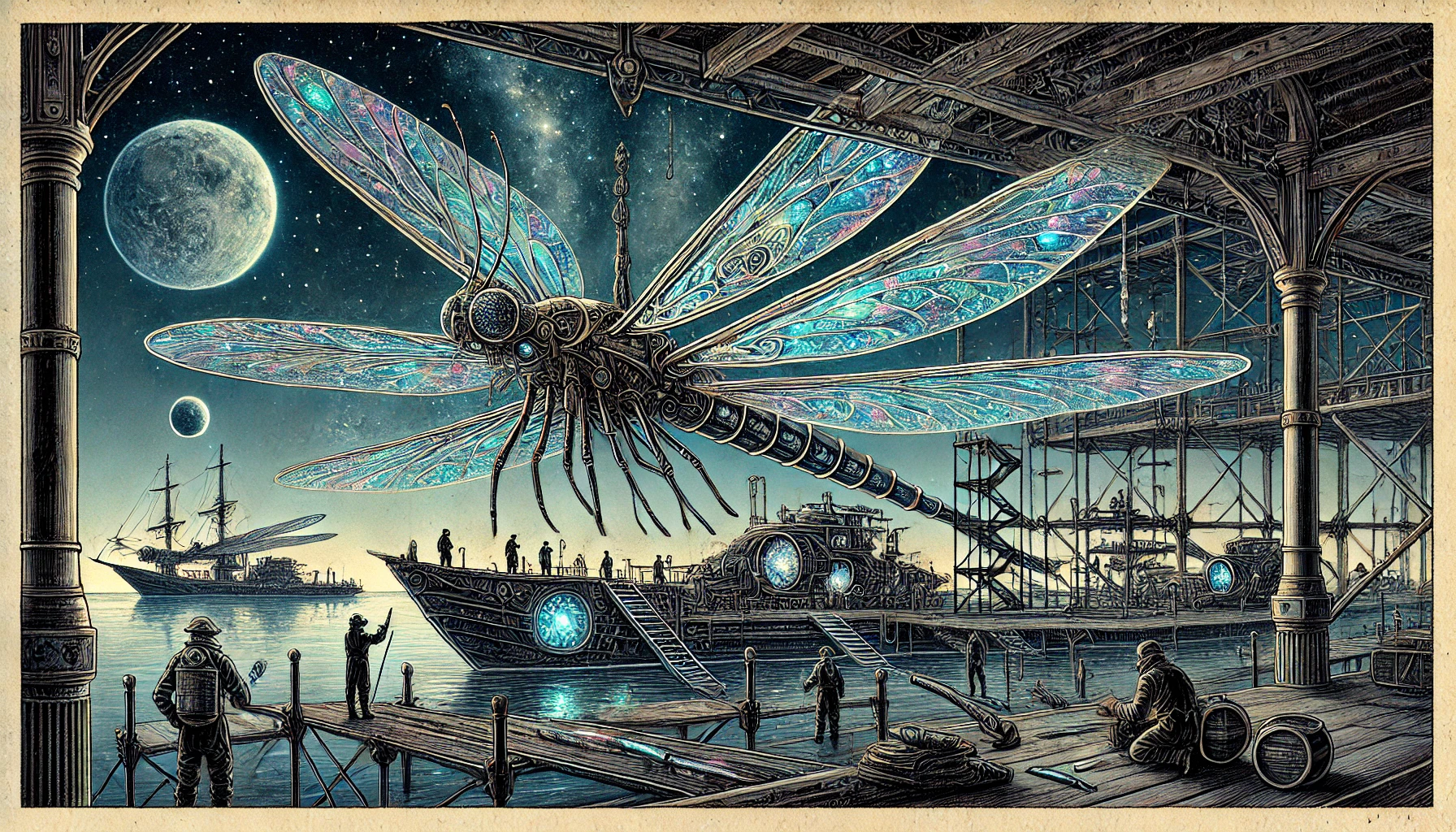
 Spelljammers docked up in a port on a water-based world.
Helms Hulls
Hull Statistics Block
Size: The size of the vehicle, using the same size categories as for creatures. The dimensions are given in parenthesis (length x width x height)
Tonnage (T): A ship's size is further defined in tonnage—the amount of displacement the ship takes up. Since this displacement also influences the amount of breathable air surrounding the ship in space, a ship's tonnage is also a reflection of both its crew capacity and requirements. One ton is not a measure of weight; instead, it is arbitrarily set to equal 100 cubic yards (2,700 cubic feet, a cube approximately 14 ft on a side).
A ship's air envelope carries enough air for a medium sized creature to breath for 6 months per ton.
Skill: Which skill governs control checks, followed by a circumstance bonus or penalty based on the overall quality of the ship.
Speed & Maneuverability Class: The vehicle’s maximum speed in a single move. Ships generally take a double move. They can also move at any slower speed unless noted otherwise. The vehicle’s maneuverability is noted in parentheses.
Maneuverability class refers to the tactical maneuverability of the craft. This is a factor of sails, oars, fins, and other controlling devices over and above those provided by the ship's rating. In general, the hull design of a ship determines its MC, with the quickest being the graceful ships of the elves and the most sluggish being sea vessels that have been converted into spacecraft. A ship can be powered by a low-level mage and, therefore, have a low ship's rating, but a high maneuverability class can still allow it to function well in tactical combat.
Ship maneuverability classes are rated similar to flying creatures, with Perfect being the most maneuverable. A Poor rating for a ship indicates that it is below minimum maneuverable standards. Such ships are usually converted seacrafts modified for space travel and are outclassed by all craft built especially for space. This rating is displayed in parenthesis after the speed.
Hull Points (HP): Like creatures with hit points, spelljammers have hull points. When a hull is reduced to 0 HP, it breaks apart.
Armor Class (AC): Just like creatures, a hull's armor class determines how difficult it is to hit with an attack. This is determined by combining the hull's natural armor, size bonus, and the bonus granted by its MC. Just as a creature loses its dexterity bonus when flat-footed, a hull loses its MC bonus when caught unawares.
Material: The material that most of a ship is made of. This determines the saving bonus and hardness of the hull. When a spell/power or other effect causes a Spelljammer to make a saving throw, its bonus is calculated by referencing the table (see below) for its save progression and using the HD of the hull (found in its stat block) to determine the base saving throw of the Spelljammer.
Rigging (Rig): The hp, hardness, and AC of the ship's sails, masts, and control lines. If a ship lacks rigging, this statistic is omitted. For dirigibles, the rigging statistic represents the durability of the balloon.
Ram: The damage dealt by the vehicle if it rams another object at maximum speed (see Combat & Movement).
Face: The size of the vehicle, given as length by width.
Height: The vehicle’s height, not including rigging, measured from the ground to the roof (for a land or air vehicle) or the waterline to the deck (for a water vehicle). Sailing ships also have a draft depth given in parentheses, which represents the minimum depth of water they need to avoid running aground
Mount: Mounting varies from ship to ship. In a typical ship description, the standard amount of mounting points is provided. Additional mounting points may be added, though this cuts down on cargo space (the room that would normally be used for cargo is instead used to provide space for large weapons and ammunition). The initial mounting number reflects the number of armaments that can be built directly into the ship—further additions can be made with each weapon eating up one ton of cargo space. Additional armament cannot exceed half the ship's total tonnage. This limitation allows room for the crew's needs and provides enough breathable air for long voyages.
Special Qualities(SQ): Any special qualities, such as resistances.
Crew: Each ship has two crew numbers. The first is the number of individuals needed to run the ship under normal circumstances. The second is the number of individuals that the ship can carry without dangerously overloading its atmospheric envelope. For example, a ship with a crew rating of 10/35 requires 10 men to run the ship properly but can carry up to 35 without endangering its atmosphere.
When talking about maximum crew numbers and the air requirements of various races, medium-sized races are assumed. Tiny and small individuals require only half as much air, while large and huge creatures need twice as much. Gargantuan creatures need five times the normal amount (though these creatures are large enough to maintain their own gravity plane and atmospheric envelope).
Cargo: This is the amount of (nonliving or nonbreathing) cargo the ship can contain. The capacity of the vehicle’s hold is measured in cubic feet A typical ship can hold half of its tonnage in cargo.
The remaining interior space is needed for crew, armament, and other necessities. For each large weapon (2 light weapons count as 1 large weapon) added to a ship over and above its standard ordnance, one ton is subtracted from the total amount available for cargo (the weapons and their ammunition occupy that space).
Power Type: This defines the type of helm, engine, or other motive force that causes the ship to go through space. Most helms gather and concentrate magical or other mystical energy and convert it into motive force. In other words, the ships run on magic or psionics. Different power types have different limitations and capabilities. A ship with no power is adrift, unable to control its motion. A ship can have multiple power sources. The one "online" is the primary power source, while the others (including any spells) are backups.
Landing: This entry indicates whether the ship can withstand landing on land or water, respectively. Several ships never land, and their crews reach the ground by shuttles, magic, or other means.
Cost: The vehicle’s cost, in gold pieces.
| Material | Fort | Ref | Will | Acid | Crushing Blow ³ | Disintegration | Fall | Magical Fire | Normal Fire ⁴ | Cold | Electricity |
|---|---|---|---|---|---|---|---|---|---|---|---|
| Bone | Poor | Poor | — ¹ | −1 | −6 | −9 | +4 | +1 | +7 | +2 | +2 |
| Cloth | Poor | Good | — ¹ | −2 | +0 | −9 | −6 | +1 | +7 | +2 | −8 |
| Glass | Poor | Poor | — ¹ | +5 | −10 | −4 | +3 | +6 | +4 | +4 | +4 |
| Leather | Poor | Good | — ¹ | +0 | +7 | −9 | +3 | +3 | +6 | +4 | −6 |
| Metal ² | Good | Poor | — ¹ | −3 | −7 | −7 | +7 | +1 | +5 | +4 | +4 |
| Ceramics | Poor | Good | — ¹ | +6 | +6 | −8 | +8 | +2 | +5 | +2 | +3 |
| Crystal | Good | Poor | — ¹ | +7 | +3 | −8 | +7 | +7 | +8 | +2 | −4 |
| Stone | Good | Poor | — ¹ | −7 | −8 | +2 | +8 | +7 | +8 | −4 | +8 |
| Rope | Poor | Good | — ¹ | −2 | +8 | −9 | +0 | −8 | −6 | +4 | +4 |
| Wood, thick | Good | Good | — ¹ | +2 | +2 | +0 | +4 | −4 | −2 | +4 | +4 |
| Wood, thin | Good | Good | — ¹ | +1 | −3 | −9 | −1 | −6 | −4 | +0 | +8 |
Columns Fort / Ref / Will are Base Saving Throw; the rest are Bonus. ¹ Objects are unaffected by spells or effects that require a Will saving throw. Item Saving Throws | |||||||||||
Outfitting
Most ships of space were captured, refitted, or inherited by their present owners. Large communities in space tend to build their own distinctive ships, which in turn are copied, stolen, or bought by others in space, accounting for both the wide variety found throughout the space lanes as well as the existence of a good group of "typical" ships.
The following section discusses the various types of hulls, power sources and armaments. Prices are given, but the general rule is "what the market will bear" (which often translates into "how much have you got?").
All ships and ship equipment are rare in space; there are a few "used spaceship shops" in the known spheres, but they are few and far between, and seldom do they have more than one or two ships available. Often, initial adventurers hire on for some trading cartel or as emissaries for some powerful wizard or enterprising faith, and take the ship in trade of some heroic deeds. Such ships are usually bottom of the line, little more than tubs, but can be converted into suitable adventuring vehicles with sufficient time and gold.
In general, there is a 10% chance that an item listed here is available at any large space civilization. There is an additional 20% chance that there is a rumor that the needed item can be found somewhere else in the system (either as treasure or part of a hulk or belonging to someone else). This 20% chance increases by 5 for every week spent in one location, so that an individual looking for a major helm on Cooper's Rock has a 30% chance of coming up with a lead on it in three weeks' time. The nature and details of such items are left to the DM.
The Ship Itself
There is a wide variety of ship hulls, ranging from converted ocean-going ships to the spaceborne beholder tyrant ships to the organically grown ships of the elves.
The types listed here are the most common ships in use. There are others, including those that DMs themselves come up with. Also listed here are the various groundling ships that are sometimes converted and taken into space. First-time adventurers normally use them, as their poor armor ratings and hard handling make them undesirable to more experienced voyagers. Note that there is a difference between "tons" when describing the displacement of an ocean-going ship and tonnage in game terms, where a spacial ton equals 100 yd^3 (2,700 ft^3) of atmosphere.
Costs of ships are given on the gold piece standard found throughout most of space. Some regions use other means of counting money, but these can be converted to the gold standard (for example, Krynn bases its monetary system on steel, not gold, and a character looking for supplies in Ansalon will have to negotiate in steel pieces at their listed conversion rate).
Listings for crew and mointing points indicate the capability to support these men and weapons. They are not included in the purchase price of the hull.
Crew listings are also less than those listed in other sources. This is because the spelljamming helm frees up a lot of manpower otherwise needed (such as sailors and rowers). If a converted groundling ship is returned to the ground, it will need its full crew to function normally.
The landing entry indicates whether the ship can stand up to a landing on water or on the ground. Several ships never land, and their crews reach the ground by shuttles, magic, or other methods.
Ship Names
There are as many names for the various ships as there are races and inhabited worlds. Each culture brings its own names into space, and a ship that qualifies to one group as a “free frigate” because of its size and purpose might be to another a “system rock” since it lacks a spelljamming helm or other inboard motive power.
Names by Size:
- Boat: less than 10 tons and unarmed; a derogatory term versus any actual ship
- Fighter: less than 10 tons and armed. Elven fighters are often called flitters
- Galley/Cog: 10–20 tons, taken from their earthbound analogies but ignoring the differences in the ship types. Also called a sloop
- Schooner: 20–30 tons
- Frigate: 30–40 tons. In trading ships, also called a skipjack
- Corvette: 40–50 tons, also called a barkentine
- Ship of the Line: 50+ tons. If primarily cargo, it is also referred to as a clipper. If primarily a warship, it is also called a man-of-war.
- Dreadnaught: rare ships of 100+ tons.
- Rock: a ship lacking a spelljamming helm. Used generally in reference to dwarven ships.
Further, a ship may be referred to by appearance and ownership. Dwarven ships are regarded as rocks primarily for their appearance, though any ship adrift is considered a Rock. A ship used primarily by a single race is referred to by that in general descriptions of the ship types (such as a mind flayer nautiloid, or a beholder tyrant-ship). Ships that owe allegiance to no particular race or nation are referred to as “Free.” A free trader out of Krynnspace owes no allegiance beyond its own ship and crew, while a Krynnish trader can be counted on to act in the best interest of its home sphere, and eventually to return there. If a ship is confined to a particular crystal shell, whether by choice or not, it is referred to as a system ship.
Finally, a ship that resembles little more than a terrestrial galley or galleon hopped up with a spelljammer helm and taken into space is called a groundling craft. Groundling is a general term used in space to refer to the Earth-bound nations and their peoples. It is not derogatory per se, but is often used by those seeking to embarrass a newcomer to the various parts of wildspace.
Hull Types
Barge
- Size Colossal Vehicle
- Keel, Beam 100 ft, 40 ft
- Beam 40 ft
- Tonnage 30
- Speed & MC 100 ft (Poor)
- Skill Pilot Helm -6
- HP 8d10+160 (204 hp), Hardness 5
- AC 3 (Natural 3, Size -8, MC -2)
- Material Thick Wood
- Ram 6d6
- Mounting 2 light, 2 heavy
- Crew 20 / 30
- Cargo 42000 ft^3
- Landing Yes / Yes
- Cost 6000 gp A barge is a groundling vehicle that is not much more than a large, flat-bottomed hull designed to haul heavy cargoes. Most barges are intended to be towed by other ships, but some are fitted out as royal yachts or war barges. Barges of this sort might have large deckhouses or weapon mounts.
Caravel
- Size Colossal Vehicle
- Keel, Beam 60 ft, 20 ft
- Tonnage 9
- Speed & MC 100 ft (Poor)
- Skill Pilot Helm +2
- HP 24d10+480 (612 hp), Hardness 5
- AC 3 (Natural 3, Size -8, MC -2)
- Material Thick Wood
- Rigging 80 (hardness 0)
- Ram 4d6
- Mounting 2 light, 1 heavy
- Crew 6 / 9
- Cargo 12600 ft^3
- Landing No / Yes
- Cost 10000 gp A groundling ship of late medieval design. A versatile cargo carrier.
Cog
- Size Colossal Vehicle
- Keel, Beam 40 ft, 20 ft
- Tonnage 6
- Speed & MC 100 ft (Poor)
- Skill Pilot Helm -2
- HP 16d10+320 (408 hp), Hardness 5
- AC 3 (Natural 3, Size -8, MC -2)
- Material Thick Wood
- Rigging 60 (hardness 0), AC 1
- Ram 4d6
- Mounting 1 light, 1 heavy
- Crew 4 / 6
- Cargo 8400 ft^3
- Landing No / Yes
- Cost 6000 gp A groundling ocean trader, popular with merchants.
Coracle
- Size Medium Vehicle
- Keel, Beam 5 ft, 5 ft
- Tonnage 1
- Speed & MC 100 ft (Good)
- Skill Pilot Helm +0
- HP 2d10+10 (11 hp)
- AC 13 (Natural 5, Size 0, MC -2)
- Material Rope
- Crew 1 / 1
- Cargo 100 lbs
- Landing Yes / Yes
- Cost 5 gp A small and very simple groundling vessel, the coracle is made from a light wicker or branch frame, over which waterproofed hide or bark is stretched. A coracle weighs only 40 lbs, and can easily be carried for short distances.
Dhow
- Size Colossal Vehicle
- Keel, Beam 60 ft, 20 ft
- Tonnage 4
- Speed & MC 100 ft (Poor)
- Skill Pilot Helm +0
- HP 18d10+360 (459 hp), Hardness 5
- AC 3 (Natural 3, Size -8, MC -2)
- Material Thick Wood
- Rigging 60 (Hardness 0)
- Ram 4d6
- Mounting 1 light, 1 heavy
- Crew 3 / 4
- Cargo 5600 ft^3
- Landing No / Yes
- Cost 7000 gp The dhow is a moderately sized groundling vessel with a single mast and a full deck. It might have a small sterncastle or deckhouse at the stern. Many dhows are made of sewed or stitched hulls—the hull planks are sewed to one another with sturdy cord.
Dromond
- Size Colossal Vehicle
- Keel, Beam 100 ft, 2 ft
- Tonnage 22
- Speed & MC 100 ft (Average)
- Skill Pilot Helm +2
- HP 60d10+1200 (1530 hp), Hardness 5
- AC 3 (Natural 3, Size -8, MC -2)
- Rigging 80 (Hardness 0)
- Ram 4d6
- Mounting 4 light, 2 heavy, ram
- Crew 15 / 22
- Cargo 30800 ft^3
- Landing No / Yes
- Cost 25000 gp A Byzantine ship—its cost and size make it a relatively good choice for initial star voyagers.
Dugout
- Size Large Vehicle
- Keel, Beam 10 ft, 5 ft
- Tonnage 1
- Speed & MC 100 ft (Poor)
- Skill Pilot Helm +1
- HP 4d10+20 (42 hp), Hardness 5
- AC 10 (Natural 3, Size -1, MC -2)
- Ram 1d6
- Crew 1 / 1
- Cargo 0
- Landing Yes / Yes
- Cost 20 gp The dugout is the simplest groundling vehicle possible—a hollowed-out log hacked into the shape of a boat.
Elven Wingship
- Size Colossal Vehicle
- Keel, Beam 60 ft, 10 ft
- Tonnage 4
- Speed & MC 100 ft (Average)
- Skill Pilot Helm +4
- HP 12d10+240 (306 hp), Hardness 6
- AC 5 (Natural 3, Size -8, MC 0)
- Rigging 80 (Hardness 0)
- Ram 4d6
- Mounting 2 light, 1 heavy
- Crew 3 / 4
- Cargo 5600 ft^3
- Landing No / Yes
- Cost 40000 gp So named because of its great, sweeping sails that seem more like a bird’s wings than a ship’s rigging, the elf wingship is the fastest ship on the sea. Despite its graceful lines and delicate appearance, the wingship is actually quite sturdily built and deadly in a naval battle. Elves rarely (if ever) sell wingships to non-elves.
Galleon
- Size Colossal Vehicle
- Keel, Beam 130 ft, 30 ft
- Tonnage 43
- Speed & MC 100 ft (Average)
- Skill Pilot Helm +0
- HP 80d10+1600 (2040 hp), Hardness 5
- AC 5 (Natural 3, Size -8, MC 0)
- Material Thick Wood
- Rigging 60 (Hardness 0)
- Ram 6d6
- Mounting 6 light, 3 heavy, ram
- Crew 29 / 43
- Cargo 60200 ft^3
- Landing No / Yes
- Cost 50000 gp One of the most advanced sailing vessels of its era, found only on a handful of worlds. Best of the groundling vessels for the leap into space, and those earthbound nations that recognize space traveling tend to use such ships.
Galley
- Size Colossal Vehicle
- Keel, Beam 130 ft, 20 ft
- Tonnage 29
- Speed & MC 100 ft (Average)
- Skill Pilot Helm -2
- HP 78d10+1560 (1989 hp), Hardness 5
- AC 5 (Natural 3, Size -8, MC 0)
- Material Thick Wood
- Rigging 60 (Hardness 0)
- Ram 6d6
- Mounting 6 light, 3 heavy, ram
- Crew 19 / 29
- Cargo 40600 ft^3
- Landing No / Yes
- Cost 30000 gp Also known as the quinquireme, or great galley, this is the largest groundling vessel normally built. Great galleys are usually warships, vessels whose primary purpose is service in a fleet. Often experimental wizards take an entire galley sailing team into space in initial experiments. This leads to no later experiments, since the crew quickly exhausts the air and dies.
Greatship
- Size Colossal Vehicle
- Keel, Beam 100 ft, 40 ft
- Tonnage 89
- Speed & MC 100 ft (Poor)
- Skill Pilot Helm -4
- HP 240d10+4800 (6120 hp), Hardness 5
- AC 3 (Natural 3, Size -8, MC -2)
- Material Thick Wood
- Rigging 80 (Hardness 0)
- Ram 6d6
- Mounting 12 light, 4 heavy
- Crew 59 / 89
- Cargo 124600 ft^3
- Landing No / Yes
- Cost 60000 gp Fitted with a towering forecastle and sterncastle, this huge, broad-beamed sailing ship is almost a seagoing castle. It has four masts and is not remotely nimble, but it is large and sturdy and can carry hundreds of sailors and soldiers. It has multiple decks, and the mainmast often has one or more fighting tops, small platforms suitable for archers to fire down at other ships.
Greatships are sometimes called carracks.
Ironclad
- Size Colossal Vehicle
- Keel, Beam 80 ft, 30 ft
- Tonnage 27
- Speed & MC 100 ft (Poor)
- Skill Pilot Helm -4
- HP 72d10+1440 (1836 hp), Hardness 10
- AC 3 (Natural 3, Size -8, MC -2)
- Material Thick Wood
- Rigging 60 (Hardness 0)
- Ram 6d6
- Mounting 8 light, 2 heavy, ram
- Crew 18 / 27
- Cargo 37800 ft^3
- Landing No / Yes
- Cost 50000 gp Protected from enemy fire by solid iron plate, the ironclad is slow and clumsy but deadly in a naval battle. The ironclad is built on a frame of thick wooden timbers, just like most other vessels; armor is then riveted or bolted onto its sides. Most ironclads are built by groundling dwarves who turn their remarkable knack for metallurgy and engineering to the construction of these warships
Junk
- Size Colossal Vehicle
- Keel, Beam 80 ft, 20 ft
- Tonnage 12
- Speed & MC 100 ft (Poor)
- Skill Pilot Helm +0
- HP 32d10+640 (816 hp), Hardness 5
- AC 3 (Natural 3, Size -8, MC -2)
- Material Thick Wood
- Rigging 80 (Hardness 0)
- Ram 4d6
- Mounting 2 light, 2 heavy
- Crew 8 / 12
- Cargo 16800 ft^3
- Landing Yes / Yes
- Cost 15000 gp A junk is a large groundling ship often found in oriental societies. It has a flat bottom, no keel, and a high stern, with two masts and a sail reinforced with bamboo ribs. The junk’s hull is partitioned into a number of small, watertight compartments, which makes it unusually seaworthy.
Launch
- Size Large Vehicle
- Keel, Beam 15 ft, 5 ft
- Tonnage 1
- Speed & MC 100 ft (Poor)
- Skill Pilot Helm +2
- HP 5d10+25 (52 hp), Hardness 5
- AC 10 (Natural 3, Size -1, MC -2)
- Material Thick Wood
- Ram 2d6
- Crew 1 / 1
- Cargo 0
- Landing Yes / Yes
- Cost 500 gp Also known as a whaleboat, the launch is a large, open groundling dinghy with a stout, round-bottomed hull that can stand up to surprisingly rough seas. Launches are often carried by larger ships for use in landing in places where the larger ship can’t go.
Longship
- Size Colossal Vehicle
- Keel, Beam 70 ft, 20 ft
- Tonnage 5
- Speed & MC 100 ft (Poor)
- Skill Pilot Helm +0
- HP 14d10+280 (357 hp), Hardness 5
- AC 3 (Natural 3, Size -8, MC -2)
- Material Thick Wood
- Rigging 60 (Hardness 0)
- Ram 4d6
- Mounting 2 light
- Crew 3 / 5
- Cargo 7000 ft^3
- Landing No / Yes
- Cost 10000 gp An ideal carrier for small numbers of adventurers in space, but as with the galleys, taking a full sailing crew beyond the atmosphere of the planet will result in the air quickly becoming fouled and the voyage ending. It does not have a deck, although some longships are built with small walks or platforms at the stern and bow
Pinnace
- Size Gargantuan Vehicle
- Keel, Beam 30 ft, 10 ft
- Tonnage 2
- Speed & MC 100 ft (Poor)
- Skill Pilot Helm +2
- HP 4d10+60 (82 hp), Hardness 5
- AC 7 (Natural 3, Size -4, MC -2)
- Material Thick Wood
- Rigging 60 (Hardness 0)
- Ram 3d6
- Mounting 2 light
- Crew 1 / 2
- Cargo 2800 ft^3
- Landing No / Yes
- Cost 4500 gp The pinnace is a small, two-masted sailing vessel. It’s sturdy enough to undertake long open-water voyages and handy enough to use close to shore. A pinnace is fully decked, but its sterncastle is hardly worthy of the name; it’s little more than a cramped cabin
Rowboat
- Size Large Vehicle
- Keel, Beam 2 ft, 5 ft
- Tonnage 1
- Speed & MC 100 ft (Poor)
- Skill Pilot Helm +0
- HP 6d10+30 (63 hp), Hardness 5
- AC 11 (Natural 4, Size -1, MC -2)
- Material Thick Wood
- Ram 1d6
- Crew 1 / 1
- Cargo 0
- Landing No / Yes
- Cost 50 gp Also called a skiff, punt, or pirogue, this is a flat-bottomed groundling boat for use in calm waters. Larger spelljamming ships usually keep a few around for docking or boarding if their shape or size woukd otherwise prevent them from doing so.
Theurgeme
- Size Colossal Vehicle
- Keel, Beam 70 ft, 20 ft
- Tonnage 10
- Speed & MC 100 ft (Poor)
- Skill Pilot Helm +2
- HP 28d10+560 (714 hp), Hardness 5
- AC 3 (Natural 3, Size -8, MC -2)
- Material Thick Wood
- Ram 4d6
- Mounting 4 light, 2 heavy, 1 ram
- Crew 7 / 10
- Cargo 14000 ft^3
- Landing No / Yes
- Cost 80000 gp The theurgeme is a groundling vessel powered by magic. Without sails or rowers it moves swiftly and tirelessly across the water. Theurgemes can be powered in a variety of ways, but the most common design is a simple paddlewheel or set of mechanical oars turned or driven by a magical construct, mindless undead, or even a bound elemental. Many theurgemes are luxuriously appointed with comfortable cabins and exotic décor, as befits the wealthy wizards who most likely own such vessels.
Mind Flayer Nautiloid
- Size Colossal Vehicle
- Keel, Beam 180 ft, 30 ft
- Tonnage 35
- Speed & MC 100 ft (Average)
- Skill Pilot Helm +0
- HP 64d10+1280 (1632 hp)
- AC 8 (Natural 6, Size -8, MC 0)
- Material Thick Wood
- Ram 6d6
- Mounting 5 heavy
- Crew 10 / 35
- Cargo 49000 ft^3
- Landing No / Yes
- Cost 40000 gp Embodiment of several illithid ideals, including staying out of the sun and striking hard and fast from armored safety. Found throughout the Known Spheres of wildspace, though there are many spacefaring nations that will attack a mind flayer ship on sight and worry about details (like who really owns it) later.
Squid Ship
- Size Colossal Vehicle
- Keel, Beam 25 ft, 25 ft
- Tonnage 45
- Speed & MC 100 ft (Average)
- Skill Pilot Helm +0
- HP 6d10+120 (153 hp)
- AC 7 (Natural 5, Size -8, MC 0)
- Material Thick Wood
- Ram 8d6
- Mounting 3 heavy
- Crew 12 / 45
- Cargo 63000 ft^3
- Landing No / Yes
- Cost 45000 gp A common ship among pirates, traders, and other spacefarers. Its effective length is increased by the 50-foot-long triple spears at the front.
Hammership
- Size Colossal Vehicle
- Keel, Beam 250 ft, 25 ft
- Tonnage 60
- Speed & MC 100 ft (Average)
- Skill Pilot Helm +0
- HP 173d10+3460 (4411 hp)
- AC 6 (Natural 4, Size -8, MC 0)
- Material Thick Wood
- Ram 6d6
- Mounting 3 heavy
- Crew 24 / 60
- Cargo 84000 ft^3
- Landing No / Yes
- Cost 50000 gp Another common spacefaring ship used both by traders and those who prey on them. Uses a blunt ram at the front, so that its ram is included in total keel length of the ship.
Dragonfly
- Size Colossal Vehicle
- Keel, Beam 100 ft, 20 ft
- Tonnage 10
- Speed & MC 100 ft (Good)
- Skill Pilot Helm +0
- HP 20d10+400 (510 hp)
- AC 4 (Natural 2, Size -8, MC +1)
- Material Thin Wood
- Mounting 1 heavy
- Crew 3 / 10
- Cargo 14000 ft^3
- Landing Yes / No
- Cost 40000 gp An excellent ship for small groups and for planetary exploration, the dragonfly is capable of touching down on most planets.
Damselfly
- Size Colossal Vehicle
- Keel, Beam 100 ft, 20 ft
- Tonnage 10
- Speed & MC 100 ft (Average)
- Skill Pilot Helm +0
- HP 20d10+400 (510 hp)
- AC 8 (Armor 4, Natural 2, Size -8, MC 0)
- Material Metal
- Mounting 1 heavy
- Crew 2 / 10
- Cargo 14000 ft^3
- Landing Yes / No
- Cost 50000 gp A version of the dragonfly hull so heavily modified as to qualify as its own separate hull type. The damselfly hull uses metal plates (and in some cases, ceramics, shells, or bones) to cover all external decks to create a battle-ready scout ship.
Mosquito
- Size Colossal Vehicle
- Keel, Beam 100 ft, 15 ft
- Tonnage 6
- Speed & MC 100 ft (Good)
- Skill Pilot Helm +0
- HP 19d10+380 (484 hp)
- AC 7 (Natural 5, Size -8, MC +1)
- Material Thin Wood
- Crew 1 / 6
- Cargo 8400 ft^3
- Landing Yes / Yes
- Cost 15000 gp Smaller than the dragonfly, and less expensive, this ship is not as good for long voyages, but is often employed as a scout ship in civilized space.
Wasp
- Size Colossal Vehicle
- Keel, Beam 80 ft, 20 ft
- Tonnage 18
- Speed & MC 100 ft (Average)
- Skill Pilot Helm +0
- HP 14d10+280 (357 hp)
- AC 6 (Natural 4, Size -8, MC 0)
- Material Thick Wood
- Mounting 1 heavy
- Crew 8 / 18
- Cargo 25200 ft^3
- Landing Yes / No
- Cost 20000 gp Designed along the lines of the dragonfly by the lizardmen tribes of space, this ship responds to the needs of that race with its pitched decks and wide passages. The ship has found common use among other races as well.
Neogi Deathspider
- Size Colossal Vehicle
- Keel, Beam 175 ft (not including arms), 50 ft
- Tonnage 100
- Speed & MC 100 ft (Average)
- Skill Pilot Helm +0
- HP 68d10+1360 (1734 hp)
- AC 7 (Natural 5, Size -8, MC 0)
- Material Crystal
- Mounting 6 heavy
- Crew 30 / 100
- Cargo 140000 ft^3
- Landing No / No
- Cost 75000 gp One of the largest ships in Known Space, the deathspiders are feared and hated wherever they appear. One can likely be had for the listed price, but the individuals buying it will be attacked on sight. The deathspider uses a grappling ram that allows it to trap its prey. It requires a major helm to operate. Not recommended for new adventurers.
Dwarven Citadel
- Size Colossal Vehicle
- Keel, Beam 250 ft, 200 ft
- Tonnage 300
- Speed & MC 100 ft (Average)
- Skill Pilot Helm +0
- HP 144d10+2880 (3672 hp)
- AC 12 (Natural 10, Size -8, MC 0)
- Material Stone
- Mounting 10 heavy
- Crew 100 / 300
- Cargo 420000 ft^3
- Landing Yes / No
- Cost 100000 gp Dwarven ships are carved-out asteroids and flying mountains. Many are found adrift in space, abandoned by their people, and used as bases by other fell races. Like the deathspiders, citadels are too large to be moved by normal spelljamming means. The dwarves use a device known as the Forge (see Power Type) for motive power.
Beholder Tyrant Ship
- Size Colossal Vehicle
- Keel, Beam 100 ft, 100 ft
- Tonnage 23
- Speed & MC 100 ft (Good)
- Skill Pilot Helm +0
- HP 28d10+560 (714 hp)
- AC 12 (Natural 10, Size -8, MC +1)
- Material Stone
- Crew 15 / 23
- Cargo 32200 ft^3
- Landing No / No
- Cost 100000 gp Beholder tyrant ships are only used by the various beholder races, and serve as home for up to 40 such creatures at a time. They are shaped like walnuts and have their own form of spelljamming power, using the beholders within. While an individual may be a guest (or prisoner) on a tyrant ship, it is unlikely anyone other than a beholder would want such a hull.
Oriental Dragonship
- Size Colossal Vehicle
- Keel, Beam 250 ft, 25 ft
- Tonnage 45
- Speed & MC 100 ft (Average)
- Skill Pilot Helm +0
- HP 138d10+2760 (3519 hp)
- AC 7 (Natural 5, Size -8, MC 0)
- Material Thick Wood
- Mounting 3 heavy
- Crew 20 / 45
- Cargo 63000 ft^3
- Landing Yes / No
- Cost 60000 gp A common ship among individuals from Kara-Tur and other oriental lands. A cross between a dhow and a dragon, it is used by ground-based nations of that region that seek to go into space.
Elven Man-o-War
- Size Colossal Vehicle
- Keel, Beam 200 ft, 20 ft
- Tonnage 60
- Speed & MC 100 ft (Good)
- Skill Pilot Helm +0
- HP 111d10+2220 (2830 hp)
- AC 5 (Natural 3, Size -8, MC +1)
- Material Ceramic
- Mounting 4 heavy
- Crew 10 / 60
- Cargo 84000 ft^3
- Landing No / No
- Cost 100000 gp The oddly curved, graceful ships of the elves are grown and twisted into their shapes, much like bonsai trees. As a result, their plane of gravity is not linear; each ship is a large, delicately fluted vessel with a lot of potential firepower. The crystalline wings of the elven ship reach 300 ft from tip to tip, brushing the edge of its own atmospheric envelope.
Elven Flitter
- Size Colossal Vehicle
- Keel, Beam 100 ft, 20 ft
- Tonnage 1
- Speed & MC 100 ft (Good)
- Skill Pilot Helm +0
- HP 26d10+520 (663 hp)
- AC 4 (Natural 2, Size -8, MC +1)
- Material Thick Wood
- Mounting 3 heavy
- Crew 1 / 1
- Cargo 1400 ft^3
- Landing No / Yes
- Cost 10000 gp At the opposite end of the scale for elven ships, the 1-ton flitter is among the smallest of the ships of wildspace. Though it can be equipped with a spelljammer helm, these ships are more often carried on larger ships and let loose when the large elvish ship enters the atmospheric envelope of another ship. The flitters then glide and board the other ship.
Tradesman (fish ship)
- Size Colossal Vehicle
- Keel, Beam 120 ft, 30 ft
- Tonnage 25
- Speed & MC 100 ft (Average)
- Skill Pilot Helm +0
- HP 62d10+1240 (1581 hp)
- AC 7 (Natural 5, Size -8, MC 0)
- Material Thick Wood
- Mounting 2 heavy
- Crew 10 / 25
- Cargo 35000 ft^3
- Landing No / No
- Cost 15000 gp The workhorse of space, this ship is found in every sphere that has a healthy trading and raiding society.
Gnomish Sidewheeler
- Size Colossal Vehicle
- Keel, Beam 120 ft, 25 ft
- Tonnage 30
- Speed & MC 100 ft (Average)
- Skill Pilot Helm +0
- HP 60d10+1200 (1530 hp)
- AC 5 (Natural 3, Size -8, MC 0)
- Material Metal
- Crew 20 / 30 (double that in gnomes)
- Cargo 42000 ft^3
- Landing 50% likely / 50% likely
- Cost 40000 gp The stats presented here are for a typical sidewheeler. Which is itself an oxymoron as sidewheelers are the epitome of atypical.
Also known as "the ship of the desperate," the gnomish sidewheeler represents the pinnacle of gnomish technology. Most intelligent creatures avoid these vessels like the plague. They operate with all manner of gizmos and devices. Price does not include gnomes needed to run things, or the giant hamsters that power the side wheels and wind the giant rubber band.
Power Sources
The chief method of moving through space is through spelljamming—converting magical energy into motive force. This section deals with the required equipment: spelljamming helms.
Spelljamming helms are the easiest way to get a ship moving, but not the only one. The dwarves use their forges to propel their great stone citadels, while the beholders use a mutated version of their own species, called an orbus, to provide the power. The mind flayers, who have psi-like ability but do not manifest true powers, use series helms to maintain their power. All of these are described below.
Most helms and other magical "engines" have a limitation on how large or how small a mass they can move. This, in turn, sets the limit on the size of most space vessels. There are large citadels carved out of asteroids, but these are not mobile in the same sense as a hammership. They only drift, with occasional (and expensive) midcourse corrections.
Helms can be acquired through a number of means, the most usual being discovery in old ruins or raiding an enemy ship for its helm. They may be researched and built by high-level artificers at great expense in both gold and time. Or they may be purchased from the Mercane, a group of outsider traders who do business in helms and other magical equipment.
No one knows the Mercane's home world, nor have ships of the Mercane ever been spotted. They seem to exist to sell. The prices listed in this book reflect the purchase price from the Mercane. The chance of a Mercane being found in a large space civilization is about those for finding any other piece of necessary equipment.
Spelljammer Helms
Cost:
100,000 gp (minor helm)
250,000 gp (major helm)
Each minor and major spelljamming helm allows the individual seated upon it to move a large mass through space by means of channeling spell energy directly into a motive force. This energy is somewhat useful for maneuvering the ship, but primarily it provides the push that makes the ship move forward (or backward). Maneuvering comes primarily from the ship's sails and oars.
The power of the force is known as the ship's rating. A minor helm converts such energy at a rate of 1 point of SR for each three levels of experience. A major helm converts at a rate of 1 SR for every two levels of experience.
At low levels, the difference between using a minor and major helm is small. A third-level mage will give his ship an SR of 1, regardless of whether a minor or major helm is used. The higher level the mage, however, the more important the difference between using major and minor helms. A tenth-level wizard, for example, can give his ship an SR of 5 with a major helm, but only an SR of 3 with a minor helm.
Using a helm prohibits any spell use by that character within that 24-hour period. As soon as a wizard or priest sits on the helm and becomes aware of the ship, he can cast no spells of any sort until he has had a chance to rest and regain spells. In effect, the helm "drains" the helmsman of all his spells the moment it is activated.
An individual can use either type of helm for 12 hours without tiring. For each hour afterward, the SR drops by 1, to a minimum of 1. After 24 hours, the individual using the helm will pass out and not be able to use the helm again until fully rested.
An individual seated upon a helm can talk and act normally. The sensation of using the helm is akin to being immersed in warm water. As a result of the magical nature of the helm, the spelljamming mage or cleric using the helm can see things around the ship as if he were standing on the deck. The ship becomes an extension of his body and responds to his demands in movement and maneuverability. The maneuverability of a craft is a reflection of both the spelljamming mage's ability and the maneuverability class of the ship.
A minor helm can move a ship of up to 50 tons. A major helm can move one of up to 100 tons. In reality, most ship designers keep their craft under the 50-ton range, though there are large men-o-war and juggernauts that are larger than 50 tons.
Only one helm may be in service at a time, though often a minor helm is kept as a backup, should something happen to the major helm. Helms draw their magical energies directly from the user, and the speeds they can attain are determined by the level (or HD) of the individual. All helm-equipped ships travel at the same rate of speed over long distances, but their differences are apparent at the tactical level. In general, given two similar helms, a ship with the more powerful spelljamming mage or priest is the faster ship.
Helms can be easily installed in any ship, primarily by lugging them aboard and bolting them to the deck. The minimum hull size required for a helm is 1 ton. If an individual is slain while using the helm, the ship loses all power until a new pilot takes command. The ship will drift in a straight line until someone else takes the helm or the ship hits something.
Major and minor helms are nearly (but not completely) indestructible. Unfortunately, this protection does not extend to the individual seated in the helm. Diligent and crafty characters may find ways to destroy helms, but the process is not easy or quick.
Series Helms
Cost: 75,000 gp (per linked helm)
Series helms are the invention of the illithids (mind flayers), but the idea has been adapted for a number of races with spell-like abilities and no levels of experience. Series helms look like the gamut of major and minor helms, running from simple-looking to ornate, but unlike the spelljamming helms, the series helms can be linked together, one to another, to increase their power.
For each helm in a series manned by a mind flayer (or whatever creature the helm is designed for), the ship has an SR of 1. If there are three mind flayers in a series, then the ship has an SR of 3. In general, mind flayer ships will have between two and five series helms, though they may not all be occupied. Empty helms in a series are ignored in figuring SR.
If a mind flayer in a series helm is slain, then the series is broken for one round, and the ship loses all power and movement. Further, all mind flayers in the series must save against magic or be slain as well.
Series helms vary from species to species, but in general are inferior to spelljammer helms, at best able to move 50 tons, on par with a minor spelljammer helm. Their lower limitation is a 5-ton ship; they cannot move items smaller than that.
Series helms save against all damage on a 3; they are not quite as tough as spelljammer helms, but almost. Spelljammer helms cannot work on the same ship with operating series helms and vice versa, but a spelljammer helm can be installed on a ship that previously used a series helm without problem (as long as the two do not co-exist on the same ship. If they do, neither functions at all).
Series helms were developed either by the illithids or by the Mercane with the illithids in mind (accounts vary according to the situation). There are other series helms for those social creatures with spell-like abilities, except for the beholders, who have found their own solution.
Pool Helms
Cost: 500,000 gp (mind flayers only)
A recent development of the illithid collective mind, the pool helm uses the natural life-pool of the mind flayers to power the ships, as opposed to illithids themselves. Such ships have an automatic SR of 5 and are used primarily as transports for illithid Great Old Ones. The pool counts as two crew members. Several nautiloid ships have been equipped with pool helms, and there are rumors of larger mind flayer ships, as the pool allows larger ships to be powered. The current rumored maximum size of such a ship would be 200 tons, but this is hearsay and speculation.
Orbus
Cost: 300,000 gp (beholders only)
The orbus is a living being that functions much like a series helm on the beholder tyrant ships. For each living orbus (maximum of five for the typical tyrant ship), the ship has an SR of 1. The orbi are usually found near the center of a beholder ship, surrounding the Great Mother or Hiveleader of the ship. If an orbus is slain, the SR is diminished by 1, and if all orbi are lost, then the ship loses all power.
Orbi appear as blind beholders, with milky skin over all their eyes. They are pale and practically helpless on their own. They have been bred by the spacefaring beholder factions to serve and serve well—they have almost no will of their own.
A single orbus can create spelljamming energy for 20 tons of ship, two to a limit of 40 tons, and three or more to a limit of 60 tons. If insufficient orbi exist, then the SR of the ship is 1.
Given the simplicity of beholder ships, it seems possible that humanoid races could make use of the orbus as well, either as a primary or backup system. The beholders guard their orbi carefully, and would rather disintegrate them than see them turned over to other races. The above price is what an Mercane or beholder of another faction would pay for an orbus.
Forges
Cost: 500,000 gp (initially), 100,000 gp (per year)
Spelljamming dwarves typically have large asteroid ships greater than those used by humans, elves, or gnomes, powered by magical engines they call forges. These forges are huge foundry rooms at the base of the ship where dwarves work around the clock, building, carving, creating, and forging.
The basic idea of the forge is the same as the spelljammer helm: the conversion of energy into movement. In the dwarves' case, the energy is not magical as much as it is creative. By building items with the forges, the dwarves generate the energy necessary to literally move mountains across the sky.
A forge requires at least 200 cubic yards (2 tons) for every 50 dwarves involved. For every 100 dwarves at work, the ship has an SR of 1. The fastest dwarven ships, therefore, are the ones that give up the most space to their forges.
The minimum size of a dwarven ship is 100 tons, with a maximum size of 700 tons (though these are rare). Attempts to transplant forge-based technology into human ships have failed miserably. The best that can be accomplished is that humans can command a dwarven mountain-ship with a full crew of dwarves. Both mountain and hill dwarves can be found in space. Apparently, no other race produces this type of energy.
A side effect of this industry is a large amount of tradable goods, as the dwarves mine their own home to produce new energy and items. These range from small metal handicrafts and jewelry to swords, armor, and other weapons. A dwarven ship almost always has an incredibly well-stocked armory and is very well defended. For every month spent in space, the dwarves produce enough goods, metal, coins, and swords to bring in 10,000 gp at the next landfall.
A negative side effect is that dwarven ships often become "finished," with no new things to mine, chip, form, or shape. At this point, the colony abandons the mountainship and sets up home in a new asteroid, stripping the forge in the process. Such abandoned mountainships become the lairs of monsters.
Gnomish Helms
Cost: 50,000 gp
Gnomish helms should not function. That is, their very construction seems to defy the nature of thaumaturgic law. They are impossible. Of course, being gnomish, they work anyway. Like most products from gnome ideas, they include a large number of bells and whistles and very little substance. Those that do work usually have a minor helm contained within, always hidden away so as to appear to be innocuous and unessential.
Gnomish helms are large, gaudy, ornate, and overblown. They occupy at least 1 ton of space, and their SR (for those that work) is determined solely by the level of the priest or mage at the helm.
Only about 60% of Gnomish helms work (because they've had a real spelljammer helm built into them somewhere). The remaining 40% is a lot of bunk and hokum. Let the buyer beware.
Those foolish enough to purchase a Gnomish helm that works should also hire two to eight gnomes to serve as repairmen. There is a 20% chance at any time (usually when you need it most badly) that the helm will malfunction and become inoperative for 2 to 8 turns.
Gnomish helms are treated with well-deserved derision among the space-dwelling community, and are often unloaded on the unsuspecting newcomer.
Crown of the Stars
Cost: a king's ransom, at least
This magical item distills the abilities of a minor helm into a portable item that can be worn, allowing the helmsman to move normally in addition to commanding his ship. Despite its name, a crown of the stars is not necessarily a crown; it may be a torq, or a necklace, or a girdle, or any other item which can be worn. It cannot be a ring, however. The only known crowns of the stars are significantly larger than rings, and all contain at least some silver.
If the crown is used to power a ship for one week or more, it becomes bonded to that ship. It cannot be used to power a different ship unless it has been away from its bonded ship for at least one week, thereby severing the bond.
The crown of the stars is effective up to one mile away from the ship it is bonded to, so a helmsman can operate the vessel even if he is not on board.
A crown of the stars will not affect a ship with an active helm (or equivalent) on board. It can provide spelljamming ability to ships that would otherwise lack it (such as a Viking longship). Often a crown is discovered on the ground where they befuddle the local sages, who do not know of the worlds spinning above their heads.
Furnaces
Cost: 100,000 gp
An early and primitive form of spelljamming helm still used in some areas, furnaces take their power not from living spell energy but from magical items. The items are fed into the furnace (and destroyed) to power the ship. Items which cannot be destroyed by fire are unaffected and retain their spells and spell-like abilities.
As a rule of thumb, for every 1,000 xp an item is worth, the furnace will function for one week at SR 2. On long voyages, this becomes an expensive proposition. The SR can be boosted to 3 by sacrificing more than one item simultaneously, but there is a 25% chance that the furnace will explode and cause 10d10 points of damage in a 30-foot radius.
Furnaces are old devices, found mostly on ghost ships and crashed hulks. They are thought to be an early version developed by the Mercane, then abandoned. They are limited solely to travel within a crystal sphere, as exposure to phlogiston causes an immediate explosion (20d20 points of damage, 45-foot radius). A chill fire spell will reduce this to normal devastation.
Artifurnaces
Cost: priceless
An artifurnace is the ultimate stage of the development of the furnace, a magically-powered spelljamming device which draws its power from a magical artifact. Each is a custom-made device tailored to contain and siphon energy from a specific artifact. Because an artifact is practically eternal, the power derived from it is equally so.
Once installed, an artifurnace provides SR 5 for as long as needed. Both artifurnace and artifact are undamageable as long as they remain together (though the ship they are in is not). The artifurnace is destroyed if the artifact is ever removed, however.
Artifurnaces are extremely rare, on the level with artifacts themselves. They also have the difficulty of attracting the attention of those powers tied to the artifact being used. Should an artifurnace be hooked up to the Eye of Vecna, Greyhawk's immortal lich will likely come looking for it (or send friends in the various spheres where the ship visits in order to recover it). No more than a double handful of artifurnaces are recorded as having existed, and almost all of them are destroyed or hidden. Where they have appeared, they have created insurrection as every captain in the area attempts to seize it for himself.
Lifejammers
Cost: 80,000 gp
The lifejammer is a very specialized and evil type of spelljamming helm which feeds off the life energy of an individual placed inside (usually against his will). The lifejammer can function on any creature with hit points, but drains the life out of the creature placed within.
For every day of operation, the lifejammer sucks 1d8 hit points from the target. These hit points cannot be regained by healing while the individual is within the lifejammer. In addition, for every day of operation (or fraction thereof) the lifejammer's victim must save versus death or perish. An individual with good hit points and saving throws is preferred, but a ready supply of weak characters can be just as useful.
A lifejammer engine gives the ship an SR as if the creature placed within was a wizard using a minor helm. A lifejammer drawing energy from an 8th level fighter, for example, will operate as if an 8th level mage was at the helm.
Lifejammers are believed to be an invention of the neogi, who use multiple lifejammers in powering their mindspider ships. Other evil races, including undead, have been known to use lifejammers as well. Good races and characters are very reluctant to use a lifejammer except in emergencies, and then are careful to remove the character from the device before his life is endangered.
Nonmagical Engines
Cost: varies, but approx. 10,000 gp
There are a number of ways of moving through space—gnomish engines, chemical propellants, even explosive mixtures ignited in a closed space. These are sometimes used in space to travel through magic-dead areas (called "Sargasso") as well as for lifeboats and shuttles that are too insignificant to merit a full-blown minor helm. Nonmagical movement is used as a backup system for larger ships when all other options fail.
All nonmagical engines share one feature: they are slow compared to helms. Their movement is never more than 17 mph, and their SR is 1. At such rates, it would take years to reach even a nearby planet. Further, they cannot be used to lift off from celestial bodies larger than class A due to their limited power. Little research has been done in expanding this "weak sister" to the spelljammer helms (because the helms provide such a good alternative), but there are situations where they are useful.
Armaments
Weapons in space have followed along the lines of their ground counterparts and are the descendants of siege machinery and large naval weapons. In addition to the wide variety of personal weapons and magical abilities, there is a collection of catapults, ballistas, trebuchets, and scorpions available to the buyer, as well as a variety of rams. Bombards and other "cannon" are used but are not common; their effectiveness is doubtful, their powers change from sphere to sphere, and the explosive nature of the phlogiston makes carrying them dangerous at best.
All of the standard ships are capable of carrying a base number of large weapons. The weapons themselves are not included in the cost of the ship; these are merely places where the buyer can install weapons without eating up living or cargo space. For each weapon added beyond that, some cargo space must be sacrificed. Some weapons count as two or three for this purpose, and these are noted accordingly.
A ship can have only a single ram. If the ram is listed with the ship's hull description, then it is an integral part of the ship. Otherwise, it must be bought and installed.
Damage for each of the weapons is listed in terms of hit points and hull points, depending on how the weapon is used. The rate of fire (in number of shots per round) assumes a full crew manning the weapon. A "½" rating means that the weapon fires one shot every two rounds. For every man less than the required minimum manning a weapon, reduce the rate of fire to the next slower level. For example, a medium catapult with a crew of three and a rate of fire of ½ would have a rate of fire of ⅓ with a two-man crew and ¼ with a single man trying to operate the weapon. A weapon cannot fire without at least one crew member.
The weapons of space are designed for space and make use of its unique properties. A light catapult dismounted from a ship and used on a planet will function like a normal light catapult under normal rules, as opposed to the items listed here.
Catapults
The general category of catapults includes large, stone-throwing devices operated by springs, cranks, or flywheels.
Catapults are fixed in position once mounted and can fire in only one direction. A catapult firing forward is permitted to fire at any target across its three forwards hexes.
All ranges take into account the nature of wildspace and the Flow. Within normal atmospheres and gravities, weapon ranges are as the same as their normal counterparts, and damage is halved (these weapons are less effective in continual atmosphere).
Catapults can be loaded with stone shot instead of large rocks. Stone shot is most effective as an antipersonnel weapon and will not affect a ship. It inflicts the listed damage to every target within a 10-foot radius of the spot where it hits (make a separate attack roll against each target in the area). Catapults armed with stone shot can also function as jettisons.
Light Catapult
Cost: 500 gp
Range: 5 hexes (2,500 ft)
Damage: 2d10 hit points, 1d4 hull points
Crew: 1
Rate of Fire: ½
Critical: -
Medium Catapult
Cost: 700 gp
Range: 4 hexes (2,000 ft)
Damage: 3d10 hit points, 2d4 hull points
Crew: 3
Rate of Fire: ½
Critical: -
Heavy Catapult (Trebuchet)
Cost: 1,000 gp
Range: 3 hexes (1.500 ft)
Damage: 3d10 hit points, 2d4 hull points
Crew: 5
Rate of Fire: ⅓
Critical: -
Counts as two large weapons for installation.
Ballistas
Ballistas include all devices that throw large bolts, javelins, and spears with greater force than possible by human (or inhuman) strength. Most are built along the lines of the crossbow and are mounted on pivots on the ship's deck to fire at any targets.
The saying goes, there is nothing in the universe that a gnome cannot make more dangerous, and when the small creatures turn their attention to weaponry, most intelligent species (except perhaps the Giff) move to another sector of space. Occasionally, the gnomes come up with an invention that works most of the time, which they then release on an unsuspecting galaxy, usually cheapening the quality in order to bring the price down.
Gnomish sweepers are an example of such a device. Still experimental, they are nothing more than a pair of light ballistas with a common mount so that they can be fired in the same direction at the same time. The two bolts are linked with a heavy chain. The intention of the chain is to be used as an antipersonnel weapon against enemy crews.
Early versions of the sweepers used chains long and thin enough to capture a couple of gnome-sized opponents, but they soon worked out the bugs to the point that they could use them against human opponents. The other problem with the sweepers remains uncorrected—when the chain strikes something heavy, like a mast, weapon turret, or other piece of deck furniture, the chain tangles and becomes useless.
A gnomish sweeper affects all targets in a 10-foot square. It will continue on into the next 10-foot square away from the ship firing it unless it meets with large, unmovable objects, which cause it to drop to the deck. In addition, every target within the 10-foot square is forced to make a Dexterity check to remain standing, the same as if a Ship Shaken critical hit had occurred.
The gnomish sweeper does not inflict any hull damage but can be used as a light ballista in a crunch, with the same requirements for crew and reload time (the weapon does not fire unless both bolts are loaded). The gnomish sweeper's use as a weapon can be argued by military sages, but it should be noted that after an initial outpouring that saw most gnomish ships carrying a sweeper, practically no new gnomish ships carry the weapons.
Light Ballista
Cost: 400 gp
Range: 6 hexes (3,000 ft)
Damage: 2d6 hit points, no hull damage
Crew: 1
Rate of Fire: ½
Critical: -
Medium Ballista
Cost: 600 gp
Range: 4 hexes (2,000 ft)
Damage: 3d6 hit points, 1d4 hull points
Crew: 2
Rate of Fire: ⅓
Critical: x2
Heavy Ballista
Cost: 800 gp
Range: 2 Hexes (1,000 yds)
Damage: 3d10 hit points, 2d4 hull points
Crew: 4
Rate of Fire: ¼
Critical: x2
Counts as two weapons or one large weapon for installation.
Gnomish Sweepers
Cost: 800 gp
Range: 3 Hexes (1,500 yds)
Damage: 1d8 hit points, Special
Crew: 3
Rate of Fire: ¼
Critical: -
Rams
The effects of ramming are covered in combat. They depend on the relative sizes of the ship doing the ramming and its target. There are several different types of rams, however.
Piercing Ram
Cost: 100 gp per ton of ship
A piercing ram is a long, sharp prow used to break open and break apart an enemy ship. An attack with a piercing ram can sometimes result in the two ships being locked together.
Blunt Ram
Cost: 100 gp per ton of ship
This is a flattened ram designed to inflict internal damage by shaking up the smaller ship. It can also break up other ships, but there is no chance the ships will become locked together after ramming.
Grappling Ram
Cost: 200 gp per ton of ship
The grappling ram incorporates one or more movable arms that attach themselves to an opponent's ship after ramming, locking the ships together. Very useful during boarding situations. A grappling ram can also inflict damage on smaller ships.
Bombards
Also called cannon, these items are very rare in the Known Spheres for a variety of reasons. They tend to be unreliable, both from the standpoint of being physically untrustworthy and, more importantly, because the chemical or magical reactions they depend on sometimes vary from one world to another. Gunpowder may work perfectly inside one shell, only to be inert in another, and is a magical jewelry polish in a third. These differences are often written off as the whims of the deities themselves, to keep mortals in their place, but the result is that bombards are rare.
The other reason that bombards are rare is that fire travels poorly through the phlogiston, and many a ship has exploded as the result of a poorly protected powder magazine. If the DM chooses to allow bombards and other cannon to operate in a particular sphere, any critical hit has a 10% chance of igniting the powder magazine, inflicting 2d10 x 5 hull points of damage.
Bombards are fixed in position once mounted, though they can be remounted in 1d4 turns in a new position. Bombards use magical smoke powder to function. One shot uses 10 charges of powder. The scarcity of smoke powder (which is a magical item in fantasy space) makes bombards impractical compared to ballistas and catapults.
Typical Bombard
Cost: 20,000 gp
Range: 2 hexes (1,000 ft)
Damage: 2d10 hit points, 1d6 hull points
Crew: 3
Rate of Fire: ⅓
Critical: x2
Jettisons
A jettison consists of a series of small catapults loaded with stones, trash, debris, iron spikes, and garbage, and used as an anti-personnel weapon to clear the enemy's decks. Any type of catapult can be converted into a jettison of the same size by loading it with small rocks instead of a single stone. A jettison, however, cannot be converted into a catapult.
Jettisons are mounted in place and cannot be moved. When fired, they hit a spot on the ship and may affect every target within the weapon's radius (make a separate attack roll for every potential target). Saving throws to avoid missile fire can also be used to affect jettison fire, if applicable.
Many spelljammers use catapults as temporary jettisons when they need to. Often jettisons are mounted at the rear of ships to deter pursuers. A jettison can be fired at an empty hex. This automatically sets up a field of debris in that hex (see Combat).
Light Jettison
Cost: 400 gp
Range: 3 hexes (1,500 ft)
Damage: 1d6 hit points, no hull damage
Crew: 2
Rate of Fire: ½
Radius: 5 ft
Critical: -
Medium Jettison
Cost: 600 gp
Range: 2 hexes (1,000 yds)
Damage: 2d6 hit points, no hull damage
Crew: 3
Rate of Fire: ⅓
Radius: 10 ft
Critical: -
Heavy Jettison
Cost: 800 gp
Range: 1 Hex (500 ft)
Damage: 3d6 hit points, no hull damage
Crew: 4
Rate of Fire: ¼
Radius: 15 ft
Critical: -
Counts as two weapons or one large weapon for installation.
Alchemical Fire Projectors
These devices shoot a thin stream of flaming, explosive liquid. Though they can be devastating in combat, like bombards, they are not popular with ships that cross between the spheres because of the flammability of the Flow. In fact, they are a recipe for disaster in the phlogiston. They are popular, however, among crews that do not leave their spheres.
Alchemical fire projectors are only effective when two ships are close enough to share a common air envelope, as any range of more than one square is sufficient to snuff out the flaming chemicals. Projectors affect the target and all other targets within a 5-foot radius. A successful save (Reflex DC 15) halves the damage.
Ships carrying alchemical fire projectors are more vulnerable to critical hits, and ships attacking them gain a +1 bonus to their attack roll to confirm a critical. For example, a medium catapult causes a critical hit with a modified attack roll of 19 or 20. Against a ship carrying a alchemical fire projector, a medium catapult causes a critical hit with a roll of 18, 19, or 20.
Alchemical fire projectors start fires where they hit, even on stone and treated wood; flammable materials nearby will catch fire and feed the flames.
Cost: 1,000 gp
Range: 1 Hex (500 ft)
Damage: 3d10 hit points, 1d4–2 hull points + Fire
Crew: 3
Rate of Fire: ¼
Critical: -
Turrets
Cost: medium 500 gp, heavy 1,000 gp
A turret is a rotating platform. Weapons mounted on turrets can be turned to face different targets quickly. For example, a heavy catapult mounted on a turret can be swung to attack any ship in a 360-degree range.
Turrets can also provide partial protection for the crew. Protected turrets are available at double the initial cost and provide soft cover (+4 bonus to AC) to the crew manning that heavy weapon. Small weapons can be moved easily without a turret, but they can benefit from the cover a turret provides.
Modifying A Hull
Multiple Modifications
Such modifications are cumulative, though they can be self-defeating. A ship can be topped out, stripped, and plated simultaneously, resulting in an increase of 1 in MC, a decrease of 1 in AR, and a requirement of half again the basic crew. Most captains would rather have a ship perform one task well than many tasks poorly.
Improving Hull Armor
All ships' hulls come with a standard Armor Rating (AR), determined by the ship's shape and construction. All ships also have a standard saving throw based on their construction: A ship made of heavy lumber saves as thick wood, while one carved from rock saves as stone. A hull's armor rating can be improved by increasing either the thickness of the hull or by plating the hull with other materials (usually metal). The options and costs are:
Increased Thickness
Cost: 100 gp per ton of ship
Increasing the thickness of the hull improves the ship's AR by 1. However, this thickening also reduces available cargo space by 20%. If no cargo space is available, the ship may not utilize this method to increase its AR. An elven flitter, for example, cannot increase its hull thickness because it is only a one-ton ship; it has no cargo space to turn into a thickened hull. A ship can have its hull thickness increased only once.
Plating
Cost: 300 gp per ton of ship
Also called barding, plating a ship consists of covering it in metal plates or scales. This increases the AR of the ship by 1, but downgrades the maneuverability class (MC) of the ship. (A ship with a maneuverability class of B is downgraded to a C). A ship's maneuverability class cannot be reduced below F. Further, it is obvious to anyone looking at it that the ship is plated. Plating can only be performed once per ship. A plated ship still uses its original saving type—a ship made of thick wood still saves as thick wood, even if it has copper plating.
Stronger Materials
Cost: 5,000 gp per ton of ship
It is possible to rebuild a ship entirely with other materials, such as transforming a ship of wood to one of metal, glassteel, or stone. This does not change the maneuverability, hull points, or AR of the ship, but does give the ship the saving throw of the new material in combat.
Netting
Cost: hemp 3 gp per ton of ship, silk 30 gp per ton of ship
Ships with large, open decks are often covered with thick, twisted ropes bound into a net. These nets serve to protect the crew partially from catapult fire and boarding from other ships. Attacks coming from above must destroy the nets first before hitting crew members. Ships with netting gain a +2 on saving throws for their crews against missile weapons or spells/powers which create solid objects.
In addition, the presence of netting allows those personnel hit by catapult stones a Reflex saving throw (the DC is equal to the attack roll) to avoid the effect of being hit by such a weapon. The netting is destroyed once it is hit by a heavy catapult shot, or two medium catapult shots. Alchemical fire destroys the netting in two rounds. Light catapults, jettisons, and ballistas cause no damage to netting.
In a boarding action, boarders must cut through the netting before they can attack the enemy crew. Netting can be cut the same as grappling lines; hemp netting has five hit points and can be burst with a DC 23 Strength check, silk netting has 10 hit points and can be burst with a DC 24 Strength check. Defenders under the netting can attack boarders above the netting with piercing weapons.
Improving Maneuverability
Each ship has a maneuverability rating determined by the shape of the ship's hull and such standard features as sails, balloons, oars, outriggers, and other physical accouterments that can help shape the helmsman's spelljamming abilities. A ship owner can add to these existing features to improve his ship's dexterity and handling. This additional maneuvering equipment is called rigging, and requires additional manpower and cost.
A second way to increase maneuverability is to reduce the armor rating of the ship, cutting the amount of mass that needs to be hauled about. This is called stripping.
Rigging
Cost: 100 gp per ton
All spelljammers have rigging of some sort. Rigging a ship beyond its standard results in an increase in the ship's maneuverability class by one. For example, a ship with an MC of Poor can be upgraded with improved rigging to an MC of Average.
Additional rigging also means there is more for the crew to do. The minimum number of crew required to operate the ship increases by half the original number (50%). If it normally takes 10 crewmen to operate the ship, the same ship with improved rigging requires a crew of 15.
Rigging can be added only once per ship. It can be used to offset the effect of plating. Rigging is many things, but never subtle. A nautiloid with additional steering oars or a Shou Lung dragonship with multiple sails will attract attention, and enemies will know (if they are familiar with the hull) whether a ship is fully rigged. Such ships are referred to as being "topped out."
Stripping
Cost: 100 gp per ton
Removing nonessential weight can increase the MC of a ship by one rank as well, raising, for example, B to A. This results in dropping the armor rating by 2 points. A ship is considered the same base tonnage despite the loss, and the missing pieces are not obvious to the casual observer.
Ammunition
Smoke Powder
Cost: Whatever the market will bear
Smoke powder is an alchemical mixture of two inert substances which, when combined, form an explosive mix. This mixture is used in arquebuses, wheel locks, and (in large doses) bombards.
A single charge of smoke powder inflicts 1d4 points of damage. Two charges inflict 2d4, 3 charges 3d4, and so forth. Any smoke powder explosion that causes 30 points of damage or more affects everything within a 5-foot radius. Any explosion of at least 50 points affects a 15-foot radius. Divide points of damage by 10 to determine how many hull points are lost to an explosion.
Smoke powder is more common in space than on the planets. It is a good seller for the Mercane, who will sell 10 charges (a bombard shot) for 3,000 gp. They may also throw in two to five bombard charges free to anyone who purchases a bombard from them.
Alchemist Fire
Cost: 100 gp per shot
Weight: 4 lbs
Alchemist fire is a slightly corrosive liquid. It usually is stored in stone or ceramic jugs, each jug containing enough alchemist fire for one shot. Loaded into a alchemist fire projector and lit, it fires a stream of flame which can set almost any target ablaze. No one has yet refined it to the point where a hand-held projector is feasible.
Alchemist fire is always flammable. If a cask is opened and comes in contact with fire, it will explode automatically, causing 3d10 points of damage to everyone within a 15-foot radius. Any other alchemist fire containers exposed to this explosion will also explode with identical results unless their containers save versus fire. Exploding alchemist fire also causes a fire in the hold.
Alchemist fire is sometimes called bannaple gas.
Ballista Bolts
Cost: 5 sp
Weight: 4 lbs
Type: Piercing
Damage: As listed for ballista, as a spear in hand-to-hand combat
A ballista bolt is a large arrow used in all the standard ballistas. A standard ballista bolt will fit a light, medium, or heavy ballista. The difference in damage is caused by the power of the ballista's mechanism.
Catapult Stones
Cost: 3 sp
Weight: 3–10 lbs
Type: Bludgeoning
Damage: As listed for catapult
Unlike ballista bolts, three types of catapult stones are available, one for each type of catapult: light, medium, and heavy. Only the proper sort of stone is useful in each catapult type. A copper-pinching captain can use any type of similarly-sized and readily available rock to inflict similar damage, and some combats have involved tossing tables, dead bodies, cows, and other items through space as shot.
Stone Shot and Jettison Shot
Cost: 2 sp per load
Weight: 20 lbs per load
Type: Bludgeoning
Damage: As listed for catapult or jettison
A bundle of stone shot or jettison shot can fit any catapult or jettison. Usually, this type of shot is stored as packages of rocks in thick bags which burst when fired. Almost any sort of stuff can be substituted in an emergency.
Bombard Shot
Cost: 1 gp (stone), 2 gp (iron)
Weight: 10 lbs
Type: Bludgeoning
Damage: As for bombard
Two types of shot are used in bombards: large, round stones and cast iron "cannonballs." Using the latter increases the bombard's damage against a ship but not against crew members. (Stone shot often breaks up on impact, scattering sharp fragments, while iron is less likely to do so.) Bombards using iron shot have a +2 modifier to hit.