Races
Races of the Stars
Many elves, dwarves, gnomes, halflings, and humans ply the spacelanes. Most player characters will come from these familiar races or specialized races (like kender and hengyokai) from one of the many worlds.
Many Wildspace races build and maintain their own spelljamming vessels and most can be encountered on groundling worlds either openly or in secret. This chapter lists several races that may be appropriate as spacefaring player characters and provides a complete description of their abilities as PCs.
Subtypes
Given the nature of spelljammer, many similar races may exist from different sources, but yet are similar enough to qualify for similar things. The following changes to types and subtypes are in effect:
- All creatures and races that are written as being related to, or descended from, dragons all gain the Dragonblood subtype if they did not already have it. IE: Kobolds
- All creatures and races that are written as being related to, or descended from, reptiles or other scaly creatures lose the Scaly One and Reptilian subtypes (if they had it) and gain the Scalykind subtype (if they did not already have it.)
- All creatures and races that are written as being related to, or descended from, insects gain the Insectoid subtye (if they did not already have it.) This extends to any creatures with insectile physiology.
Dracons
The dracons are a sentient race of dragon-centaurs that have recently appeared on the fringe of the Known Spheres. Dracon exploration ships have been spotted in the phlogiston and at the edges of known space. They are just beginning to appear in the smaller communities of space.
A dracon is centaurlike in appearance, with the body of a brontosaur, the torso and arms of a human, and the head of a dragon. Its feet are flat, like those of an elephant, and it has a long, snake-like tail. Its hands have six digits (five fingers and a thumb) and end in claws.
Dracons speak their own language and that of dragons. They speak the common tongue haltingly and with a thick accent. Their speech is often formal and ornately ceremonial
Combat
Dracons found in space will be found on ships with spelljamming helms. These are usually modified galleons, but there have been cases of hammerships appearing among the dracons.
The dracons consider themselves civilized and have among themselves a stylized dueling code. Under this code:
- One dracon challenges another; the challenged gets to choose the weapons (swords, bare hands, etc.).
- The challenger then names the terms of the battle (to the death, to first blood, to half hit points, or to three falls, for example).
- Finally, the challenged names the place and time, within reason (though a dracon rhyme speaks of the Battle Eternal, in which heroes return each year to fight a single round of combat).
Dracons use this code among themselves but do not offer it to non-dracons. If an outsider offers such terms, the dracon would be honor-bound to adhere to them, within reason. (A single dracon will not accept a challenge from a mind flayer unless the mind flayer pledges not to use its psionic blast.)
Dracons usually use thin-bladed long swords in combat but are just as adept at holds and wrestling.
In addition to their swords, dracons carry darts and halberds. The halberd is useful in space as a grappling hook but is not commonly used in battle. It is most often used in formal duels and as a ceremonial tool.
Dracons are adequate metalsmiths, the equal of elves but less skilled than dwarves. They carry armor on board, which they ritualistically don before entering battle.
Habitat & Society
The vegetarian dracons follow a strong herd instinct, which carries through into space. A lone dracon is a rarity and a freak among its people. Dracons prefer to travel in familial units, headed by the eldest dracon, male or female.
Dracons separated from their family will take ill unless they find a method of recreating a familial unit. Individuals have been known to adopt non-dracons as pseudo-family members.
Sages assume that the most adventurous dracons have traveled in the newest ships to new planets, but even so, the dracons seem stuffy and passive, more content to retreat than fight. There are exceptions, particularly dracons who have adopted humanoids into their family units.
The leader of a dracon herd is called a kaba. The choosing of a kaba is determined not by strength or speed, but by a system of kinship relations that borders on the mystical.
Dracons have a flair for genealogy, and through a long series of questions and answers, they can trace one dracon’s relation to another, determining who should lead the herd. Cynical non-dracons believe the dracons make these relationships up on the spot, using old slights and favors to determine precedence. If this is the case, quick-thinking and craftiness ensure survival.
The kaba of the herd is assisted by the shalla, or high priest. Each herd, no matter how small, has a shalla, usually with clerical powers. The shalla is:
- The keeper of ritual
- The advisor of the kaba
- The healer of the people, if such a healer exists
Religion
The dracon faith is pantheistic, worshiping dracon equivalents of human, dwarven, and elven deities. They have deities of war, fertility, storms, and the sea.
Unlike most human deities, dracon deities are always pictured together in a massive herd, moving together and led by the Ub-Kalla, or Full Leader. The Ub-Kalla is a deity of leadership and wisdom who always knows the correct course of action.
To be called Ub-Kalla by a dracon is a high honor, meaning that your decision-making is compared favorably with dracon wisdom.
Dracons & Other Races
Dracon relationships with non-dracons are cordial and curious. All of these races are lumped under the word for “the deformed”.
Dracons are very good at sorting their own differences, but they often confuse non-dracons, assigning the traits of one to another. (They can never figure out who operates the big rock-ships.)
- Lizardfolk get along very well with the dracons and are often adopted into larger families as “disabled smaller relatives.”
- Centaurs and other similar races are considered long-lost allies.
- Dracons hate the neogi, which puts them in good standing with other races.
- Dracons consider beholders comical. Beholder jokes make the rounds among dracons, comparing them to large kickballs used in ritual games on their homeworld.
The race of dracons holds dragons in awe. The shalla have declared dragons to be messengers of their deities, and their actions are watched carefully for signs of the deities’ wants or intentions.
Dracon Homeworld & Ecology
The familial relationships of dracons suggest that they are all natives of the same planet and have only recently ventured into space. According to the dracons, their homeworld is a dry, arid orb with only two types of terrain:
- Fast-growing grass
- Desert
The climate is in continual flux, forcing herds to move and cooperate to survive.
The dracons describe a spiderlike Dark Deity that lies beneath the sand and captures younglings who stray too far.
This boogeyman may be:
- A real creature
- A product of herd mentality
- A symbolic representation of the neogi, whom dracons hate with a passion.
Their homeworld contains large, shallow seas and at least one large moon. Beyond that, dracons are reluctant to share more information, possibly to prevent other races from finding them.
Dracon Racial Traits
- +9 Str, -3 Dex, +4 Con
- Large Size: -1 penalty to Armor Class, -1 penalty on attack rolls, -4 penalty on Hide checks, +4 bonus on grapple checks, lifting and carrying limits double those of Medium characters.
- Space/Reach: 10 ft/5 ft
- A dracon's base land speed is 50 ft
- Darkvision out to 60 ft
- Racial Hit Dice: A dracon begins with two levels of monstrous humanoid, which provide: 2d8 Hit Dice; Base Attack Bonus +1; Base Saving Throw Bonuses; Fort +0, Ref +3, Will +3
- Racial Skills: A dracon's monstrous humanoid levels give it skill points equal to 7 × (2 + Int modifier). Its class skills are Listen, Move Silently, Spot, and Survival.
- Racial Feats: A dracon's monstrous humanoid levels give it two feats.
- Monstrous Humanoid (dragonblood): Dracon's are monstrous humanoids with the dragonblood subtype. For all effects related to race, a draccon is considered a dragon.
- +3 natural armor bonus.
- Automatic Languages: Common and Draconic.
- Bonus Languages: Dowhar, Dwarven, Gnome, Scro, Undercommon.
- Favored Class: Cleric
- Level Adjustment: +2
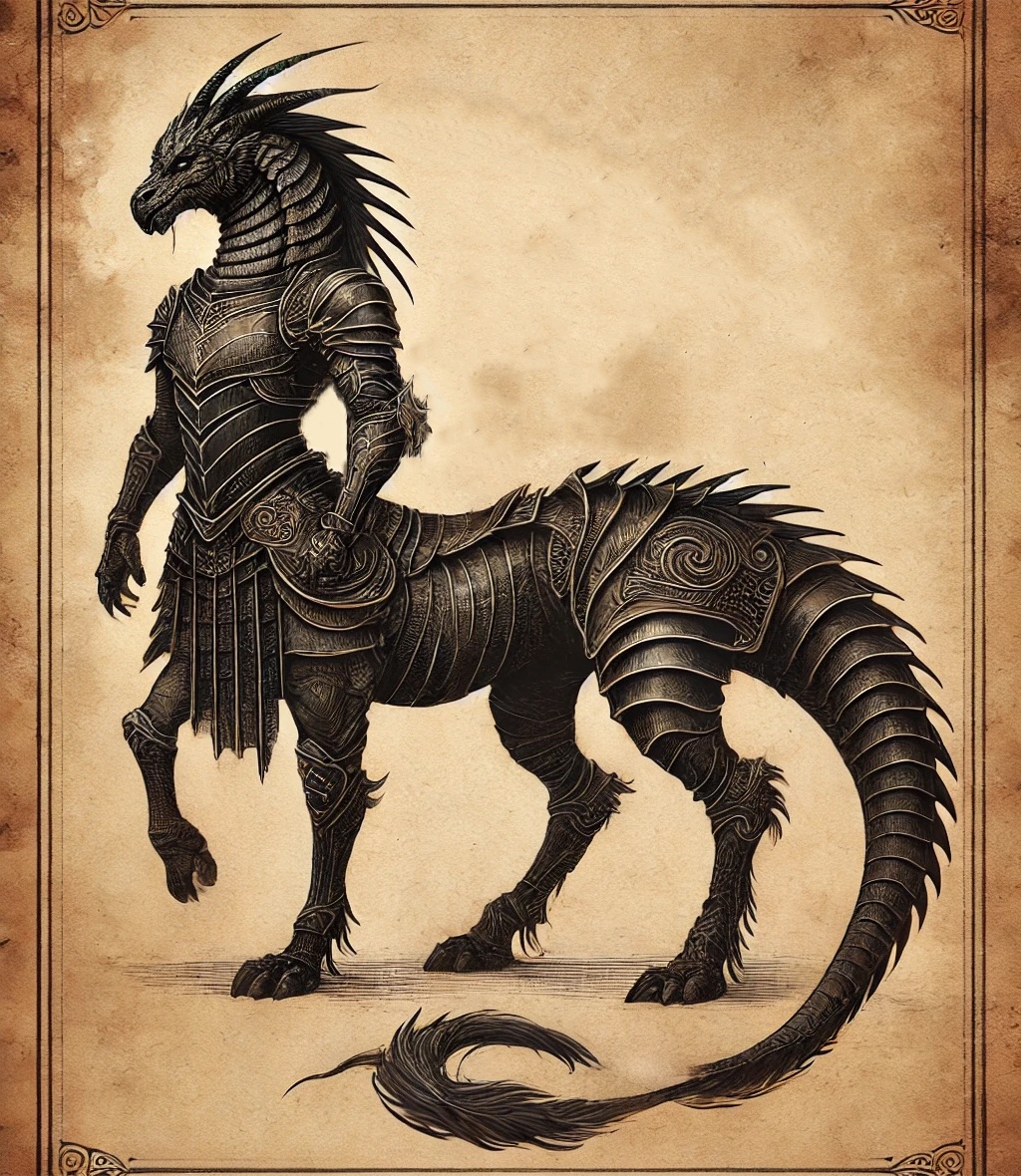 A typical Dracon.
Giff
Blustering humanoid hippopotami, the giff wander Wildspace in search of a good fight. They find ready employment as mercenaries.
Personality
The giff are not so much a warrior race as a soldiering race. Giff communities organize themselves in a chain of command, freely borrowing grandiose ranks and titles from races they encounter. Giff society is built upon discipline and hierarchy, but they harbor no imperial ambitions. In fact, they care little for land—theirs or anyone else’s. Nor do they care for money, preferring payment in what they truly value, such as food, weapons, and—especially—explosives. The bigger the explosion, the better they like it.
For all their love of ostentation and arms, giff remain intensely orderly. A giff’s word is his bond, with one exception—giff refuse to fight other giff, no matter how well-paid either platoon might be.
Physical Description
A giff resembles an anthropomorphic hippopotamus—a gray, broad, and seemingly clumsy creature. Shorter than an ogre but much more massive, a giff’s bulk disguises quick reflexes and surprising grace. Although herbivorous, giff possess powerful tusks and iron-muscled arms.
Giff would appear terrifying to most races if not for their fashions. Giff demand spit-and-polish military garb and take this to such an extreme of ostentation as to border on the absurd. No one doubts the bravery or ferocity of the giff, and those who know their predilections know to keep a safe distance from them, but few are intimidated by an 8-foot-tall humanoid hippopotamus who hides the entirety of his plate armor beneath a mess of campaign ribbons.
Relations
Giff see other races in one of two ways: as employers or troublemakers. Mercenary to the core, the giff follow orders to the letter. As such, quite without knowing it, they often end up on what most humanoids would describe as the wrong side, fighting alongside illithids, scro, or—worst of all—escorting the avian dowhar to new markets.
Although the origin of the giff’s attraction to firearms is unknown, their desire for the weapons has only grown over the years. Hippofolk adore them to distraction, and a distracted giff is dangerous indeed. Employers who promise a giff platoon a steady supply of black powder acquire fanatically loyal mercenaries, but a few giff can bankrupt anyone unwise enough to make the offer. A giff prefers to carry as many pistols, blunderbusses, and muskets as his mighty frame can handle.
Alignment
Despite their love of explosive weaponry, giff remain resolutely lawful. Their structured and intensely stratified society, deep-seated sense of honor, and total obedience ensure that few giff ever show even a trace of chaotic behavior (aside from an almost childlike joy at loud and colorful explosions). Few giff are either good or evil—they just follow orders.
Giff Lands
The giff travel Wildspace and the planets in it, forever selling their services to the highest bidder. Aside from the occasional shipwrecked castaway, giff neither settle down nor stop to admire the scenery. No living giff recalls his race’s homeworld, spoken of now only in legend.
Religion
The giff possess no actual religion of their own—perhaps they lost it with their homeworld. Giff adopt the worship of whatever war deities their employers venerate. In addition, giff hold to a quasi-mystical deism, claiming that all things have a purpose in the world and that the purpose of giff is to follow orders.
Language
Giff speak their own language, a gruff, blustery tongue full of bellowing lows and trumpeting highs. Most giff also speak Common, to better negotiate for gunpowder and other necessities.
Names
Giff use names in the Common tongue, as their native names are either unpronounceable or forgotten. They generally deal directly with wealthy employers and have adopted upper-class Common names to garner respect. Giff have somewhat unconventional tastes, and many of these names are uncommon even among the aristocratic and merchant classes.
- Male Names: Algernon, Bertram, Cordell, Eustace, Horatio, Trenton.
- Female Names: Beatrice, Dora, Isabella, Louisa, Ophelia.
- Family Names: Cartwright, Galloway, Hadley, Kilburn, Upton.
Adventurers
Giff love to travel, fight, and find new and interesting weapons. As such, they make natural adventurers. On the other hand, many giff prefer to remain in the regimented and familiar company of their own kind.
Most giff adventurers hail from devastated platoons. Considering giff tactics, these orphans are a relatively common occurrence. The giff who survive them find adventuring work comparatively easy.
Other giff adventure under orders—giff platoons try their best regardless of the mission, and some missions send individual giff far from their platoons and others of their kind.
Giff Racial Traits
- Str +4, Con +2, Int -2
- Medium: As Medium creatures, giff have no special bonuses or penalties due to size.
- Giff base land speed is 20 ft
- Powerful Build: The physical stature of a giff lets it function in many ways as if it were one size category larger. Whenever a giff is subject to a size modifier or special size modifier for an opposed check (such as during grapple checks, bull rush attempts, and trip attempts), the giff is treated as one size larger if doing so is advantageous to him. A giff is also considered to be one size larger when determining whether a creature's special attacks based on size (such as improved grab or swallow whole) can affect him. A giff can use weapons designed for a creature one size larger without penalty. However, his space and reach remain those of a creature of his actual size. The benefits of this racial trait stack with the effects of powers, abilities, and spells that change the subject's size category.
- Nonmagical Nature: By nature, giff are nonmagical and never cast spells. In fact, their nature is so nonmagical that they cannot use spelljamming helms. Furthermore, they gain SR 8 and have a 5% spell failure chance that applies to all spells they cast and magic items that require activation. Items thus affected use the spell completion or spell activation method of use.
- Weapon Familiarity: Giff culture prizes gunpowder weapons. As such, giff treat firearms as martial weapons, rather than exotic weapons.
- Natural Armor: A giff's tough hide protect it from harm, giving it a +2 natural armor bonus to AC.
- Automatic Languages: Common and Giff.
- Bonus Languages: Dowhar, Dwarven, Gnome, Scro, Undercommon.
- Favored Class: Fighter.
- Level Adjustment: +2
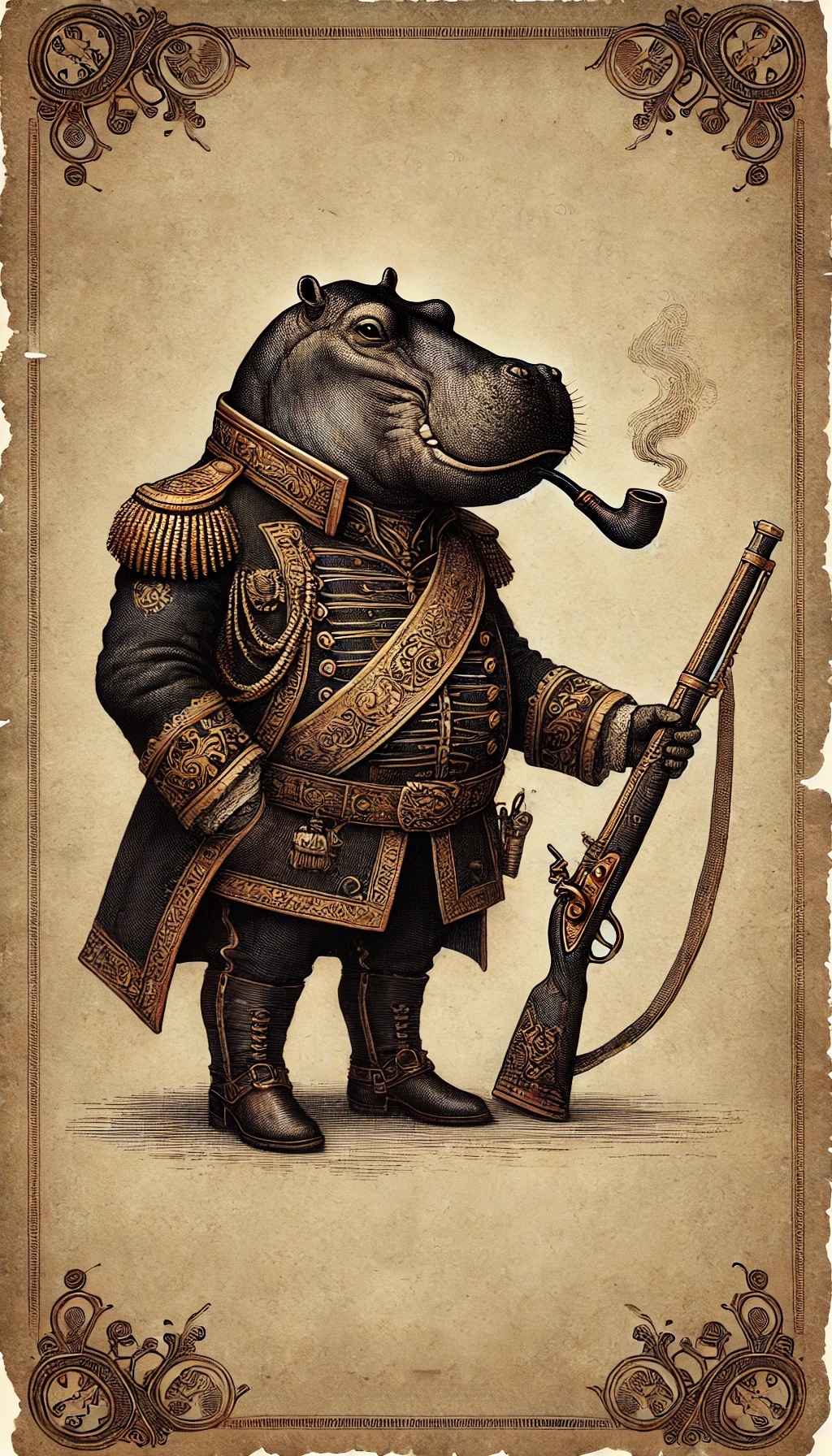 A typical Giff.
Grommams
Grommams are gorilla-like apes with heavy upper-body musculature. Their legs are short, and their feet are roughly soled with toes that have limited ability to grasp objects. Grommams have short, rough, copper-red fur all over their bodies except on their faces, the palms of their hands, and the soles of their feet. Their skin is a rich chocolate brown. Most grommams stand five feet tall with arm spans up to nine feet wide. Males weigh 350–500 lbs, while females weigh half as much.
Grommams use a gestural and finger-sign language. Body postures, facial expressions, and a variety of vocal hoots, screams, grunts, and calls add to the basic language, called "grommish" by other races.
Grommams prefer to wear loose, brightly colored clothing, particularly short-sleeved kimonos. They are fond of belts, arm straps, and leg straps, to which they attach weapons and tools that are tied down.
Combat
Grommams prefer to use weapons when attacking, though some enjoy wrestling and similar martial arts. Almost any melee weapon that a human can use can also be used by a grommam without change.
Chain mail is used almost exclusively for its light weight and flexibility. Shields can be used, but most grommams take advantage of their ambidexterity and use a weapon in either hand.
Habitat/Society
Grommams are generally peaceful, with their leadership made up of "director" females led by a demigod. (The grommam demigods openly live among the grommams, but they never adventure.) Unmarried males form the backbone of the military forces, and more than a few become adventurers. They make their homes in forests, but they enjoy the same climates as humans. They climb extremely well, and some build treehouses, but most grommams are ground dwellers.
A grommam family usually consists of one adult male, 1–2 adult females, and 1d4 children.
- One female generally cooks, cleans, and manages the children.
- The other female directs all household affairs such as finances, purchases, and dealings with other grommam families.
- The male performs heavy labor, either for the family or for a local guild or business. Several dozen related families form a clan, the basic social unit, and 2d4 clans form a house, which is led by a demigod (see below). In most clans, only the "director" female is allowed to vote on political issues. Unmarried males form the backbone of the military forces, and more than a few become adventurers.
Ecology
Grommams are omnivorous, eating almost any sort of fruits, vegetables, nuts, roots, and small game animals. They have no trouble eating the food of any human or demihuman race. Grommams have little effect on the affairs of other races.
Religion
Like other races, grommams have deities—but their deities (of demigod level) openly live among them as their rulers and advisors. Most are LG.
Spelljamming and Ship Design
Grommam spelljammer ships (usually purchased from humans) are altered to appear powerful and dramatic, with bright colors and wild designs, but they function like any other spelljamming ships.
Because grommams are so adept at climbing, they make heavy use of ropes, riggings, and swing bars.
"The noise is ungodly when they're all talking at once, and they eat like there's no tomorrow. But frankly, I'm too scared to fire them now."
- Merchant captain with three grommams in his crew.
Grommam Racial Traits
- +2 Str, +2 Dex, -2 Int, -2 Wis
- Medium: As Medium creatures, grommam have no special bonuses or penalties due to size.
- Grommam base land speed is 30 ft
- Grommam have a +8 racial bonus on Climb and Use Rope checks and can always choose to take 10 on Climb and Use Rope checks, even if rushed or threatened.
- Speak With Kin (Ex)): Grommams have the ability to communicate with apes (and other similar animals) as if they were under the effect of the Speak With Animals spell.
- Grommams have a -2 penalty on Bluff and Diplomacy checks made with non-ape-like races.
- Grommams have a +2 racial bonus on Handle Animal and Wild Empathy checks made with apes and ape-like animals.
- Automatic Languages: Common and Grommam.
- Bonus Languages: Dowhar, Elven, Gnome, Hadozee, Scro, Undercommon.
- Favored Class: Fighter.
- Level Adjustment: +0
Hadozee
Overview
Hadozee, or deck apes, are tall, slender, tailless simianlike humanoids renowned for their agility, resilience, and adaptability. Their most distinctive trait is the broad membrane of skin (patagia) that stretches between their arms and legs, allowing them to glide across ship decks, between low-gravity surfaces, and even through Wildspace itself.
For generations, hadozee have been an important part of the spelljamming trade, working as crewmen, mercenaries, and explorers. They have earned respect throughout the Known Spheres for their diligence, combat prowess, and unwavering loyalty to their ships and crews. Their adaptability, natural athleticism, and willingness to work hard make them indispensable members aboard spelljamming vessels.
Personality
Hadozee are known for their intensity, exuberance, and sharp tongues. They express themselves freely—laughing, jeering, and shouting without restraint. Among their own kind, they exchange constant insults and banter, but they refrain from this behavior in the presence of their employers, especially elves.
Despite their coarse speech, hadozee are good-natured, optimistic, and hardworking. They approach their work with pride and dedication, rarely complaining about difficult conditions. Even in dire situations, a hadozee is more likely to crack a joke than succumb to despair.
While they are generally peaceable, hadozee do not shy away from combat. They fight with ferocity and cunning, using their gliding ability and dexterity to gain tactical advantages in battle.
Physical Description
Hadozee typically stand between five and six feet tall, though their stooped posture makes them appear slightly shorter. They tend to have a muscular build, their bodies well-suited for the demands of shipboard life. Their black, glittering eyes are well-adapted to dim lighting, and their fur ranges from light tawny golden brown to deep chocolate.
Distinctive Features:
- Patagial Flaps: Their gliding membranes allow them to traverse ship decks, gravity planes, and asteroid clusters with ease.
- Dexterous Limbs: Their hands and feet are equally nimble, each possessing opposable thumbs, making them natural climbers, riggers, and multi-taskers.
- Combat Adaptability: Hadozee can wield weapons and tools with both hands and feet, making them especially versatile in combat and labor-intensive tasks.
Most hadozee do not wear clothing, as it interferes with their patagial flaps. However, aboard spelljamming ships, many wear harnesses, tool belts, and armored caftans for practicality.
Relations With Others
Hadozee greatly admire elves, often fawning over them. They have served alongside elven fleets since the Unhuman Wars, forging a relationship based on mutual benefit—though elves do not regard them as equals.
They work well with most other races but dislike those who shirk hard work. Among their closest allies are wavecrest gnomes, whom they respect for their ingenuity and ability to speak with spacefaring birds.
Hadozee often find themselves in competition with scro, a rivalry stemming from the Unhuman Wars. While individual hadozee and scro may work together under neutral circumstances, tensions between the two races run deep, especially on the frontiers of Wildspace.
While hadozee enjoy working with other species, they tend to keep their strongest bonds within their own kind. A group of young adult hadozee (typically twenty to thirty individuals) will sign on with the same captain and train together, forming a tight-knit shipboard community.
Alignment
Hadozee care little for grand philosophies or moral debates. They prefer to live freely, work hard, and leave others to do the same. Their natural pragmatism and independent spirit make them predominantly neutral in alignment.
Hadozee Lands
Although the hadozee once had a homeworld, they no longer know or care where it is. They have always been a migratory people, traveling among other races aboard ships and exploring the vastness of Wildspace.
Hadozee live communally whenever possible, particularly in port cities and spacefaring outposts. Their temporary dwellings serve as meeting places, training grounds, and shelters for young hadozee or those between berths. New mothers, the injured, and retired spacers maintain these homes, ensuring that no hadozee is ever without a place to stay.
If a hadozee arrives at a port with no other hadozee present, they often choose to remain aboard their ship rather than settle in unfamiliar surroundings.
Religion
Hadozee are not particularly religious, though they are respectful of the sea deities and astral deities worshipped by other spacers. A hadozee who encounters a powerful deity may become devoted to that deity, but such occurrences are rare.
Language
The Hadozee tongue is composed of hoots, barks, and low vocalizations, supplemented by expressive body language. While their speech is simple, hadozee are capable linguists, delighting in learning new languages.
Due to their similarities, those who speak the Hadozee language can vaguely understand Grommam, with the reverse also being true.
Hadozee also commonly speak Common, Dowhar, Dwarven, Gnome, Grommam, Scro, Undercommon, Elven, Goblin, and Orcish, and they often pick up additional languages throughout their travels. Their extensive experience working aboard spelljamming vessels exposes them to a wide variety of languages spoken by traders, mercenaries, and explorers.
Names
Hadozee names are often inspired by the ships they serve aboard. A hadozee who has served on the Dream of the Night might take the name Garsh Nightdream. These “ship-names” serve as a badge of honor, signifying a deep bond between hadozee who have served on the same vessel.
Male Names:
Bansh, Darsh, Falth, Garsh, Grath, Grob, Harth, Krath, Marh, Forth.
Female Names:
Bahasha, Bannithi, Dashi, Kalla, Kasha, Mara, Risha, Yasha, Yetha.
Ship-Names (Examples):
Dawnwarrior (The Dawn Warrior), Midnightchild (The Midnight Lady), Nightdream (The Dream of the Night), Pearldaughter (The Lady of the Pearl), Swiftson (The Swift Star), Swordstorm (The Sword in the Stars), Wavedancer (The Wave Dancer).
A hadozee does not change their ship-name lightly—only the most legendary ships and captains earn this distinction.
Adventurers
Hadozee adventurers are common, as most hadozee eventually feel the call to explore the vastness of Wildspace. Those who choose to abandon shipboard life entirely are viewed as unusual but not ostracized.
They excel in roles that require agility, adaptability, and teamwork, whether as sailors, warriors, explorers, or merchants. Many take on mercenary work or serve as security aboard trading vessels, ensuring the safety of both crew and cargo.
Hadozee often use their gliding abilities and dexterity to great effect, whether in combat, ship repairs, or daring escapes. They are particularly skilled at traversing the rigging of spelljamming vessels, boarding enemy ships, and navigating low-gravity environments.
Hadozee Racial Traits
- +2 Dexterity, –2 Charisma.
- Medium: As a Medium creature, a hadozee has no special bonuses or penalties due to her size.
- Hadozee base land speed is 30 ft
- Gliding: Hadozee can use their arm-flaps to glide, negating damage from a fall of any height and allowing them to travel 20 ft horizontally for every 5 ft of descent. A hadozee glides at a speed of 40 ft (average maneuverability).
- +4 racial bonus on Balance and Climb checks: Hadozee are natural climbers and have no fear of narrow pathways. A hadozee does not lose her Dexterity bonus to AC while climbing and can climb unimpeded while holding something in one hand.
- Automatic Languages: Common, Hadozee. Bonus Languages: Any (other than secret languages, such as Druidic). See the Speak Language skill.
- Favored Class: Rogue
Herwaet (Wiggle)
The hurwaeti, also known as wiggles, are an ancient humanoid reptilian race distantly related to both sahuagin and lizard men. Once a powerful spacefaring civilization that had colonized many systems, they spread art, civilization, morality, and a philosophy favoring altruism and discipline throughout the spheres. Their empire was shattered by an ancient war that killed the brightest and most energetic among them. Many survivors degenerated into the swamp and salt wiggles, while others became scattered wanderers, working as mercenaries, traders, salvagers, or pirates.
In the modern era, hurwaeti are found across the Known Spheres, often working aboard salvaged ships or living as part of tribal clans. Despite their decline, they are still valued as disciplined, reliable, and uniquely skilled crewmates.
"Better check your translating dictionary. I think you just asked them if they painted their mother's beholder yesterday." ~Whispered comment to a nervous diplomat facing a party of angry hurwaeti.
Personality
Hurwaeti are generally accommodating and nonaggressive, but they are covetous and mercenary. No one gets anything from a hurwaet for free, nor do hurwaeti expect anything for free. They tend to be neutral but have lawful leanings, showing strong loyalty to tribe and crew unless mistreated. Hurwaeti will do anything to avoid capture by neogi, illithid, or beholders, fighting to the death rather than submitting to such enemies.
They are brave, stubborn, and persistent, with a cultural disdain for surrender. Even in defeat, they consider it a matter of honor to resist to the last. Young hurwaeti are ambitious and seek to gain wealth and status either by serving on their clan ships or by venturing forth independently.
Physical Description
Hurwaeti have thick, tough, glossy olive-green scales that can appear damp or slimy to observers. Their bodies are humanoid but feature long frog-like legs, webbed fingers and toes, and gnome-like faces with large ears, pointed noses, and sharp bearded chins. Adult hurwaeti tend to have sparse beards and tufts of coarse hair on their heads. Venerable hurwaeti may develop thick brows and fuller facial hair.
They range from six to seven feet tall and typically weigh between 190 and 230 lbs. They wear simple, brightly colored loincloths and belts, often decorated with jewelry made from ceramic, shell, or bone. Favorite adornments include large earrings, armbands, wristbands, and ankle bracelets. Their clothing tends to be minimal and practical, supplemented with packs for carrying equipment.
Relations With Others
Hurwaeti tribes are composed of multiple clans, each ruled by an elder. The senior clan head, usually the oldest and wealthiest, governs the tribe. All disputes are settled by appealing to the chief. When a chief dies, a new one is elected from among the clan elders. Wealth and honor are earned by service, particularly on ships or through independent ventures.
They are commonly found serving on the ships of other races. Their own ships are typically salvaged, refitted vessels from other cultures, often modified for hurwaeti use. True hurwaeti-built ships are rare and resemble those of lizard men. Hurwaeti groups tend to consist of same-sex individuals of similar age. Around 5% of hurwaeti groups voyage in search of mates. When two such groups meet, there is a high chance one or more members will leave their employer and defect to the other group.
If leadership is weak or unjust, hurwaeti crews will protest, mutiny, or desert at the first opportunity. Their loyalty is often conditional on fair treatment and shared honor.
Alignment
Hurwaeti tend toward neutrality with lawful inclinations, especially among spacefaring clans. Those that have degenerated into swamp or salt wiggles often display evil and chaotic tendencies, particularly in their aggression, selfishness, and savagery.
Hurwaeti Lands
Hurwaeti no longer have a unified homeland. They are a widely scattered people who live aboard ships, in small enclaves on alien worlds, or in tribal communities in swamps and coastal regions. Ancient colonies have fallen into ruin or degeneration, producing savage offshoots such as swamp and salt wiggles.
Religion
Hurwaeti religion is not prominently featured. Among degenerate hurwaeti, especially salt wiggles, there are alliances with monstrous beings such as sahuagin, ixitxachitl, and krakens. These bonds appear more transactional than spiritual, based on power or survival rather than worship.
Language
Hurwaeti speak an archaic dialect of Scalykind with a difficult, convoluted syntax filled with hisses and clicks. Most humans and demihumans find it challenging to learn and even harder to speak. Other scalykind can learn it easily, however. Hurwaeti typically also learn the languages of other scalykind, Common, and any other racial tongue common to their region or adopted home system.
The various scalykind adopted their languages through their interactions over generations, but have adopted their own dialects of this language.
Adventurers
Hurwaeti tend to be fighters, rogues, or swashbucklers. They favor large swords and shields in melee and often use slings or javelins for ranged combat. While most hurwaeti are neutral, they are dependable and can be counted on to follow orders when fairly treated.
Many hurwaeti who venture out as adventurers are former crew members, mercenaries, or scavengers. They are physically well-suited for adventuring roles that require strength, jumping ability, amphibious movement, or rugged endurance. On hurwaeti ships, most adventurers are lightly armored warriors with long blades, bows, or similar weapons.
Hurwaet Racial Traits
- -2 Con, +2 Wis
- Type: Humanoid (Scalykind)
- Medium: As a Medium creature, a hurwaet has no special bonuses or penalties due to her size.
- Hurwaet base land speed is 30 ft
- +1 racial bonus on attack rolls against neogi, illithid, and beholderkin.
- +4 racial bonus on Jump checks: Hurwaet have anatomy similar to frogs. In addition, hurwaet treat all Jump checks as though they have a running start.
- Scaly Hide: Hurwaeti have a natural armor bonus of +2. Additionally, non-magical armor must be custom made to fit a hurwaet's body shape. Such armor costs 50% more than normal armor.
- Fog Cloud (Ex): Once per day, a hurwaet can produce a fog cloud similar to the spell of the same name (CL = HD). This cloud is considered fresh air when in an air envelope, and can be used to freshen the envelope equal to an ammount appropriate to the dimensions of the cloud.
- Automatic Languages: Hurwaet and Scalykind. Bonus Languages: Common, Dowhar, Elven, Gnome, Scro, Undercommon, any other scalykind racial dialect.
Lizardfolk
Lizardfolk are large, reptilian humanoids known for their survival instincts and alien worldview. Deeply tied to the natural world, they are emotionally reserved and view most things through a pragmatic lens. While they often appear primitive to outsiders, lizardfolk societies are ancient and enduring, some even having adapted to spacefaring life with the aid of hurwaeti knowledge. They value strength, utility, and tribal loyalty above all else.
"If the Lizardfolk word for everyone else is the same as their word for 'prey', their word for halfling must be 'appetizer.'" ~An old [bad] wildspace joke.
Personality
Lizardfolk assess everything based on practicality—if something cannot be eaten, wielded, or used for survival, it holds no value. They are emotionally stoic, slow to trust, and disinterested in social nuance or aesthetic expression. Though not inherently cruel, they often make decisions that appear callous or brutal to outsiders. Trust is earned by action, not words. Lizardfolk rarely lie and speak with blunt honesty.
Physical Description
Lizardfolk stand between six and seven feet tall and are heavily muscled, with thick, scaly hides in shades of green, gray, or brown. Their long, powerful tails aid in swimming, balance, and combat. Most non-lizardfolk struggle to distinguish their sexes, but lizardfolk themselves have no difficulty.
Groundling lizardfolk, born and raised in the swamps and marshes of the world, are built for power—broad of chest, thick of limb, and rugged in posture. Their bodies are built for a life of labor, combat, and survival in dense, wet terrain.
In contrast, spacefaring lizardfolk—those who have lived most or all of their lives aboard spelljammer ships or in low-gravity asteroid colonies—are more lithe and nimble than their terrestrial kin. Their frames are leaner, their movements quicker and more fluid, honed for climbing rigging, navigating tight corridors, and leaping between decks in the shifting gravity of the stars. Despite their lighter build, they retain the same survival instinct and tribal loyalty of their groundling cousins.
They hatch from eggs and reach maturity within a few years. While some can live up to eighty years, many males perish long before that due to frequent combat. In old age, they slow down significantly, often choosing to bask in the sun or watch over hatchlings. Upon death, they are often consumed ceremonially by their tribe, returning their essence to the group.
Relations With Others
Lizardfolk see most other races as threats, prey, or tools for survival. The more intelligent among them may understand the potential for mutual benefit or trade, but they remain cautious. They find the customs of other peoples confusing or frivolous and have little interest in assimilation. Contact with outsiders is often pragmatic and temporary, and a hungry lizardfolk is notoriously difficult to reason with.
Alignment
Lizardfolk are typically neutral, guided more by instinct and necessity than ideology. Some tribes lean lawful, adhering to longstanding traditions or hierarchies, while others are chaotic and aggressive. Their morality centers on the tribe's survival rather than abstract principles of good or evil.
Lizardfolk Lands
Lizardfolk dwell primarily in swamps, marshes, jungles, or flooded cave systems. About a third of all tribes live in partially submerged or underwater air-filled caverns. Their camps consist of crude but efficient shelters made from scavenged materials, woven reeds, mud, and bone.
Some rare tribes have adapted to spacefaring life through ancient ties with hurwaeti, traveling aboard swamp-grown spelljamming vessels or asteroid-bound jungle settlements. Regardless of location, their settlements are built for defense and survival, not comfort or aesthetics.
Religion
Lizardfolk worship Semuanya, a deity of survival, fertility, and natural endurance. Worship is informal—there are no temples, only the wisdom of shamans and druids who invoke Semuanya’s blessings when needed. The deity’s influence is found in every act of preservation, from food gathering to brood rearing.
Semuanya is not seen as a figure of mercy, but as a symbol of continuity. Those who follow him often grow into druids or spiritual leaders, their faith seamlessly blending with reverence for nature itself.
Language
Lizardfolk speak their own racial dialect—a guttural, rhythmic language built from growls, hisses, clicks, and low-pitched vibrations. This tongue is instinctive, passed down through generations without writing, and is universally understood among lizardfolk regardless of tribe or region.
In addition to their own dialect, lizardfolk are born with an innate understanding of the shared language of Scalykind: a primal tongue spoken by other reptilian races such as serpentfolk, locathahs, troglodytes, and others with similar physiological and cultural roots.
Lizardfolk seldom learn the languages of softskins, seeing little use for them in tribal life. However, those who travel aboard spelljamming vessels or live among mixed communities will acquire the languages of their crewmates—typically for coordination and necessity rather than interest. Even then, they prefer to speak among their own kind whenever possible.
Literacy is uncommon among lizardfolk. Only those who have spent time in foreign cultures, taken up specialized roles, or adopted nontraditional paths tend to read or write.
Names
Lizardfolk names are descriptive and often earned through personal deeds, traits, or environmental association. Examples include “Stonehide,” “Redclaw,” “Silenttail,” or “Mudfang.” These names may change throughout a lizardfolk’s life as their role or accomplishments shift.
Adventurers
Lizardfolk adventurers are rare and often driven by duty, exile, or necessity. Some are scouts or emissaries; others seek powerful knowledge or weapons to protect their tribes. They do not pursue wealth or glory but survival and purpose. Lizardfolk rarely travel alone, usually journeying in pairs or small groups to maintain their identity. They are cautious among foreign cultures and often retain their tribal mannerisms even while adapting to the wider world.
Spacefaring Lizardfolk Racial Traits
Lizardfolk who were hatched in space and have lived their entire lives among the stars have bodies that have adapted to this lifestyle.
Spacefaring lizardfolk have all of the lizardfolk racial traits given in the Monster Manual (pp. 169) except as follows:
- +2 Dex, +2 Con, –2 Int
- Type: Humanoid (Scalykind)
- Racial Skills: A lizardfolk’s humanoid levels give it skill points equal to 5 × (2 + Int modifier, minimum 1). Its class skills are Balance, Jump, and Tumble. Lizardfolk have a +2 racial bonus on Balance, Jump, and Tumble checks.
- Spacefaring lizardfolk have a +2 racial bonus on Wildspace Survival checks
- Automatic Languages: Lizardfolk and Scalykind. Bonus Languages: Common, Dowhar, Elven, Gnome, Scro, Undercommon, any other scalykind racial dialect.
- Favored Class: Rogue.
Rastipede
Rastipedes are insectoid centaurs with long, segmented bodies and eight legs that allow them to scuttle about with impressive speed and agility. Their upper torsos are vaguely humanoid, with two dexterous arms and a head that features large compound eyes, chitinous mandibles, and long, whip-like antennae. Covered entirely in a hard chitinous exoskeleton, they are naturally protected and visually striking. Rastipedes are renowned across the Known Spheres for their mercantile prowess, often serving as traders, intermediaries, and facilitators in complex deals.
"You idiot! Of course those fifty suits of armor you bought from that rastipede were marked 'half off'! They're all made for gnomes!" ~A scro captain to his supply officer, just before the latter's execution.
Personality
Rastipedes are cunning negotiators who delight in clever wording and technicalities. They take pride in honoring the precise terms of an agreement, often using this literal-mindedness to exploit assumptions made by others. Though not inherently dishonest, they are unapologetically opportunistic. A rastipede will fulfill every word of a contract while letting the other party suffer for their own misunderstandings. Despite this, they rarely break their word and are generally reliable, if sometimes infuriating. They have a strong sense of duty toward their community and are highly educated in literature, mathematics, and logic.
Physical Description
Rastipedes have long, segmented lower bodies that resemble those of giant insects, with eight legs and a solid, armored exoskeleton. Their upper bodies are humanoid, but with features that reflect their insect heritage: large mandibles, antennae, and compound eyes. They are ambidextrous and double-jointed, capable of intricate manipulation and fluid movement despite their bulk. Their natural armor is formidable, though it limits their ability to perform delicate tasks. The antennae grant them an acute sense of smell, sharp enough to detect creatures behind them as long as an odor is present.
Rastipedes are gifted with natural armor and impressive physical speed, making them agile and resilient. Their antennae grant them a sense of smell so acute they are nearly impossible to surprise. They are natural tunnelers, with an innate sense for underground depth, slopes, and structural instability. This subterranean upbringing gives them an instinctive awareness of their surroundings.
Relations With Others
Due to their extensive trading activities, rastipedes are familiar with many cultures and customs, often speaking multiple languages and navigating social situations with ease. They are often employed by or aligned with the Mercane, acting as intermediaries or trusted agents. This association has led to rumors of a secret, possibly sinister alliance, though no evidence has ever confirmed such a relationship. Other species regard rastipedes with a mix of respect and caution, appreciating their business acumen while remaining wary of their legalistic tendencies.
One of their most extraordinary traits is their unmatched proficiency with spelljamming helms. A rastipede’s connection to these magical devices allows them to pilot them with incredible efficiency, far beyond what their magical training alone would suggest. This anomaly has fueled speculation of a deeper link between rastipedes and the Mercane, though no such connection has ever been conclusively proven.
Alignment
Rastipedes tend toward neutral alignments, often favoring structure and balance over extremes of good or evil. Their devotion to the letter of the law, contracts, and mutual agreements reflects a lawful bent, but they are not above exploiting loopholes for personal gain.
Rastipede Lands
Rastipedes are born from eggs laid by a queen who dwells deep underground in secluded caverns. These hidden nests serve as the cradle of rastipede society, where the young are nurtured and educated in the traditions of their kind. A single nest can contain hundreds of individuals, most of whom are immature and incapable of defending themselves. The adults, however, guard the nest with fanatical dedication. Their societies value duty, education, and community well-being, and young rastipedes typically spend their first decade underground before venturing into the broader world.
Religion
Rastipedes do not appear to place particular emphasis on religion. Their lives revolve more around communal duty, commerce, and intellect. If they venerate anything, it may be abstract ideals such as order, knowledge, or prosperity.
Language
Rastipedes have a native language composed of chirps and clicks, but their role as merchants compels them to learn many other tongues. Most rastipedes are polyglots, conversant in the languages of the species they trade with.
Due to having similar anatomy, all insectoid races have the ability to understand the racial dialects of other insectoid races, though this does not give them the ability to speak them.
Names
Specific naming conventions for rastipedes are not detailed, but it is likely their native names consist of complex clicks and chirps. When dealing with other races, they may adopt simplified or translated names more palatable to humanoid speech.
Adventurers
Though peaceful by nature, rastipedes are capable of defending themselves and do not hesitate to act when threatened. Their preference in combat tends toward ranged weapons, particularly a specialized longbow crafted by their own kind. They are often seen accompanying ships as scouts, archers, or spelljamming specialists. Rastipede adventurers are typically drawn to the pursuit of knowledge, the thrill of exploration, or the opportunity for profit and influence. Those who leave their nests often carry with them a strong sense of identity, a deep respect for structure, and an insatiable curiosity about the worlds beyond.
Rastipede Racial Traits
- +2 Str, +2 Dex, -2 Int, +2 Wis
- Type: Monstrous Humanoid (Insectoid)
- Medium: As Medium creatures, rastipedes have no special bonuses or penalties due to their size.
- Rastipede base land speed is 40 ft. Additionally, rastipedes have a 20 ft burrow speed.
- Darkvision out to 60 ft
- Natural Attacks: Rastipedes can attack with four claws and a bite. The claws deal 1d4 points of damage, and the bite is a secondary attack that also deals 1d4 points of damage. A rastipede can attack with a weapon (or multiple weapons) at its normal attack bonus and make either a bite or claw attack as a secondary attack. For example, a rastipede ranger with the Multiweapon Fighting feat who is armed with four short swords could attack with all four swords at a -2 penalty (the normal penalty for fighting with multiple weapons while using light weapons in off hands) and also make a bite attack at a -5 penalty.
- Racial Hit Dice: A rastipede begins with one level of monstrous humanoid, which provides 1d8 Hit Dice, a base attack bonus of +2, and base saving throw bonuses of Fort +0, Ref +2, Will +2.
- Racial Skills: A rastipede's monstrous humanoid levels grant skill points equal to 5 × (2 + Int modifier). Class skills include Balance, Climb, Jump, Listen, and Spot.
- Natural Polyglot: Rastipedes gain the Speak Language skill, and it is always considered a class skill for them.
- +2 racial bonus on Helm Pilot skill checks. This does not grant the ability to use the skill untrained.
- +2 racial bonus on Wildspace Survival skill checks.
- Scent (Ex): Rastipedes gain the scent ability.
- Automatic Languages: Common and Rastipede. Bonus Languages: Any (other than secret languages, such as Druidic). See the Speak Language skill.
- Favored Class: Ranger
- Level Adjustment: +2
Scro
The Scro are advanced orcs from a distant sphere, forged into a disciplined and warlike race after the defeat of the orcs in the Unhuman Wars. Transformed by the visionary Dukgash, the Scro abandoned chaotic savagery in favor of rigorous structure, tactical discipline, and militarized culture. Feared and grudgingly respected, they are consummate warriors—adept at fighting against overwhelming odds, in formation, or in command of less disciplined allies. Though rare now, they are poised to return as a dominant force in wildspace.
"Thanks." ~A scro general accepting a surrendering elven commander's sword, just before using the same weapon to kill the commander and his remaining troops.
Personality
Scro are aggressive and intense by nature, but their iron discipline keeps their emotions buried beneath a cold exterior. Even among their own kind, they maintain a rigid chain of command and suppress individuality for the greater good of their race. Unlike most evil creatures, the typical Scro is selfless, focused, and self-disciplined. In battle, they remain composed, unleashing calculated violence rather than rage. They show tact in social settings, but are quick to deliver scathing, alliterative insults in combat, often crafted to throw enemies off balance.
Physical Description
Scro resemble orcs in their brutish features, pig-like snouts, and powerful jaws, but they are taller (averaging 6 to 8 ft), stronger, and more erect in posture. Their teeth are filed into points and often inscribed or decorated with gems and tribal symbols. Their skin tones range from jet black to moss green to burnt orange, with rare albino variations. Their eyes glow a phosphorescent green in dim light. Scro wear highly maintained, jet-black studded leather or heavier armor, adorned with insignias of tribe and rank. Their weapons and gear are kept in meticulous condition, and they take pride in their appearance as warriors.
Relations With Others
The Scro are notorious for their genocidal hatred of elves and open disdain for all non-orcish humanoids. Their worldview is one of contempt, superiority, and isolationism. Dragons, beholders, and other powerful beings are seen as threats to avoid, while other humanoids are viewed as tools or fodder. When forced to interact socially, Scro show restraint and tact but remain ever alert and dominant. Their war against elves is both cultural and ideological, and all Scro are required to learn Elvish—to ensure their enemies know who is killing them.
Alignment
Generations of regimentation have bred chaos out of the Scro. They are nearly always lawful, driven by an internalized sense of hierarchy and discipline. While their goals are cruel and expansionist, they rarely indulge in senseless brutality, preferring calculated violence toward strategic ends. Most are LE, though rare exceptions exist.
Scro Lands
The Scro homeworld is unnamed and secret, though it is ruled by the Ultimate High Overlord and organized into 24 tribes, each led by an Almighty Leader. The planet is marked by strong fortresses, efficient shipyards, and a harsh but well-ordered society. Populations range from 10,000 to 100,000 per city. While they do not seek multiversal conquest, they intend to remove all non-Scro from wildspace, reducing them to slaves or exterminating them outright. Outside their homeworld, the Scro establish militarized outposts and warships to enforce their dominance.
Religion
The Scro abandoned the old orc deities after their defeat in the Unhuman War. Their modern belief system venerates Dukgash, who taught them to forsake brutality for martial perfection and cultural discipline. While public religious displays are rare, war-priests perform private rituals centered on self-denial and inner strength. These war-priests are always multiclassed spellcasters, required to balance arcane and divine knowledge. The Scro’s devotion to Dukgash's teachings is absolute—his tomb even orbits their planet, watching over them like a star-bound guardian.
Language
Scro speak a refined dialect of Orcish, expanded by Dukgash to carry greater nuance and tactical vocabulary. The language is significantly more expressive than traditional Orc, boasting triple the vocabulary. All Scro learn Elvish, and many also speak Common for espionage, diplomacy, or mocking their foes. Scro prefer not to debase their ancestral tongue, but they will learn any language that serves the war effort.
Names
Scro favor long, complex names, often derived from heroes or ancestors. Male names include Dukgash, Horageth, Kagemdakh, Skalkash, Thokmakh, and Varvageth. Female names follow similar patterns, often formed by adding a suffix to male names (e.g., Dukgashia, Kagemdakhia). Clan names reflect a notable act or figure, and the suffix “-ulak,” meaning “the hero’s,” is applied to honor them. For instance, “Skalkash, Captain, 2nd Company, Dukgashulak” might be a full name. Scro do not use family names in the traditional sense, but rather titles, ranks, and tribal designations.
Adventurers
Scro adventurers are often from the lower castes—those who failed to meet the Scro’s harsh standards or were exiled for disobedience or weakness. Some adventurers are principled individuals whose values clash with Scro society, while others may have been exiled for erratic or chaotic behavior. That said, not all Scro adventurers are outcasts. Some operate as sanctioned infiltrators, spies, or mercenaries working abroad while secretly serving the Scro war machine. These agents answer to the Ultimate High Overlord and use their freelance status to infiltrate and sabotage other societies. Whether rogue or loyalist, Scro adventurers are dangerous, disciplined, and usually still loyal—if only to their own ambition.
Scro Racial Traits
- Str +4, Dex +2, Con +2: Scro possess the best traits of orcs and hobgoblins with few of the drawbacks.
- Type: Humanoid (orc)
- Medium: As medium creatures, scro have no special bonuses or penalties due to size.
- Speed: Scro base land speed is 30 ft
- Darkvision: Scro can see in the dark up to 60 ft. Darkvision is black and white only, but it is otherwise just like normal sight, and scro can function just fine with no light at all.
- +1 racial bonus on attack rolls against elves
- Automatic Languages: Common and Scro. Bonus Languages: Common, Dowhar, Dwarven, Elven, Gnome, Giff, Goblin, Undercommon, and Orc.
- Favored Class: Monk
- Level Adjustment: +2
Xixchil
Xixchil are six-limbed insectoid beings resembling humanoid praying mantises, known across wildspace for their mastery of surgery and self-modification. Their forward limbs end in sharp retractable blades, while their central limbs are delicate manipulators often replaced or enhanced with mechanical precision tools. To the xixchil, the body is a blank shell meant to be transformed—through artistry, discipline, and surgery—into something beautiful and deadly. Their culture treats surgical enhancement as both philosophy and spiritual practice, and most xixchil are adorned with embedded jewels, metallic inlays, and biological ornamentation. Their talent for both healing and augmentation has made them renowned among other species, even if their motivations remain alien and self-centered.
"You wished us to give you the vision of an eagle, and so we did. The beak and feathers are free." ~Xixchil surgeon
Personality
The xixchil are intensely individualistic beings who believe in the principle of “survival of the fittest.” For them, this means the continual pursuit of personal perfection through surgical modification, experience, and self-discipline. Their morality is structured in strict layers—first the self, then family, and finally society. They are highly analytical, pragmatic, and often cold, placing little value on emotional bonds. Beauty, to a xixchil, is found in function, efficiency, and precision. A perfectly crafted blade or specialized limb is considered as beautiful as a gemstone.
Physical Description
Xixchil are tall, insectoid beings with six limbs and a body structure resembling a humanoid praying mantis. Their exoskeleton is naturally armored and often adorned with intricate modifications: embedded jewels, carved metal inlays, and artistically enhanced chitin. The forward limbs end in long, retractable blades used for both surgery and combat. The central limbs are often replaced with mechanical manipulators, allowing for delicate or complex tasks. Each xixchil is visually unique, a walking masterpiece of biological and mechanical art.
Relations With Others
Xixchil can be difficult for other species to relate to. Their obsession with bodily modification and their alien aesthetic values are unsettling to many. They form bonds sparingly, usually based on utility rather than sentiment, and rarely show vulnerability or affection. Nevertheless, their surgical skill and battlefield effectiveness make them respected, if not trusted, allies. Adventuring parties who earn a xixchil’s respect may be acknowledged as “family,” though true emotional connection is rare.
Alignment
Most xixchil lean toward N or NE alignments. Their motivations are usually internal—focused on self-improvement and mastery—rather than driven by morality, justice, or altruism. While not cruel by nature, they are unapologetically pragmatic and often disregard the needs of others if those needs conflict with their goals.
Xixchil Lands
The xixchil evolved on a dangerous world full of predators, where only the most cunning and adaptable survived. There, they developed advanced biological control, camouflage, and metabolic enhancements, eventually rising to dominance. Modern xixchil are spacefarers, establishing surgical enclaves instead of permanent settlements. These mobile clinics, outfitted with tools and biological workspaces, serve as both homes and laboratories. Their spelljamming ships reflect their unique culture—covered in living plant structures, floral ornamentation, and organically grown components.
Religion
Surgery is considered a spiritual act by most xixchil. They believe that the body is a blank canvas, a shell to be transformed into something beautiful and functional. While they rarely worship deities in the traditional sense, some venerate deities of transformation, artifice, or evolution. Their religious expression, if any, is deeply tied to ritualistic self-enhancement and the philosophy of becoming.
Language
Xixchil communicate through a blend of spoken words, clicks, and gestures. Their native tongue is related to that of the rastipedes but distinct, incorporating mandible clicks and delicate hand signals. They also learn Common and other humanoid languages to interact with patients and allies.
Due to having similar anatomy, all insectoid races have the ability to understand the racial dialects of other insectoid races, though this does not give them the ability to speak them.
Names
Xixchil names are typically complex and unpronounceable by outsiders. When dealing with other races, they often adopt descriptive or symbolic names such as “Glassspine,” “Crimson Hook,” or “Third Blade,” usually inspired by their body modifications or surgical philosophy.
Adventurers
Some xixchil venture into the wider universe in search of new techniques, rare materials, or to test their capabilities. These adventurers may serve as battlefield surgeons, enhancement specialists, or deadly precision fighters. Their innate ability to synthesize poisons and anesthetics, combined with their combat adaptations, makes them formidable. While rare, some xixchil develop broader perspectives through adventuring, learning that growth is not limited to the body alone. Still, even these more open-minded individuals remain focused on their own advancement.
Xixchil adventurers are known for modifying themselves with extra limbs or combat-adapted tools such as blowguns, mancatchers, or built-in weaponry. These modifications, while highly effective, often come at great cost and are irreversible. Among other adventurers, they may be valued for their surgical expertise, combat utility, and biological enhancements—if not always for their warmth.
Xixchil Racial Traits
- +2 Dex, -4 Cha
- Type: Monstrous Humanoid (Insectoid)
- Medium: As medium creatures, xixchil have no special bonuses or penalties due to size.
- Speed: Xixchil base land speed is 30 ft
- Darkvision: Xixchil can see in the dark up to 60 ft
- Body Manipulation: Xixchil are proficient with augmenting and manipulating the physical body. They gain proficiency in the Body Manipulation skill and it is always considered a class skill for them.
- Secretions: 3 times per day, as a move action, a xixchil may secret a substance that causes their next attack to apply an anesthetic poison, which paralyzes the target for 1d6 rounds. Xixchil are immune to their own secretions. A successful Fort Save (DC 10 + ½ HD + Con Mod) negates the effect, and the creature is immune to the character's secretions for 24 hours. The character's secretions have no effect on creatures that have more HD than the character. These secretions only last for 10 minutes outside the character's body before breaking down and becoming useless.
- Automatic Languages: Common and Xixchil. Bonus Languages: Dowhar, Elven, Gnome, Scro, Undercommon, and any other insectoid racial dialect.
- Favored Class: Artificer
- Level Adjustment: +1
New Skill: Body Manipulation (Dex; Trained only)
Description: This proficiency is restricted to xixchil, as they are the only race with sufficiently precise Dexterity to even attempt this difficult skill, or the glands needed to secrete the required chemicals.
This proficiency allows the character to perform bodily modifications on others. Using this proficiency, the character may modify a patient's body through a combination of surgery and chemical changes.
Check: Making a Body Manipulation check takes 1 hour of uninterrupted concentration. Any distractions cause an automatic failure. Each success or failure causes the DC of each subsequent attempt to increase by 5.
Success Table:
DC | Action | Max Repeats
- 20 | The patient gains a tough outer shell. They gain a +1 natural armor improvement for each successful attempt. | 3
- 20 | The patient's eyes are modified to grant them Darkvision 30 ft. Darkvision is black and white only, but it is otherwise just like normal sight, and the target can function just fine with no light at all. | 1
- 25 | Claws or talons now extend from the patient's fingers. They gain a natural claw or talon attack apropriate to a creature of their size | 1
- 30 | The patient gains a +1 bonus to their Strength, Dexterity, or Consitution score. | 3
- 30 | The patient gains large wings, granting them a fly speed based on the number of successful attempts: 15 ft (clumsy), 30 ft (poor), 45 ft (average), 60 ft (good) | 4
For every successful attempt the patient loses 1 point of Charisma for undergoing the modification; this loss is also permanent. (Xixchil are notorious for favoring function over form.)
Performing such an extensive modification takes a minimum of two weeks. The patient must also make a Fortitude save (DC 15 + the number of times performed) or suffer a failure. The DM may decide to choose a result or roll on the accompanying table.
The DM may determine a result not listed on the failure table is apropriate instead.
Failure Table
Roll | Result
- 1 | Loss of limb: patient loses a limb
- 2 | Weakened immune system: Permanent -4 on Fort saves vs Poison and Diseases
- 3 | Weakened bones: Patient gains vulnerability to bludgeoning damage
- 4 | Thin blood: Patient gains vulnerability to slashing damage
Insectare
Personality
Insectare are cold, secretive, and cautious when dealing with outsiders. While they appear emotionless, they are capable of a wide range of feelings, though many of these emotions seem alien to other humanoids. Among their own kind, they communicate empathy directly through their antennae. Each insectare views their race as a unified family, with their deity Klikral as its divine head. This deep-seated loyalty fosters an adversarial stance toward all who are not part of their "family." Even those who travel with others maintain emotional distance, hiding their true nature and sometimes eliminating those who discover their identity.
Physical Description
Insectare resemble tall, slim elves with lime-green skin and elongated limbs. Their most distinguishing features are the long antennae that sprout from behind their ears and the chitinous plates that armor parts of their bodies. These plates form a natural exoskeleton, typically hidden beneath robes or armor. Their eyes appear normal from a distance but are actually multifaceted like an insect’s. Insectare priests are an exception, possessing normal humanoid eyes. To blend in, they often use dyes, makeup, and clothing to pass as elves or humans.
Relations With Others
Few races trust the insectare, and those who understand their goals trust them even less. Their manipulative and clandestine nature causes widespread suspicion. Elves, in particular, hate them and deny any connection. Goblinoids, orcs, and scro also see them as dangerous rivals. Insectare hide their origins and often pretend to be members of other races to better manipulate their surroundings.
Alignment
Insectare are LE. Their ultimate goal is the domination of all life through magical research and calculated manipulation. They operate within a rigid hierarchy and pursue their objectives with discipline, strategy, and a long-term perspective.
Insectare Lands
Their homeworld is isolated and heavily protected. It features enormous forests and vast, hollowed-out mountains used as hive-like cities. These subterranean homes extend deep into the ground, similar to dwarven citadels. Insectare prefer dark, enclosed environments and often settle in similar terrain elsewhere. Outsiders are forbidden from their homeworld and are executed after interrogation if captured.
Religion
The insectare worship Klikral, an LE godlike entity who resides on their homeworld. Klikral is the spiritual and societal anchor of the insectare, seen as the father of the race. Worship is kept secret even among fellow worshippers, and priests are fanatically loyal. Insectare priests never pursue other roles. Klikral grants powers such as summoning insect swarms to punish enemies. Priests alone are born with humanlike eyes, setting them apart from others.
Language
Insectare speak a unique language that combines clicking and lilting insectoid sounds with elements of Common. Among themselves, they communicate emotion and meaning through their antennae. While they also speak Common and often Elven to blend in, their native language cannot be fully translated by outsiders. At best, non-insectare may grasp the general idea of a conversation, but never its full nuance.
Due to having similar anatomy, the insectare have the ability to understand the racial dialects of other insectoid races, though this does not give them the ability to speak them.
Names
Insectare do not use personal names among themselves. During missions, they adopt local pseudonyms that suit the culture they are infiltrating. These names are purely functional and are discarded as needed. An insectare’s true identity is never shared with outsiders.
Adventurers
Insectare adventurers act in service to their race. They seek lost knowledge, arcane power, and magical artifacts. They often travel with other races to explore ruins and dungeons but maintain secrecy at all costs. Most attempt to gain the trust of their companions without ever trusting them in return. Many will eliminate anyone who uncovers their true nature. Even when revealed, insectare prefer solitude, discretion, and privacy over companionship or loyalty.
Insectare Racial Traits
- Dex +2, Con –2, Int +2, Cha +2
- Type: Humanoid (Elf, Insectoid)
- Medium: As Medium creatures, insectare have no special bonuses or penalties due to size.
- Insectare base land speed is 30 ft
- Darkvision: Darkvision out to 60 ft. Darkvision is black and white only, but it is otherwise just like normal sight, and insectare can function just fine with no light at all.
- Natural Weapons (antenna rake): An insectare can make two attacks with his antennae each round, treating them as an off-hand weapon (with all the associated penalties). These attacks deal 1d3 points of slashing damage plus one-half the insectare’s Strength bonus. An insectare can instead attack with only a single antenna as an attack action at his normal bonus.
- Natural Armor +2
- +2 racial bonus on Bluff and Disguise checks
- Automatic Languages: Common and Insectare. Bonus Languages: Any (other than secret languages, such as Druidic). See the Speak Language skill.
- Favored Class: Sorcerer*. Insectare cast spells naturally, drawing power from their arcane ancestry. They constantly seek new spells, which are somehow absorbed into future bloodlines and eventually learned by other insectare.
- If Complete Adventurer is available in your campaign, the insectare’s favored class is spellthief.
- Level Adjustment: +1.