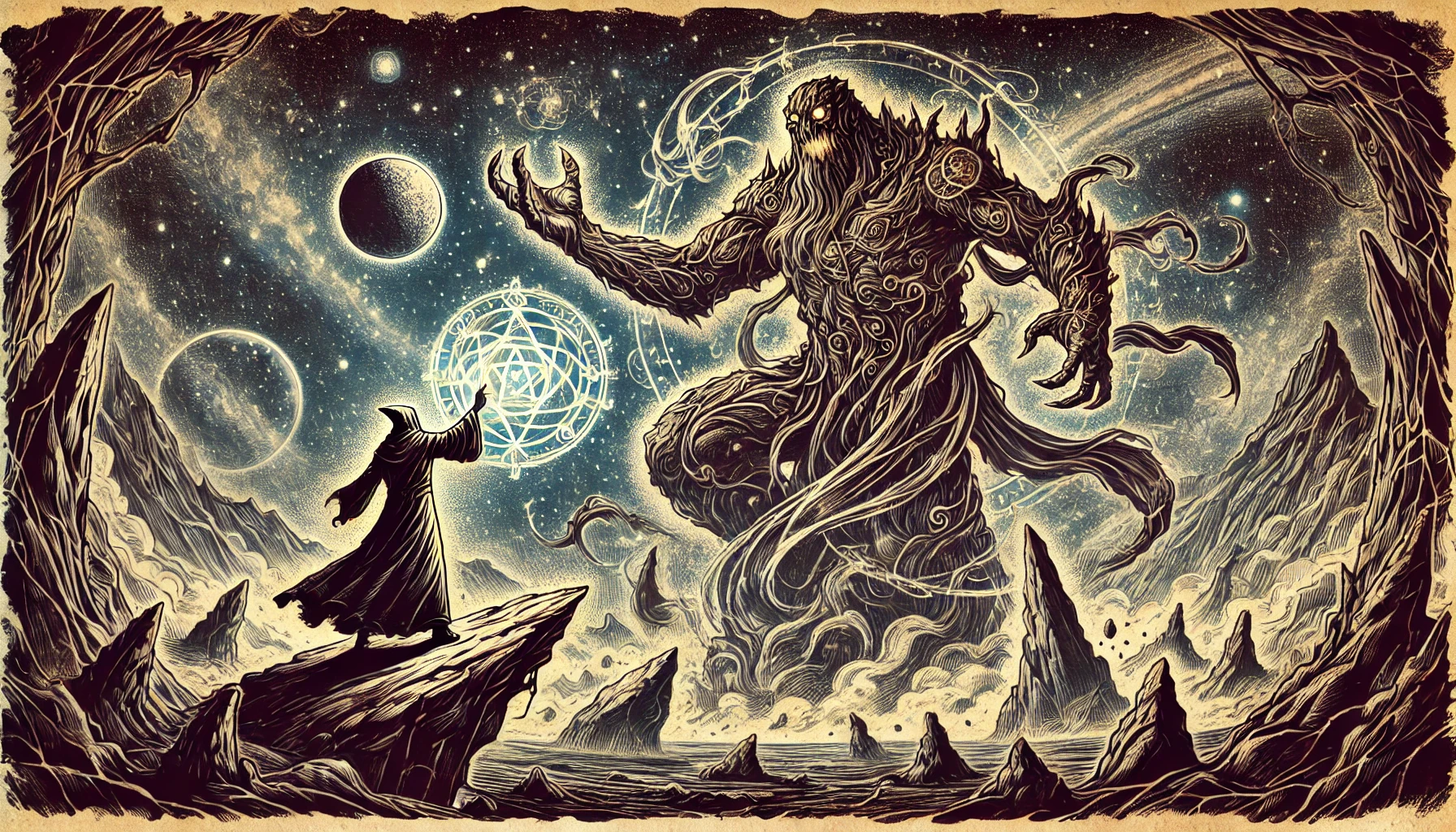
 A wizard engaging a colossal golem on an asteroid.
Magic
Magic Use in Space
The effects of certain magical and clerical spells and spell-like abilities are limited in the phlogiston that lies between the crystal spheres. However, those limitations are offset by the availability of new spells for mages and clerics in space. Individuals with magical abilities may also use their powers to operate a spelljamming helm, allowing them to move their ships across the stars.
Clerics in Space
Divine magic operates normally within the crystal shell that surrounds a cleric's native world but is severely hampered once that cleric enters the phlogiston. A prepared divine caster receives his spells through the offices of his deity, and his deity's effectiveness ends at the crystal shell. The phlogiston is impenetrable to extra-dimensional magics, and as a result, the "deities" and other powers have no sway there.
A prepared divine caster entering the Flow may use those spells he brought with him (with normal restrictions for the physical nature of phlogiston). However, he may not regain spells above 2nd level while in the phlogiston. This is because he remains out of direct contact with his deity. Loss of such spell abilities does not affect a prepared divine caster's spelljamming ability.
A prepared divine caster who enters a foreign crystal shell is similarly restricted. The only exceptions occur when his deity (or a similar power) is recognized in the foreign shell, or he casts a successful gate spell, affording his deity access to the foreign shell.
Any deity or power is considered "recognized" within a sphere if he has worshipers and/or an organized church anywhere within that system. This does not mean that a PC can move into a shell and automatically establish a base of worship for his deity. For a deity to be a recognized power in any shell, he has to have an established group of worshipers somewhere in the system.
Characters native to space may worship the deities of the sphere they are in or may follow a number of faiths found in many space civilizations. These faiths include:
- The Polygots
- The Path & The Way
- Various planar churches
These faiths are represented wherever there are space civilizations.
Given the effects of clerics having variable abilities from sphere to sphere, or even from world to world, the civilizations of space have evolved their own faiths that take into account the wide variety of beliefs. These faiths are recognized wherever there is space civilization in the Known Universe. Where there are no such civilizations, these sects are not recognized, and their clerics are limited like groundling clerics—they cannot gain spells above second level.
The Polygots
The Polygots are a pantheistic faith that worships entire organizations of Powers as opposed to a particular Power. A priest of the Greek mythology or the Norse deities would qualify as a Polygot priest. If any members of a particular Polygot priest's pantheon are present in the sphere, then that cleric regains his spells normally. For example, Tyr of Toril is originally a native of the Norse mythos (though Thor, Odin, and Loki have never made beachheads on the planet or attracted a large following). A cleric worshiping the Norse Polygot (all the Norse deities) would regain spells on Toril since Tyr is a native.
With the expansion of the Polygots in space civilization, representatives of the various Polygot sects can be found in most organized shells. Polygot priests are not popular on the ground, however, because it is there that the various deities struggle against each other for worshipers. A Polygot priest of the Lendore Isles of Oerth would find himself under increasing pressure from the various faiths of Oerth to "choose sides" if he spent any amount of time in those isles. Most nonhuman (elvish, gnomish, dwarvish, etc.) priests found in space are Polygot clerics of their racial mythologies.
The Path & The Way
Referred to either as a single grouping or as either of its parts, The Path and the Way are a terrestrial gathering of faiths that made the leap full-blown into the stars. A teaching used primarily by the Oriental groundling nations, it does not set forth one particular deity as worthy of all worship, but rather presents a celestial bureaucracy, well-managed and organized, with various Powers taking on particular duties, each recognizing the place of the others in the cosmic whole.
The differences in the various branches of The Path and the Way come from the organized teachings of those faiths as opposed to the Powers they venerate. The different schools may disagree (sometimes violently) about the true nature of The Path or the inner nuances of The Way, but the organization of regaining spells for clerics remains unaffected.
This grouping of faiths transferred very easily early in the exploration of the various spheres, and there are worshipers of all races throughout the known universe. For most groundling clerics, however, only those from a background that respects The Path and/or The Way may benefit from the pan-spherical power of the faith.
Planar Churches
Planar Churches represent a fractious merging of both The Path and the Polygots, where clerics respect and venerate all the powers of a particular inner or outer plane. A planar clertic venerates the Seven Heavens and all the Powers who dwell within, regardless of portfolio, position, or attributes. For instance, a planar priest of Arvandor/Olympus would venerate both the Greek and elvish mythoi that reside in that plane.
Characters generated specifically for a space fantasy campaign may choose to be any of these multi-branched faiths or belong to a "groundling" sect recognized in the sphere where the campaign begins. Characters from various campaign worlds may join the various multi-sphere sects only with the permission of their first deity. A commune spell is required at the very least, likely coupled with a major quest and an atonement when that cleric returns to his home world.
Oriental Adventures characters who already follow either The Path or The Way suffer no effects on their abilities in space, since their religion has preceded them into a number of different spheres and thrived.
All "space clerics" have spells as standard clerics—they cannot become special mythos priests while following these various pan-deity groups. A cleric who goes into space from a terrestrial world retains the benefits of their faith but cannot join a pan-deity organization.
Conjuration/Summoning Spells
Spells that call upon beings from the surrounding area will not function if none of those creatures are located within the spell's range. For example, a Summon Nature's Ally spell will not work in wildspace if there are no animals present. Conjuration/summoning spells will not work in the phlogiston if they summon extra-dimensional monsters or powers. No power, deity, elemental, or other meta-planar creature can be summoned in the phlogiston, and any spell that attempts to do so will fail.
Additionally, any spells that place the caster in contact with an extra-dimensional power fail in the Flow.
Planar Travel
Travel between the planes of existence functions normally within the various crystal shells. A character in wildspace may go ethereal, enter the astral plane, or open a gate into one of the outer planes. In the phlogiston, however, the dimensions cannot be accessed. Therefore, devices and spells, including armor of etherealness and portable holes, will not function in the Flow. A device or spell that holds objects in external dimensions will still hold them, but the items cannot be accessed with anything short of a limited wish spell.
For example, a particularly nasty efreet is trapped in a portable hole in Waterdeep in the Realms, then carried to the edge of that system's crystal shell and thrown into the Flow. A passing ship finds the portable hole but cannot open it until it makes landfall inside another crystal shell. Once the portable hole is opened within the new system, the very irritated efreet can leave.
Fire In Arcane Space
Within the air envelope that surrounds a planet, fire burns normally. Outside that envelope, however, there is a vacuum that will not support fire. Magical fire (such as fireballs) will work in the vacuum of space, as it is the sudden creation of fire that requires no air. However, magical fire will not cause other objects to burst into flame because there is no air to support a non-magical reaction.
Fire works all too well in the phlogiston. As noted in the chapter on Arcane Space, the entire area is permeated with an explosive mix, making both magical and non-magical fire extremely dangerous. The effect of the Flow on non-magical flame is discussed in the section on the phlogiston. Magical fire used in the phlogiston will cause an automatic detonation of the spell on the user. For example, a wizard trying to cast a fireball will find himself at the center of a ball of flame. This may be advantageous to a powerful spellcaster with resistance to fire, but in general, such dangerous displays are frowned upon since they can be damaging to ships.
Spelljamming
Spelljamming is the conversion of magical energy directly into motive force for ships in space. Spelljamming can be accomplished either by spells or through a magical device known as the spelljammer helm. Clerics, Psions and wizards can spelljam, as can creatures with spell-like or psi-like abilities. Character classes such as paladins and rangers gain spelljamming abilities at the point that they may cast spells, but cannot spelljam until that time. Characters with access to specific domains may also be able to use certain spells to accomplish it.
The spelljammer helm is a device shaped like a great chair, with recesses for the head, feet, and arms of the person using it. The styles of helms vary from simplistic and functional to ornate and gothic. In all its configurations, the helm is designed to pull magical energies from the user and convert them into full-fledged spelljammer power to move and maneuver spaceships.
A major helm converts magical ability to energy at a rate of 1 per 2 levels. Round fractions down. A 1st- or 2nd-level wizard provides a ship's spelljamming rating (SR) of 1, while a 20th-level cleric provides a spelljamming rating of 10 (SR = level/2, rounded down). The chapter on Helms & Hulls details the importance of the SR number.
A minor helm converts magical ability to energy at a rate of 1 per 3 levels. Round fractions down (SR = level/3, rounded down). Therefore, a 1st, 2nd, or 3rd-level wizard provides a spelljamming rating of 1, while a 20th-level cleric provides one of 7. Ships often maintain a minor helm as a backup system, and some ships even use minor helms as relatively inexpensive primary systems.
Another magical item that can provide spelljammer power is the Crown of the Stars. This device is worn over the head and creates a spelljamming rating as a minor helm (SR = level/3, rounded down). It has the advantage of portability and allows the spelljammer to move about while using it.
Both major and minor helms require "fresh" and well-rested spellcasters to function at their best. A spellcaster that has cast any of his possible complement of spells before activating a spelljammer helm loses one spelljamming rating for each spell cast (minimum SR of 1).
Using a major or minor helm, even for a short period, removes all spellcasting or manifesting ability from the user until the individual rests long enough to recover spells or powers. Humanoid spellcasting races normally use spelljammer helms to travel through space. Other creatures use a variety of methods to propel their ships. Mind flayers, who have powerful psionics, use several specially designed helms in series. Beholders use a mutated version of their race known as an orbus to move their ships. Dwarves without spellcasting or manifesting ability use devices called forges to journey through space. All these alternate spelljamming techniques are discussed in the chapter on Helms & Hulls.
In addition to the various magical items that can propel a ship, there are several new magical spells and psionic powers that provide spelljamming powers for a limited duration.
New Spells/Powers
Cleric
0th Level
-
Create Air: The caster may generate a bubble of fresh, breathable air around a person. 2nd Level
-
Contact Home Power: Establishes a tenuous link which permits the caster to regain his spells as if their deity is recognized and venerated within the sphere.
-
Detect Powers: Allows the caster to determine if there are friendly deities and/or other powers so that he may recharge his higher-level spells. 4th Level
-
Softwood: The target is placed in suspended animation in a manner similar to that of individuals lost in the Flow.
- Create Minor Helm: Transform a normal chair or seat into a minor spelljamming helm.
Druid
0th Level
-
Create Air: The caster may generate a bubble of fresh, breathable air around a person. 4th Level
-
Softwood: The target is placed in suspended animation in a manner similar to that of individuals lost in the Flow
Paladin
0th Level
- Create Air: The caster may generate a bubble of fresh, breathable air around a person.
Psion
4th Level
-
Create Minor Helm, psionic: Transform a normal chair or seat into a minor spelljamming helm. 5th Level
-
Create Major Helm, psionic: Transform a normal chair or seat into a major spelljamming helm.
Sorcerer/Wizard
2nd Level
- Locate Portal: Find the nearest portal through a crystal shell into or out of the Flow.
-
Chill Fire: Reduces the flammable nature of the phlogiston. 3rd level
-
Enhance/Decrease Rating: This spell raises the SR of the ship using the helm for the duration of the spell. 4th Level
-
Create Minor Helm: Transform a normal chair or seat into a minor spelljamming helm. 5th level
-
Create Portal: Causes a large area of a crystal shell to become temporarily insubstantial and ethereal.
- Enhance Maneuverability: Increase or decrease the maneuverability class of target ship
- Create Major Helm: Transform a normal chair or seat into a major spelljamming helm.
Spell Descriptions
Chill Fire
Transmutation
Level: Sorc/Wiz 2
Components: V, S, M
Casting Time: 1 standard action
Range: Close (25 ft + 5 ft/2 levels)
Area of Effect: 20 ft radius
Duration: 1 round/level
Saving Throw: None
The chill fire spell functions only in the phlogiston; casting it in other surroundings is useless. In the phlogiston, however, the spell reduces its flammable nature. The damage caused by the phlogiston igniting will be normal rather than tripled. This applies to both magical and non-magical fire.
Material Component
A sliver of glass or ice.
Contact Home Power
Divination
Level: Clr 2
Components: V, S, M
Casting Time: 10 minutes
Range: Personal
Target: You
Duration: 1 week
The user of this spell establishes a tenuous link through the Astral Plane between his present location and that of the power he venerates. This link allows the caster to regain his spells as if their deity is recognized and venerated within the sphere.
Distance does not affect the caster's attempt to contact the home power, but dimensional gates, anti-magical fields, and the effects of dispel magic will prevent the use of the spell. Also, the spell will not function in areas from which the power has been banished explicitly (whether from the death of an avatar, banishment, or some voluntary action of the deity). The caster attempting to uplink with his power in such locations will be informed through the spell that such contact with his deity is forbidden. However, the caster will not be given the reasons, as deities are notably reticent to explain why they cannot exert their power, preferring to appear all-powerful to their worshipers.
The spell remains in effect for the entire duration as long as the caster remains in the same crystal sphere he cast the spell. Passage into another plane (even the ethereal) will end the spell, as will a targeted dispel magic. This spell cannot be cast in the phlogiston.
Create/Destroy Air
Conjuration (Creation) [Air]
Level: Clr 0, Drd 0, Pal 1
Components: V, S
Casting Time: 1 standard action
Range: Close (25 ft + 5 ft/2 levels)
Target: You or one other willing medium-sized creature, see text
Duration: Instantaneous
Saving Throw: No and Yes, see text
Spell Resistance: No and Yes, see text
By means of this spell, the caster may generate a bubble of fresh, breathable air around the target. This air will drive out the stale air around the target and restore it to the "fresh" state. In cases of individuals adrift in space, this allows another rolling of the die to determine the duration of the fresh air. Within a larger envelope of air (such as the deck of a spelljammer or a planet's atmosphere), the freshened air will drift off, combining with the existing air. The spell can replace air that may be stale or befouled, including air that is poisoned or tainted by a cloudkill or stinking cloud spell.
You may target one additional willing Medium or smaller creature per two caster levels. A Large creature counts as two Medium creatures, a Huge creature counts as two Large creatures, and so forth. All creatures to be targeted must be within range of the spell. As with all spells where the range is personal and the target is you, you need not make a saving throw, nor is spell resistance applicable to you. Only other creatures receive saving throws and spell resistance.
Create Major Helm
Transmutation
Level: Sorc/Wiz 5
Components: V, S, F
Casting Time: 10 minutes
Range: Close (25 ft + 5 ft/2 levels)
Target: Object to be turned into a major helm
Duration: 1 day/level
Saving Throw: No
As the spell Create Minor Helm, except as noted.
Create Major Helm, psionic
Psychometabolism
Level: Psion 5
Display: Auditory, Visual, Material
Manifesting Time: 10 minutes
Range: Close (25 ft + 5 ft/2 levels)
Target: Object to be turned into a helm
Duration: 1 day/level
Saving Throw: No
As the spell Create Major Helm, except as noted.
Material Component
A chair, stool, or other seat suitable for use as a helm. The material component is not consumed on use.
Create Minor Helm
Transmutation
Level: Clr 4, Sorc/Wiz 4
Components: V, S, F
Casting Time: 10 minutes
Range: Close (25 ft + 5 ft/2 levels)
Target: Object to be turned into a minor helm
Duration: 1 day/level
Saving Throw: No
The caster may transform a normal chair or seat within range into a minor spelljamming helm suitable for powering a ship through space. This spell does not replace the need for a permanent magical helm onboard and is used primarily as a backup system or in emergency situations.
The minor helm may power a ship of no more than two times the spellcaster's level in tonnage. In operation, a major spelljamming helm created in such a fashion is identical to a regular, permanent helm, with one exception: if dispelled, the helm created by this spell will disappear for a single round, then reappear.
Creating a helm counts as the casting of one spell, and therefore reduces the caster's effectiveness in using the helm for that day. Of course, this does not mean another user cannot act as the helmsman, using a helm created by another person.
Focus
A chair, stool, or other seat suitable for use as a helm.
Create Minor Helm, psionic
Psychometabolism
Level: Psion 4
Display: Auditory, Visual, Material
Manifesting Time: 10 minutes
Range: Close (25 ft + 5 ft/2 levels)
Target: Object to be turned into a helm
Duration: 1 day/level
Saving Throw: No
As the spell Create Minor Helm, except as noted.
Create Portal
Transmutation
Level: Sorc/Wiz 5
Components: V, S, M
Casting Time: 1 minute
Range: Medium (100 ft + 10 ft/level)
Area of Effect: Area of crystal shell 100 ft in radius
Duration: 1 round/level (D)
Saving Throw: None
This spell causes a large area of the shell to become temporarily insubstantial and ethereal, allowing a ship (or anything else) of the correct size to pass through.
The opening does not weaken the crystal shell, and any objects resting physically on the shell are unaffected by the portal. It takes but a fraction of a round for a ship to pass through a portal opened in this fashion. However, if the portal is dispelled or otherwise prematurely closed, roll 1d10 to determine the fate of the object passing through the opening as it closes:
1–5: Portal closes before the ship reaches the shell. Ship must turn or ram the shell.
6: Portal closes on the ship. Ship is cut in half.
7–10: Portal closes after the ship passes through.
Portals created by this spell are magical and temporary, so they can be dispelled. Portals that occur naturally in the crystal shell may not be dispelled.
Material Component
A piece of wire wrapped around a bit of amber.
Detect Powers
Divination
Level: Clr 2
Components: V, S, M
Casting Time: 1 round
Range: Long (400 ft + 40 ft/level)
Target: A crystal shell in range
Duration: Instantaneous
Saving Throw: None
Casting this spell outside a crystal shell allows the caster to determine if there are friendly deities and/or other powers so that he may recharge his higher-level spells within its borders. The detect powers spell will also reveal if the deities revered by the caster are worshipped within that sphere.
If the sphere is one known to the DM (i.e., the characters just discovered it), and he has no clear idea what lies within, then roll on the table below for a possible response to the spell.
| Die Roll | Response |
|---|---|
| 01–10 | Power is known in this sphere. The cleric can recharge spells normally. |
| 11–50 | Power is unknown in the sphere, but a related power exists. The cleric may regain spells normally after contacting clerics of the related deity. |
| 51–90 | Power is unknown in the sphere. The cleric may not regain spells above second level until contact is restored with his original power, or the cleric performs a great task for the new power. |
| 91–00 | Power is unknown in the sphere. |
While many powers will have similar portfolios and areas of interest (war, healing, agriculture, death, and so on), they are often at varying alignments. In one crystal sphere, a war deity might be a positive figure and, therefore, good and lawful. In another world, war might be regarded as a destructive force, and its deity is evil and chaotic.
The caster will be able to tell the alignment of the power closest to his deity through the detect powers spell. Accepting spells from a power of similar outlook but opposite alignment is dangerous, and any cleric that does so must regain favor with his chief deity (through quest or atonement) before further advancement in his class is possible.
Material Component
A handful of sand, which is cast towards the crystal shell.
Enhance/Decrease Rating
Transmutation
Level: Sor/Wiz 3
Components: V, S, M
Casting Time: 1 Round
Range: Close (25 ft + 5 ft/level)
Target: A single creature using a spelljammer helm you can see
Duration: 1 round/ level
Saving Throw: Will negates
This spell will raise the spelljamming rating (SR) of the ship using the helm by 1d4–2 points for the duration of the spell. Only one enhance rating spell may be used at a time, and the caster may not use it on himself.
The reverse of this spell, decrease rating, reduces the SR of the spelljamming helm and its user by the same amount for the duration of the spell.
Material Component
A small ivory arrow, pointed upward for the enhance rating spell or broken for the decrease rating spell.
Enhance/Decrease Maneuverability
Transmutation
Level: Sor/Wiz 3
Components: V, S, M
Casting Time: 1 Round
Range: Close (25 ft + 5 ft/level)
Target: 1 ship of up to 10 times the caster's level in tonnage
Duration: 1 round/level
Saving Throw: None
This spell may be cast on any ship to either increase or decrease its maneuverability class (MC). A ship's MC may only be increased or decreased by one class using this spell. No ship can have its MC increased or decreased more than one class above or below its initial MC, through the use of this spell, no matter how many times it was cast upon it.
Material Component
A vial of wind from an air-based world.
Locate Portal
Divination
Level: Sor/Wiz 2
Components: V, S, M
Casting Time: 1 Round
Range: Long (400 ft + 40 ft/level)
Target: A crystal shell in range
Duration: Instantaneous
The caster of a locate portal spell can find the nearest portal through a crystal shell either into or out of the Flow. The spell indicates direction and distance (either in miles or in travel time if the caster knows the particulars of his own ship).
In general, from any point on a crystal shell, the portals for a normal-sized ship are 2d20 days away from any location. At the DM's option, there may be more portals than normally available, less, or none at all. This is up to the DM to determine.
Material Component
A conch shell.
Softwood
Transmutation
Level: Clr 4, Druid 4
Components: V, S, M
Casting Time: 1 Round
Range: Touch
Area of Effect: A medium-sized creature, see text
Duration: Permanent, see text
Saving Throw: Will negates
The recipient of a softwood spell immediately has his body surrounded by soft, spongy wood, similar to that of a rotting stump. The softwood is a living entity that inhabits the individual's air envelope, sustaining that individual's life at a lower level than normal. The character is placed in suspended animation, like an individual lost in the Flow.
The softwood surrounding a body is extremely resistant to heat and cold, and while the form within is unconscious, it cannot be harmed. A character in a softwood cocoon could fall to the ground, and the spell would absorb the heat and impact of the fall.
Softwood dissolves in open air. If a character enters and stays in a new envelope of fresh air for three turns, the softwood will begin to dissolve, letting the individual loose. A softwood spell cast in the open air will cocoon the target for 30 minutes, then dissipate after.
The softwood spell was created as a defensive measure, to preserve those cast adrift in space. For every three levels, the caster may target an additional creature. Enterprising and aggressive priests have turned the spell into both a handy method of containing enemies, as well as a way of sending both foes and mutinous friends into wildspace (and off their ships) without having to slay them.
Material Component
A bit of bark. The softwood will become that type of bark covering the body. (If maple is used, then the covering will appear as maple; if pine, it will appear as pine.) If the bark of a sentient or "monster"-type plant is used, the softwood will be of similar physical features, but will lack any special abilities of the original plant.